
What Is Scale Accuracy Class and How Do You Read It? (OIML I, II, III, IIII)
A plain-language breakdown of OIML accuracy classes, what the markings on your calibration certificate actually mean, and why it matters for industrial scale calibration in Saudi Arabia.

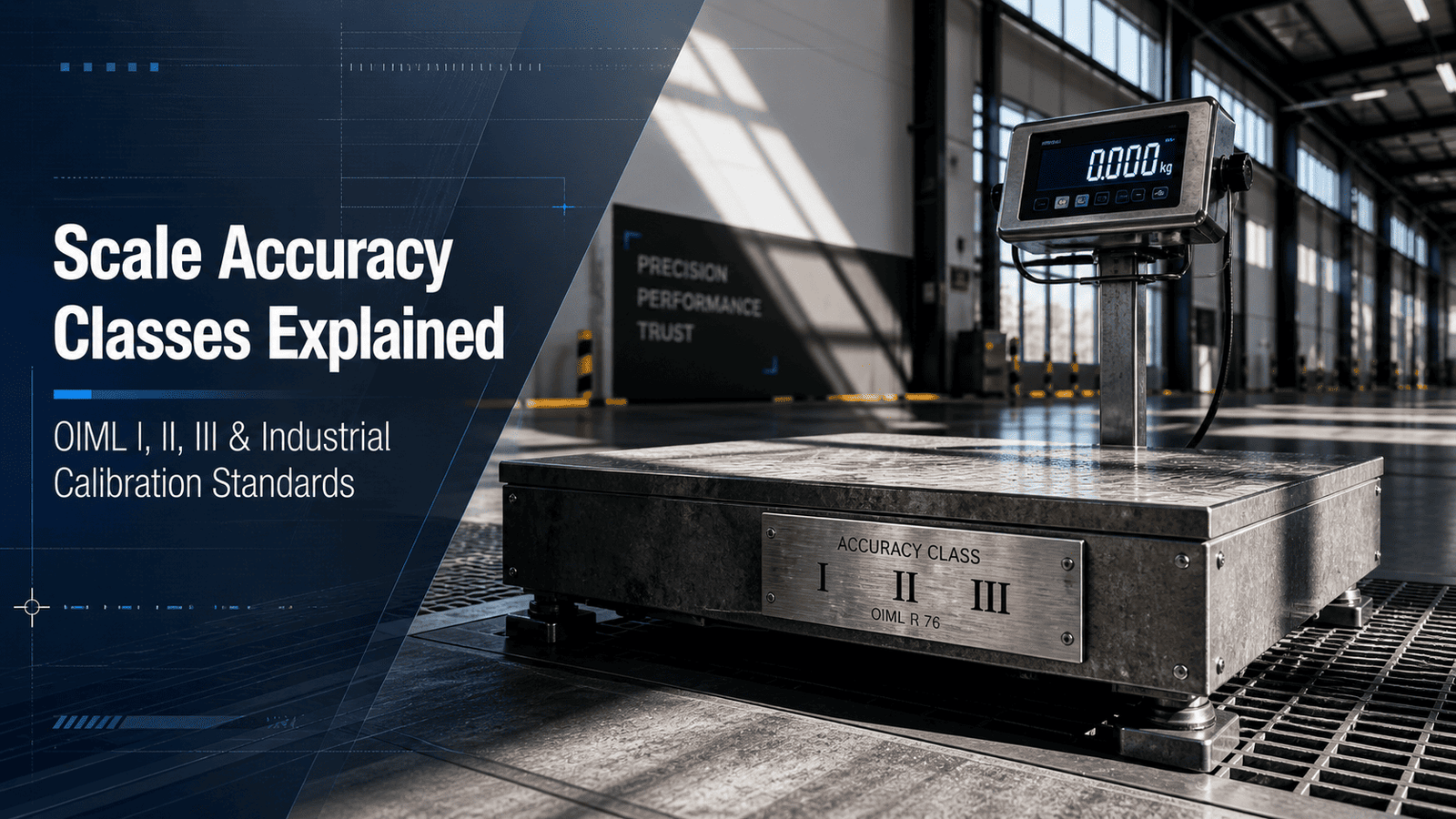
You've just received a calibration certificate for your floor scale. Somewhere near the top it says "Class III" and lists an e value of 0.5 kg. Your procurement manager wants to know what that means before signing off the annual compliance report. Your calibration technician gives you a one-word answer: "standard." That's not particularly helpful.
Scale accuracy class is one of those things that looks bureaucratic on paper but has real, practical consequences for industrial scale calibration, legal-for-trade status, and whether your process weighing data is actually worth anything. Get it wrong and you're either paying for accuracy you don't need, or running instruments that can't legally back a commercial transaction. Neither is a good situation.
Here's a proper breakdown.
01 What Scale Accuracy Class Actually Means
Scale accuracy class is a standardised designation that tells you how accurate a weighing instrument is designed to be, and what tolerances it must stay within to remain legally verified. The framework comes from the International Organisation of Legal Metrology, known by its French acronym OIML.
The specific document is OIML R 76, which covers non-automatic weighing instruments. It defines four accuracy classes, each represented by Roman numerals: I, II, III, and IIII. Yes, four Is, not IV. That's intentional — the notation avoids confusion with the numeral four in certain contexts and is the correct OIML designation.
Each class is defined primarily by two things:
- The verification scale interval (e) — the smallest increment the scale uses for official verification and legal-for-trade purposes. This may differ from the actual display division d on the screen, but e is what matters for compliance.
- The number of verification scale intervals (n) — calculated as maximum capacity (Max) divided by e. This ratio tells you how "fine" the scale resolves its total weighing range.
The combination of these two parameters is what places an instrument in a specific class. It's not just about how much weight a scale can handle. It's about the resolution it achieves relative to that capacity.
02 The Four OIML Accuracy Classes, Explained
Each of the four OIML accuracy classes serves a distinct band of applications — and understanding which one applies to your equipment is the starting point for any meaningful industrial scale calibration conversation.
Class I — Special Accuracy
Class I instruments are at the very top of the precision hierarchy. To qualify, the number of verification scale intervals must be at least 50,000, with no defined upper limit. That's why analytical balances in pharmaceutical labs can have e values as small as 0.001 mg and still fall within this class.
You'll find Class I instruments in pharmaceutical and chemical laboratories, precious metal and gemstone trading, scientific research, and any application where measurement uncertainty needs to be extremely small. For most industrial operations in the GCC, Class I instruments aren't the day-to-day tool. But if you're weighing active pharmaceutical ingredients or conducting reference measurements for secondary calibration, Class I is what you need.
Class II — High Accuracy
Class II covers instruments with a verification scale interval count between 100 and 100,000. These are high-precision instruments designed for practical commercial use rather than purely laboratory settings.
Common applications include postal and courier weighing, precious stone and jewellery trade, grain and seed testing, and high-value commodity trade where weight directly determines price at a fine level. In an industrial context across Saudi Arabia, Class II instruments often appear in quality control labs attached to food production or pharmaceutical packaging facilities, where internal process accuracy requirements exceed what Class III can deliver.
Class III — Medium Accuracy
This is the class that matters most for the vast majority of industrial operations. Class III instruments have a verification scale interval count between 100 and 10,000, and they cover an enormous range of practical weighing applications.
If your facility uses platform scales, floor scales, pallet weighers, checkweighers for bulk goods, or vehicle weighbridges, you are almost certainly working with Class III equipment. The e value on a Class III industrial floor scale is typically 0.1 kg, 0.2 kg, 0.5 kg, or 1 kg, depending on the capacity and application.
Class III is the standard designation for legal-for-trade weighing in commercial and industrial settings globally, and it's the class referenced in SASO requirements for weighing instruments used in trade transactions in the Kingdom of Saudi Arabia. When a client asks us about industrial scale calibration for a logistics depot or a cement plant in the Eastern Province, Class III is what we're calibrating to, verifying against, and certifying on the paperwork.
Class IIII — Ordinary Accuracy
Class IIII instruments have a verification scale interval count between 100 and 1,000. These are the least precise of the four classes and are intended for rough or coarse weighing where tight tolerances aren't required.
Applications include basic agricultural weighing, approximate load assessment, and contexts where the weight measurement is informational rather than legally binding. In practice, Class IIII equipment is rarely the right choice for any application where weight determines a commercial transaction or a compliance-critical process output.
03 How to Read Scale Accuracy Class on a Certificate or Nameplate
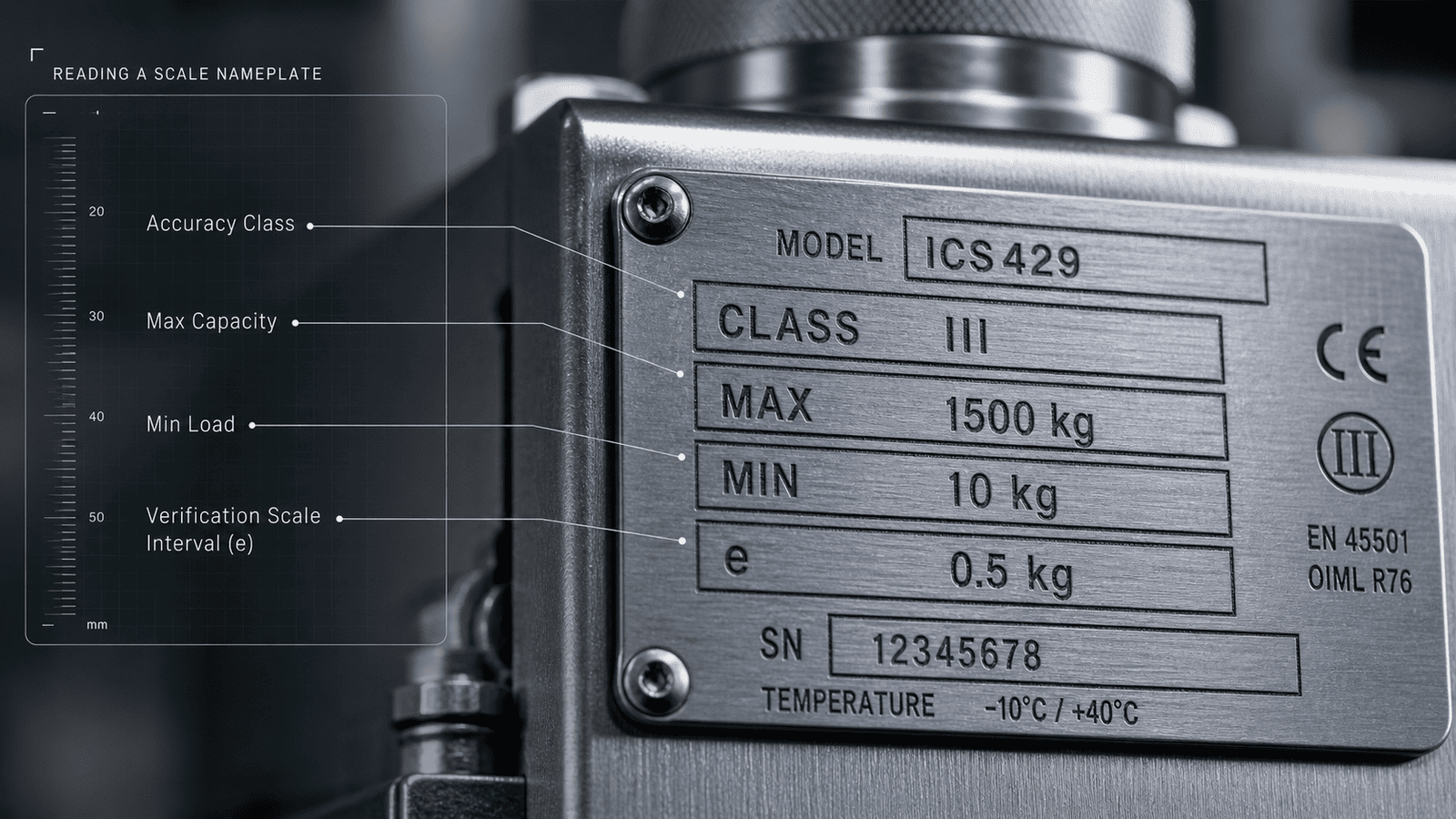
This is where things get practical. When you pick up a calibration certificate or look at the nameplate on an instrument, here's what you'll typically see and what each item means.
On the instrument nameplate, the key markings are:
| Marking | What It Means |
|---|---|
| Class III (or the OIML class symbol in a circle) | The accuracy class designation |
| Max: 1500 kg | Maximum weighing capacity |
| Min: 20 kg | Minimum load for a reliable legal-for-trade reading |
| e = 0.5 kg | Verification scale interval — the tolerance basis for calibration |
| d = 0.5 kg | Actual display division (often equals e; sometimes finer) |
| Tare range: −1500 kg | Maximum tare deduction permitted |
Common mistake
Many operations teams assume d and e are always the same value. They're not. On some instruments, the display division d is smaller than the verification interval e, meaning the screen shows finer increments than the instrument has been officially verified to. For legal-for-trade purposes, e is the number that counts — not the finest division you can see on the readout.
A correctly issued calibration certificate for industrial scale calibration will state the accuracy class, the e value used during verification, the test weights applied at specific load points, and the measured errors at each point compared to the maximum permissible error (MPE) for that class.
The MPE for Class III instruments — the tolerance that your scale must stay within to remain verified — is defined in OIML R 76 as follows:
| Load Range | Maximum Permissible Error (MPE) at Initial Verification |
|---|---|
| 0 to 500e | ±0.5e |
| 500e to 2,000e | ±1.0e |
| 2,000e to 10,000e | ±1.5e |
So for a scale with e = 0.5 kg: at loads up to 250 kg, the instrument must read within ±0.25 kg. Between 250 kg and 1,000 kg, within ±0.5 kg. And so on up the capacity range. That's the actual precision boundary your industrial scale calibration technician is checking against at each test point. If the measured errors sit within those MPE values at all test points, the instrument passes verification and the certificate is issued.
“ A lot of operations teams focus on the class number and ignore the e value. That's a mistake. — Section 04
04 Why the e Value Matters More Than Most People Realise
Here's a scenario I've seen more than once: two floor scales, both Class III, both with a 3,000 kg maximum capacity. One has e = 0.5 kg. The other has e = 1 kg. At a load of 2,000 kg, the first scale has an MPE of ±1.0 kg. The second has an MPE of ±2.0 kg. Same class. Completely different resolution and tolerance.
For a food production line where you're bagging 25 kg product and trying to stay within ±0.1 kg for recipe accuracy, neither of those floor scales is the right instrument (you'd want a higher-resolution Class III or Class II checkweigher). But for a logistics depot weighing pallets destined for commercial invoicing, the difference between e = 0.5 kg and e = 1 kg has a direct impact on billing accuracy at volume.
This is why, during industrial scale calibration, the e value that appears on the certificate isn't a formality. It defines what your scale is legally permitted to do.
05 Accuracy Class, Scale Calibration, and SASO Requirements in Saudi Arabia
In the Kingdom of Saudi Arabia, weighing instruments used in trade are regulated by the Saudi Standards, Metrology and Quality Organization (SMMQ), which operates under SASO. The technical requirements for legal-for-trade weighing instruments align with OIML standards.
For any scale used to determine the weight of goods in a commercial transaction — whether that's a truck weighbridges at a logistics hub, a checkweigher in a food factory, or a platform scale at a port terminal — the instrument must be of an approved type and must be periodically verified by an accredited body. Keeping your industrial scale calibration current isn't just a compliance tick-box. It's the only way to know that your e value is still being met in real operating conditions.
Heat is a genuine factor here. Ambient temperatures that regularly exceed 45°C in the summer months across the Eastern Province and Central Region place real thermal stress on load cells and electronics. Instruments that were verified in the spring can drift meaningfully by August if they're not temperature-compensated and properly specified for the environment.
As Mettler Toledo's official partner in Saudi Arabia, Global Scales & Systems specifies and supplies instruments rated for extreme temperature conditions. Mettler Toledo's POWERCELL PDX load cells carry a 10-year warranty and include built-in predictive diagnostics that flag performance drift before it becomes a calibration failure. For facilities running weighbridges year-round in the GCC climate, that kind of designed-in stability matters.
“ Instruments verified in spring can drift meaningfully by August without proper temperature compensation for KSA conditions. — Section 05
06 Which Accuracy Class Does Your Application Actually Need?
Here's a practical guide. These aren't rigid rules — application details always matter — but they'll get you to the right starting point.
| Application | Typical Accuracy Class | Typical e Value |
|---|---|---|
| Analytical / pharmaceutical lab balance | Class I | 0.001 mg to 1 mg |
| Jewellery / precious metal trade scale | Class II | 0.001 g to 0.1 g |
| Retail trade scale (grocery, market) | Class II or III | 1 g to 5 g |
| Industrial floor / platform scale | Class III | 0.1 kg to 1 kg |
| Checkweigher (process / packaged goods) | Class III | 0.1 g to 50 g |
| Truck / vehicle weighbridge | Class III | 5 kg to 20 kg |
| Bulk / rough weighing (non-trade) | Class IIII | 1 kg to 5 kg |
These are indicative ranges. Always verify with your calibration authority and confirm against the specific OIML approval documentation for the instrument model.
The thing that trips up operations teams most often is assuming a higher class is always better. Sometimes it is. But an over-specified scale in the wrong environment can actually perform worse in practice than a properly rated Class III instrument that's been selected for the correct load range and operating conditions. Matching the instrument to the application is what makes industrial scale calibration meaningful.
07 The Difference Between Calibration and Verification (And Why Both Matter)
These two terms get used interchangeably, and they shouldn't be.
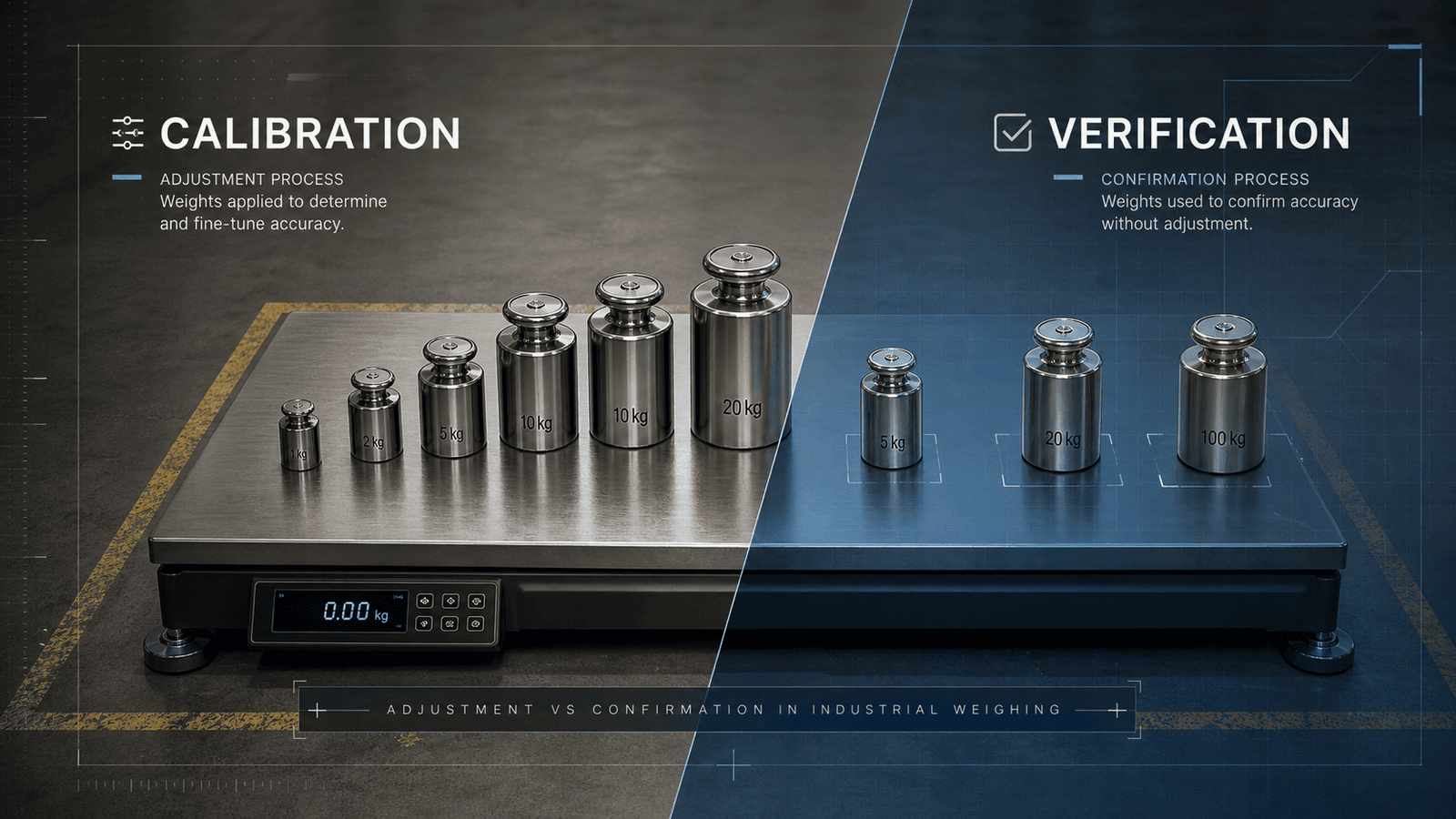
Calibration is the process of comparing an instrument's output to a known reference. It quantifies error. It may or may not involve adjustment.
Verification (or legal metrology verification) is the official process by which an accredited authority confirms that an instrument meets the requirements of its accuracy class and issues a certificate. For legal-for-trade instruments in KSA, verified status is what you need.
You can calibrate your own equipment using in-house reference weights to monitor performance between official verifications. Many facilities with critical process weighing do exactly that. But calibration records don't replace a valid verification certificate for trade purposes.
Pro tip
Both calibration and verification belong in a sound scale management programme. Internal calibration records tell you what your instruments are doing day to day and let you catch drift early. Verification by an accredited body confirms they still meet their class at the point of official check. Run both, and you're covered operationally and legally.
Both are part of a sound scale management programme. Calibration tells you what your instruments are doing day to day. Verification confirms they still meet their class at the point of official check.
08 FAQ: Scale Accuracy Class and Industrial Scale Calibration
The questions we get asked most often, answered directly.
What does "Class III" mean on a weighing scale certificate?
Class III is the OIML accuracy designation for medium-accuracy weighing instruments. It covers instruments with a verification scale interval count between 100 and 10,000, and it's the standard class for industrial floor scales, platform scales, and vehicle weighbridges used in commercial and industrial applications.
What is the difference between e and d on a scale?
e is the verification scale interval — the division value used for legal-for-trade calibration and for calculating maximum permissible errors. d is the actual display division shown on the indicator. They're often the same value, but on some instruments d is smaller than e, meaning the screen shows finer divisions than the verified accuracy of the instrument.
How often does industrial scale calibration need to happen in Saudi Arabia?
For legal-for-trade instruments, annual verification is the standard expectation in KSA, though specific requirements depend on the industry sector and the authority issuing the verification. High-throughput applications and environments with extreme temperature or vibration may warrant more frequent internal calibration checks between official verifications.
Can a Class III scale be used for pharmaceutical weighing?
Generally, no. Pharmaceutical applications typically require Class I or Class II accuracy, depending on the substance being weighed and the quantities involved. Class III instruments don't provide the resolution or the verified accuracy needed for active ingredient weighing in pharmaceutical production. Always check the specific regulatory requirements for your product and facility.
What happens if my scale fails its calibration check?
If measured errors exceed the maximum permissible error for the instrument's class at any test point, the scale cannot be certified for legal-for-trade use until the error is corrected. The instrument may need adjustment, repair, or in some cases replacement. A valid calibration certificate cannot be backdated to cover the period when the instrument was out of tolerance.
Is SASO verification the same as OIML certification?
Not exactly. OIML issues internationally recognised certificates of conformity through its Certificate System for Measuring Instruments (OIML-CS). SASO verification in Saudi Arabia is the national legal metrology process that confirms an instrument in service meets the applicable standards. An OIML certificate for a specific instrument model supports type approval, but the in-service verification is a separate process conducted by a SMMQ-accredited body.
What accuracy class are Mettler Toledo weighbridges?
Mettler Toledo vehicle weighbridges, including those supplied through Global Scales & Systems as Mettler Toledo's official partner in Saudi Arabia, are Class III instruments. They're typically supplied with e values between 5 kg and 20 kg depending on the maximum capacity configuration and the application requirements.
“ A valid calibration certificate cannot be backdated to cover the period when an instrument was out of tolerance. — Section 08
For industrial scale calibration enquiries, accuracy class guidance, or SASO verification support across Saudi Arabia and the GCC, contact us to be your reliable compliance partner. As the official Mettler Toledo partner in the Kingdom, we work with operations teams in construction, logistics, oil and gas, food production, cement, and mining to keep their weighing infrastructure certified, accurate, and fit for purpose.

 Click to start chat