
Retail Weighing Scales in Saudi Arabia: The Smart Buyer's Complete Guide
What every retailer, buyer, and store owner in KSA needs to know about scale types, SASO compliance, realistic pricing, and the specs that actually matter before you spend a riyal.

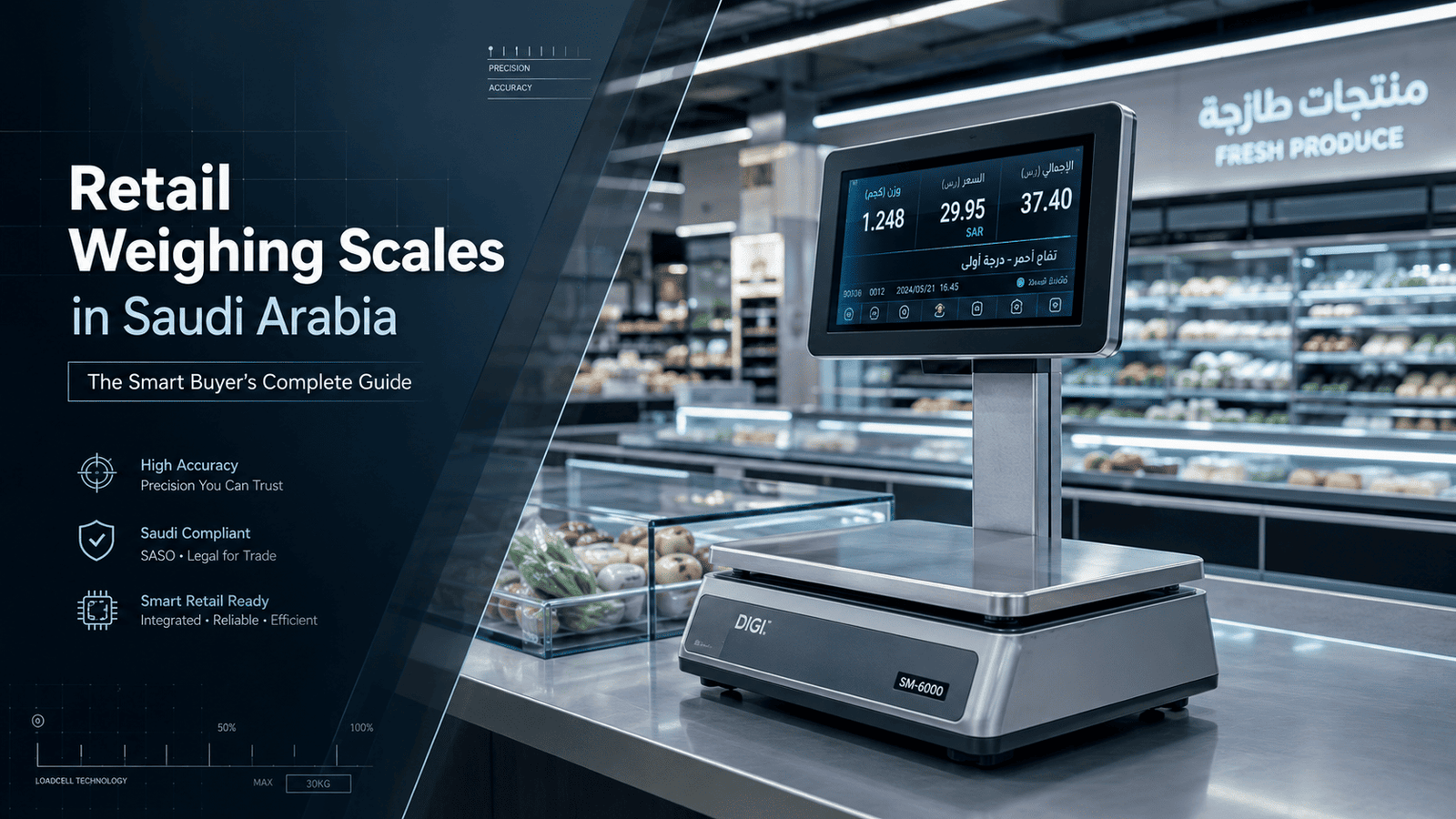
Walk into any hypermarket in Riyadh on a Thursday evening and the produce section is a blur of activity. Shoppers stacking their trolleys, staff repricing items, the deli counter backed up six people deep. At the center of all of it is a scale. Not glamorous, not the subject of anyone's strategy deck. But when that scale is wrong, or slow, or won't talk to the POS system, everything behind it goes sideways.
And yet, when I talk to procurement managers across the food retail and commercial sectors in KSA, the conversation about retail weighing scales in Saudi Arabia almost always goes the same way: "We just need something that works." Which sounds reasonable until you realize how much "just works" actually means, and how quickly the wrong choice costs you.
Saudi Arabia's food retail market hit over $50 billion in 2024, according to USDA data, growing at more than 5% annually. The Saudi digital weighing scale market was valued at USD 89.3 million in 2025, with IMARC Group projecting it to reach USD 144.8 million by 2034. This isn't a niche purchase anymore. The scale sitting on your service counter is part of a much larger commercial infrastructure, and it needs to be chosen accordingly.
This guide covers everything: scale types, SASO compliance requirements, real pricing in SAR, and the specs that separate a good scale from one that creates headaches. Let's dig in.
01 What Retail Weighing Scales Are Actually Used For in KSA
Before you start comparing spec sheets, it helps to be clear on the use case. Retail weighing scales in Saudi Arabia fall across a surprisingly wide range of applications, and the wrong category match is one of the most common buying mistakes we see.
Fresh food counters and deli sections. The most common retail scale context in the Kingdom. Your butcher counter, fish market, deli, and hot food section all need a price computing scale, one that weighs and automatically calculates the total price based on a per-kilo rate. At a hypermarket like Panda or Tamimi, this is also a high-throughput environment, so speed and POS integration matter as much as accuracy.
Checkout and checkout-adjacent applications. Loose goods, produce sold by weight, bulk items. These need a checkout scale, typically embedded into or placed near a POS terminal, built for high-cycle reliability and resistance to liquid spills and general punishment. They've got to survive eight-hour shifts, five days a week.
Self-service and prepack. A growing segment in KSA. As Vision 2030 continues reshaping the retail environment and consumer expectations shift toward convenience, electronic payments already account for 79% of all Saudi retail transactions as of 2024, up from 70% in 2023, per SAMA data, retailers are investing in self-service fresh food stations. These need touchscreen scales with integrated printing.
Specialty retail: jewelry, pharmacy, and spice markets. Saudi Arabia's jewelry sector is significant and gold traders need analytical precision scales, a completely different product from a supermarket deli scale. The same applies to pharmacies compounding medications and traditional spice shops in markets across Riyadh, Jeddah, and the Eastern Province.
Back-of-house and receiving. Warehouses, receiving bays, distribution centers. Here you're typically looking at floor scales or industrial bench scales built for heavier loads and rougher handling.
The reason I'm walking through this is simple: a procurement manager who buys a checkout scale for a deli counter, or a basic bench scale for a jewelry shop, is going to have a bad time. Start with the use case. Everything else follows from there.
02 SASO Compliance: What "Legal for Trade" Actually Means for Retail in KSA
This is the section most buyers skip, and it shouldn't be. Any retail weighing scale in Saudi Arabia used to determine a price payable by a customer, meaning any scale where the weight reading results in a financial transaction, is legally required to be a verified, legal-for-trade instrument under SASO (Saudi Standards, Metrology and Quality Organization) requirements. This is not optional. It is the law.
SASO's metrology requirements for weighing instruments align with OIML (International Organization of Legal Metrology) standards, specifically OIML R 76 for non-automatic weighing instruments. In practice, this means the scale must be of an approved type (type approval from the manufacturer, recognized by SASO), it must be verified before being put into service, and it must be re-verified at regular intervals, typically every 12 months for commercial retail use.
The Verification Stamp Matters
A scale without a valid SASO/NMI verification stamp is not legally compliant for retail trade in Saudi Arabia. If you're running a fresh food counter or a jewelry shop, this is non-negotiable. Don't let a supplier talk you into "we can sort the certification later." That conversation is a red flag.
Accuracy Class: Why It Matters Which One You Buy
For general retail (food, produce), you need a Class III scale under OIML R 76. For jewelry and precious metals, Class I or Class II precision is required. These are not marketing categories. They define the acceptable error tolerances of the instrument and are verified during type approval. Buying the wrong class for your application means the scale cannot be legally certified for your use case, regardless of what the supplier tells you about it being "accurate."
What happens if you ignore compliance? Municipal inspection teams and SASO-affiliated inspectors do conduct spot checks on commercial premises, particularly food retail. A non-compliant scale can result in fines, forced closure of the counter, and in repeat cases, more serious regulatory action. It's one of those risks that feels abstract until it lands on your doorstep at 11am on a busy trading day.
Pro tip
Buy from a supplier who can handle the SASO verification paperwork for you. In Saudi Arabia, getting a new scale type-approved and verified can take time if your supplier doesn't know what they're doing. Working with an authorized partner, like Global Scales & Systems as Mettler Toledo's official Saudi partner, means the compliance documentation is managed from day one, not retrofitted after installation.
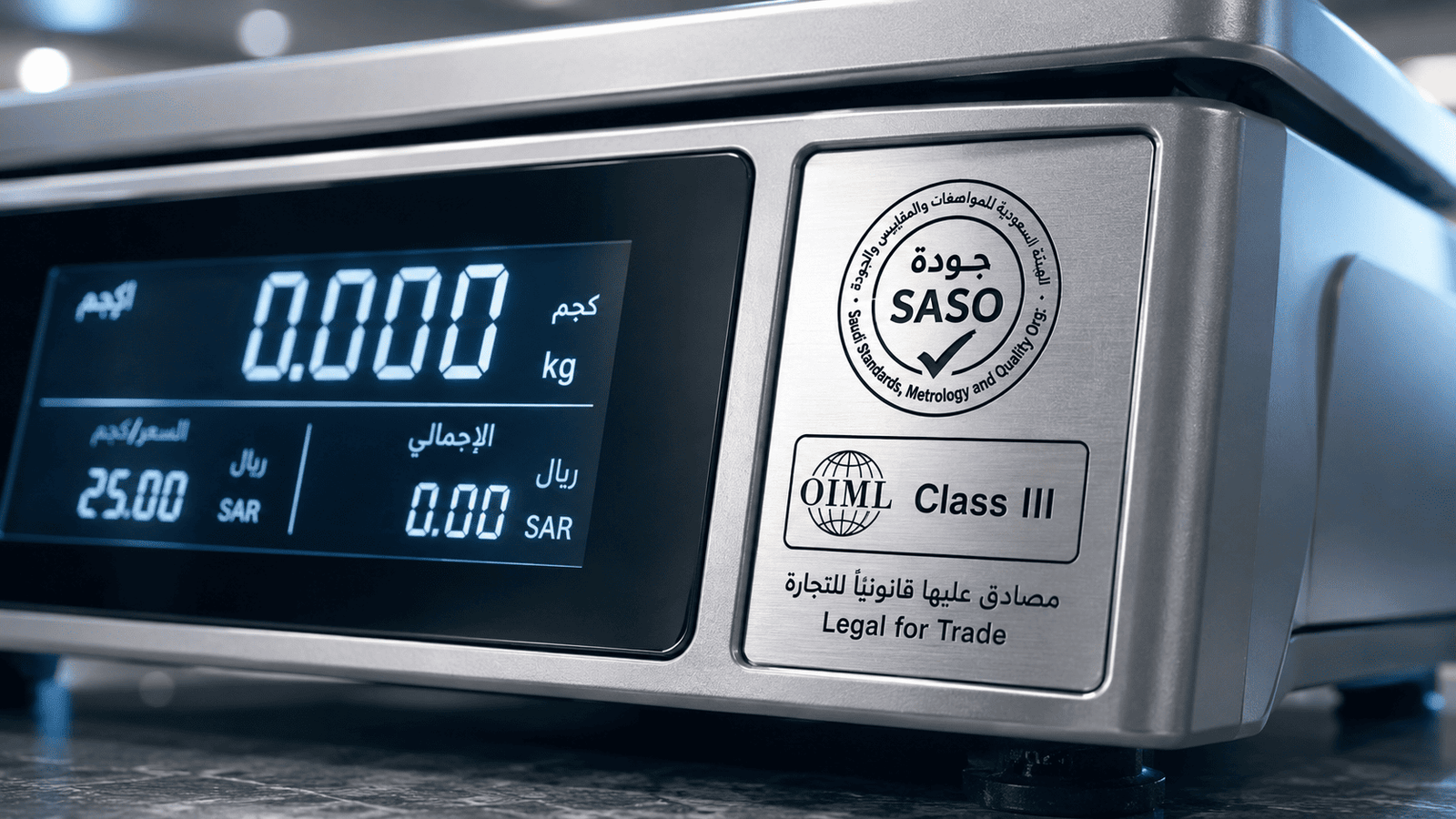
“ A scale without a valid SASO verification stamp cannot be legally used for retail trade in Saudi Arabia, regardless of how accurate the supplier claims it is. — Section 02
03 Types of Retail Weighing Scales: A Practical Breakdown
Here's a clean reference for the main categories you'll encounter when buying retail weighing scales in Saudi Arabia. Not all of these will be relevant to your operation, but knowing what's available helps you have a more productive conversation with your supplier.
Price Computing Scales
The workhorse of the deli and fresh food counter. These display weight, unit price per kilo, and total price simultaneously. Most mid-to-high-end models include PLU (Price Look-Up) memory for fast item retrieval, a customer-facing display, and connectivity to your POS or back-office system. This is the scale category you need for most fresh food service counters.
Counter Scales with Label Printing
A step up from the basic price computing scale. These print pre-packed or serve-over labels with weight, price, barcode, ingredients, and allergen information. In Saudi Arabia, SFDA labeling requirements for pre-packaged food make this functionality increasingly important for retailers who pre-pack fresh items. If you're doing any level of in-store packing, you need this capability.
Self-Service Scales
Designed for customer-operated use. Touchscreen interface, robust enclosure, integrated label printer. These are showing up more in high-traffic produce sections across major KSA hypermarkets as retailers chase convenience-focused shoppers. The growth trajectory here follows a broader trend: Saudi Arabia's online grocery market, valued at USD 1.54 billion in 2024 per IMARC Group, is pushing physical retailers to match digital convenience in-store.
Checkout Scales
Built to sit at or be integrated into a POS counter. IP-rated for spill resistance, fast response time, serial or USB connection to POS software. These are built to take abuse and keep running. The speed of the transaction matters here: a slow checkout scale creates a queue.
Platform and Bench Scales
General-purpose receiving and back-of-house scales. Not typically configured for legal-for-trade front-of-house use, but essential for logistics, goods receipt, and production environments. If your receiving bay is weighing incoming deliveries to verify supplier quantities, this is what you need.
Precision Scales for Jewelry and Pharmacy
High resolution, temperature-compensated, often fitted with enclosed draft shields. Built for extremely fine measurements at gram and sub-gram level. The Saudi jewelry market is significant and these environments have zero tolerance for inaccuracy. Buying a food retail scale for a gold shop is one of those mistakes you only make once.
04 The Specs That Actually Matter Before You Buy
Honestly, most buyers focus on capacity and price, and stop there. That's not enough. Here's what to actually look at when comparing models.
Accuracy class and readability. For a fresh food counter, you want a 15kg or 30kg maximum capacity scale with readability to 5g or 2g. For jewelry, you're looking at 500g or less capacity with 0.01g or even 0.001g readability. These aren't arbitrary numbers. They're what OIML and SASO compliance requires for each use case.
IP rating. IP stands for Ingress Protection, and in a commercial kitchen, deli, or fish market environment, it matters enormously. An IP65 rating means the scale is fully dust-tight and protected against water jets. In a fish counter or wet market environment, IP67 or IP68 is what you want. Anything without a meaningful IP rating in those environments will fail faster than you'd expect, and repairs in a live retail environment are disruptive and expensive.
POS and ERP connectivity. If your scale can't talk to your POS or back-office system, you're creating manual data entry work, which means errors and time waste. Look for RS-232, USB, Ethernet, or Wi-Fi connectivity depending on your existing infrastructure. This should be confirmed before purchase, not discovered afterwards.
Display and ergonomics. The operator display and customer display need to be clearly readable from practical distances and angles. For deli counters, a dual-sided display is essential. Touchscreen models accelerate throughput at busy counters. These things seem minor until you're standing in front of a busy Friday evening deli queue.
PLU capacity. A scale with 200 PLUs is fine for a small butcher shop. A hypermarket deli with 500+ fresh food SKUs needs a scale that handles significantly more, often with the ability to sync PLU updates centrally across multiple terminals. Confirm this with your supplier before signing anything.
Battery backup. In outdoor markets, kiosks, and mobile retail environments across KSA, battery operation can be a practical necessity. Confirm whether the model supports both AC and battery modes if this is relevant to your setup.
05 Retail Weighing Scale Pricing in Saudi Arabia: Realistic Ranges
Here's the part everyone wants, and the part that requires the most context. Retail scale pricing in Saudi Arabia varies significantly by category, brand, specification, and whether you're buying one unit or equipping an entire store chain.
The ranges below are indicative market estimates for budget planning purposes only. Actual pricing depends on supplier, configuration, volume, installation requirements, and certification costs. Always request a formal quotation for your specific project.
| Scale Type | Typical Use Case | Est. Price (SAR) | Est. Price (USD) |
|---|---|---|---|
| Basic digital bench scale | Back-of-house, goods receiving | SAR 200 - 800 | $53 - $213 |
| Entry price computing scale | Small grocery, butcher shop | SAR 800 - 2,500 | $213 - $667 |
| Mid-range counter scale with label printer | Deli counter, supermarket | SAR 3,500 - 8,000 | $933 - $2,133 |
| High-end connected scale (ERP/POS integration) | Hypermarket, multi-branch chain | SAR 8,000 - 20,000 | $2,133 - $5,333 |
| Precision analytical scale | Jewelry, pharmacy, laboratory | SAR 500 - 4,000 | $133 - $1,067 |
| Self-service scale with integrated printer | High-traffic produce, modern retail | SAR 6,000 - 15,000 | $1,600 - $4,000 |
* Indicative market estimates as of 2025-2026 only. Prices exclude installation, SASO calibration and verification fees, and ongoing maintenance. Exchange rate: 1 USD = 3.75 SAR. Contact Global Scales & Systems for a project-specific quotation.
“ The scale itself is usually the clearest line item. What catches buyers out are the calibration, consumables, and service costs that arrive every year after. — Section 07
06 What Global Scales & Systems Brings to KSA
As Mettler Toledo's official partner in Saudi Arabia, Global Scales & Systems Co. Ltd. works with retailers across the Kingdom, from corner butcher shops in Jeddah to major hypermarket chains in Riyadh and the Eastern Province. The Mettler Toledo retail range covers essentially every use case we've described above.
FreshBase counter and self-service scale. A high-performance touchscreen scale designed for supermarkets, deli counters, and butcher shops. It integrates with back-office systems via FreshBase software, supports remote maintenance diagnostics via the FreshPro platform, and handles the throughput demands of busy service counters. The design is compact and easy to clean, which matters more than it sounds in a daily food service environment.
FreshWay T. A tower-style PC scale ideally suited for lower retail counters. The raised display makes it easy for both the operator and customer to read simultaneously. It supports self-service configurations and is built for flexibility across multiple retail use cases.
Ariva-S checkout scale. Built for the checkout lane. Dual interval weighing (which handles both heavy items and fine goods without switching scales), cast aluminum housing, stainless steel platter, and RS-232/USB connectivity for POS integration. The Ariva-S Mini variant takes up 64% less counter space than the standard model, which is a genuine advantage in space-constrained checkout setups.
XPress XRW compact scales. IP65-rated for wet environments, battery and AC operation, dual display. These are the go-to choice for fish markets, wet market counters, and food processing environments where water resistance is a daily reality.
Precision and analytical scales. The Mettler Toledo Excellence and NewClassic ranges cover jewelry, pharmacy, and laboratory weighing needs, with automatic calibration functions and draft shields as standard.
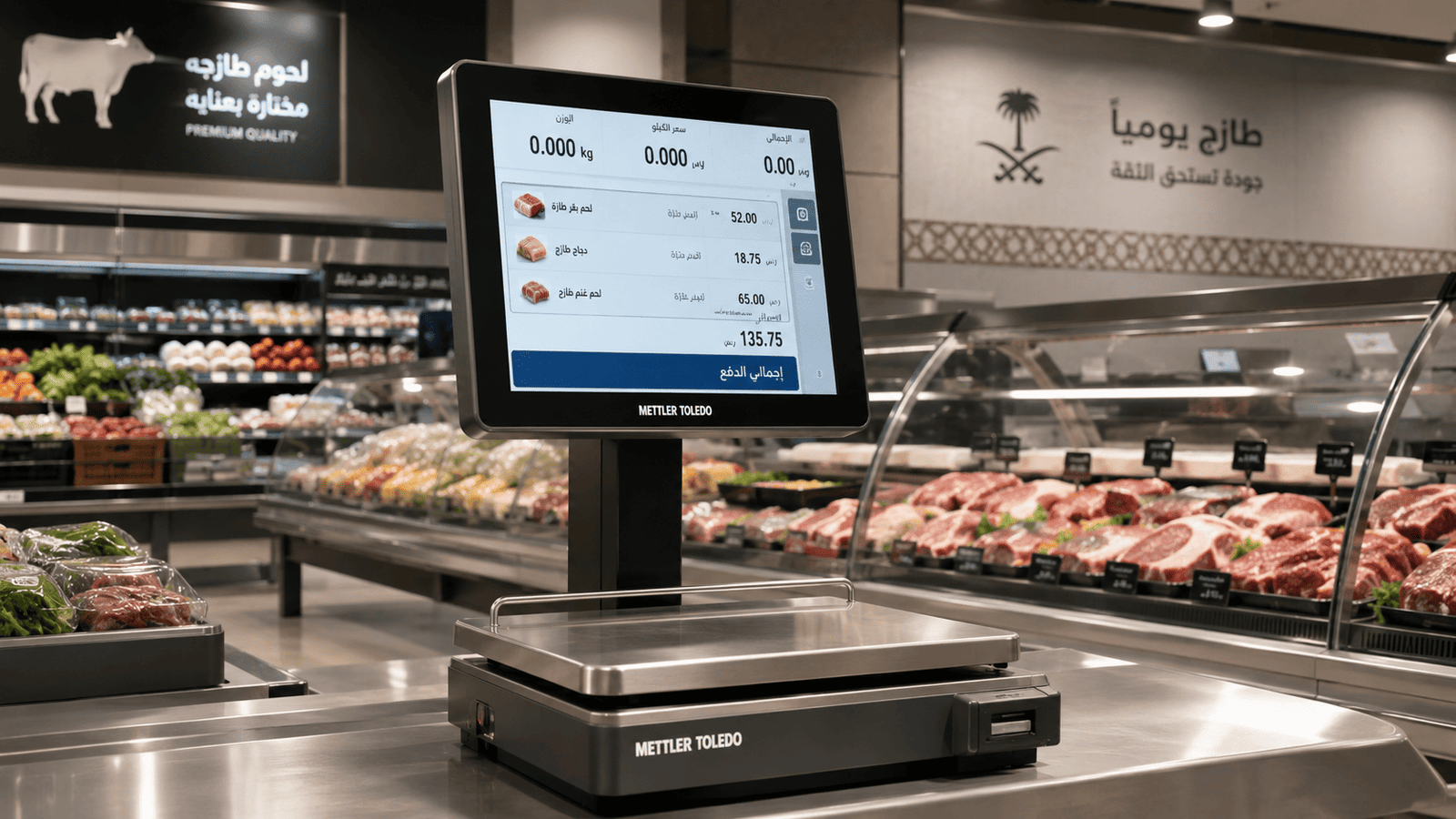
Here's a feature-to-benefit breakdown so you can see what the specs actually mean for day-to-day operations:
| Feature | What It Actually Means for Your Operation |
|---|---|
| IP65 enclosure (XPress XRW range) | Survives wet market and fish counter conditions without deteriorating from the inside out |
| FreshBase central software integration | PLU updates, pricing changes, and maintenance diagnostics pushed from one server to all terminals across your store |
| Dual interval weighing (Ariva-S) | One scale handles both heavy and light items without a swap, which keeps the checkout lane moving |
| Touchscreen display (FreshBase, FreshWay T) | Faster service, fewer errors, and easier staff training versus button-based legacy models |
| FreshPro remote diagnostics | Reduced downtime because faults can be diagnosed and often resolved before an engineer visits on-site |
| Class III legal-for-trade certification | Fully SASO-compliant for all retail food, deli, produce, and checkout use cases in Saudi Arabia |
07 Hidden Costs Buyers Don't Think About
The scale itself is usually the clearest line item in the quote. What catches people out are the costs that arrive every year after.
Calibration and annual verification. Your SASO-compliant retail scale needs to be calibrated and re-verified periodically. Budget for this annually. For a small retailer with a handful of scales, this might be SAR 200-400 per unit per visit. For a large hypermarket with dozens of scales, it adds up quickly, and it's a cost that doesn't disappear over the life of the equipment.
Label and consumable rolls. If your scale has a label printer, you'll be buying thermal label rolls regularly. Factor this into your total cost of ownership. Cheap generic rolls sometimes cause print quality issues and can jam printers designed for the manufacturer's media. One of those things that seems trivial until your deli counter is backed up at 6pm on a weekend.
Common mistake
Using off-brand label rolls to cut costs is one of the most common service call triggers we see. The printer isn't faulty — it's the media. Thermal label rolls that don't match the printer specification cause jamming, smearing, and poor barcode readability. Use approved rolls and you'll avoid most of these issues entirely.
Software licensing and updates. Connected scales with back-office software like FreshBase or similar systems may carry licensing fees, update costs, or integration work if you're rolling them into an existing POS or ERP system. Confirm this upfront. "The software is free" often means "the first year is included."
Training. A proper touchscreen deli scale has a learning curve. Budget time for staff training, especially if you're replacing a simpler older model. Staff who don't know the system make errors, and errors at a fresh food counter mean customer disputes and potential over or under-charging.
Service and spare parts availability in KSA. This is a big one. If a scale fails and the supplier doesn't have local spare parts or a local service engineer, you're waiting. Ask your supplier directly: where is your nearest service center? What's your average response time for a fault call in Riyadh? Jeddah? the Eastern Province? If they hesitate on that question, it tells you something important.
08 What to Do Before You Buy: A Practical Checklist
Saudi Arabia's retail sector is expanding fast. According to Euromonitor, Panda Retail alone has earmarked 20 new stores for 2025 with emphasis on Riyadh and remote areas. The wider food retail market is forecast to grow by nearly USD 18 billion between 2025 and 2029, per ResearchAndMarkets data. That growth creates real demand for properly specified, fully compliant weighing infrastructure across every store format and size.
Before you commit to a purchase, work through this checklist:
- Be clear on your use case first. Don't buy a general bench scale for a legal-for-trade food counter.
- Confirm SASO legal-for-trade compliance for any scale used in a customer-facing pricing role.
- Check the IP rating if you're operating in a wet, humid, or outdoor environment.
- Confirm POS and ERP connectivity before you purchase, not after the scale is installed.
- Ask the supplier specifically about local calibration and service support, and what their response time is in your city.
- Factor in the full cost of ownership: calibration, consumables, label rolls, software, and staff training.
- Work with an authorized partner who handles compliance documentation from day one.
The scale on your counter is a small piece of a much larger picture. But it's the piece customers interact with every single transaction. Get it right.
09 Frequently Asked Questions
These are the questions we hear most often from retailers and procurement teams across Saudi Arabia when they're evaluating retail weighing scales.
Are retail weighing scales in Saudi Arabia required to be SASO certified?
Yes. Any scale used to determine a price payable by a customer in a commercial retail setting must be a verified, legal-for-trade instrument under SASO requirements. This applies to supermarkets, deli counters, butcher shops, jewelry stores, and any retail environment where weight is used to calculate a transaction value. Non-compliance exposes you to fines and forced counter closure during inspections.
What accuracy class do I need for a fresh food retail scale in Saudi Arabia?
For fresh food retail, a Class III non-automatic weighing instrument is the standard requirement under OIML R 76. For jewelry and precious metals, Class I or Class II precision is required. Your supplier should confirm the accuracy class of any model they recommend for your specific application before you purchase.
How often do retail scales need to be recalibrated in Saudi Arabia?
Most commercial retail scales used for legal-for-trade purposes in Saudi Arabia require annual re-verification. The exact schedule can depend on the scale type, application, and the certifying authority. A service agreement with a certified calibration partner like Global Scales & Systems means this is tracked and managed for you automatically.
Can retail weighing scales in Saudi Arabia connect to a POS or ERP system?
Yes, and for anything beyond a basic single-location setup they should. Most professional-grade retail scales support RS-232, USB, Ethernet, or Wi-Fi connectivity. The Mettler Toledo FreshBase system integrates with existing corporate IT infrastructure via browser-based and web services technologies, allowing PLU management, pricing updates, and remote diagnostics from a central server across multiple locations.
What is the difference between a price computing scale and a label printing scale?
A price computing scale shows weight, unit price, and total price on screen. It's sufficient for serve-over counters where staff handle the transaction directly. A label printing scale does all of that and also prints a barcode label with weight, price, ingredients, and allergen information. For pre-packed food products governed by SFDA labeling requirements, you need the label printing capability.
How much do retail weighing scales cost in Saudi Arabia?
It depends significantly on category and specification. A basic digital bench scale starts around SAR 200-800. A professional deli counter scale with label printing and POS integration typically runs SAR 3,500 to SAR 20,000 depending on brand and configuration. Precision scales for jewelry run SAR 500-4,000. These are indicative market ranges. Contact Global Scales & Systems for a project-specific quotation.
Global Scales & Systems Co. Ltd., we stand as your strategic partner in Saudi Arabia and the GCC for supply, installation, calibration, and service of the full retail weighing scale range across the Kingdom, with coverage in Riyadh, Jeddah, the Eastern Province, and beyond. Reach out today for tailored support and assistance.

 Click to start chat