
Semi-Micro Balances for Gem Labs: 5 Honest Answers Every KSA Certification Lab Needs Before Buying
Do you actually need a semi-micro balance or will a well-specified carat scale do the job? The answer depends on what your lab does and who's watching. Here's how to decide properly.

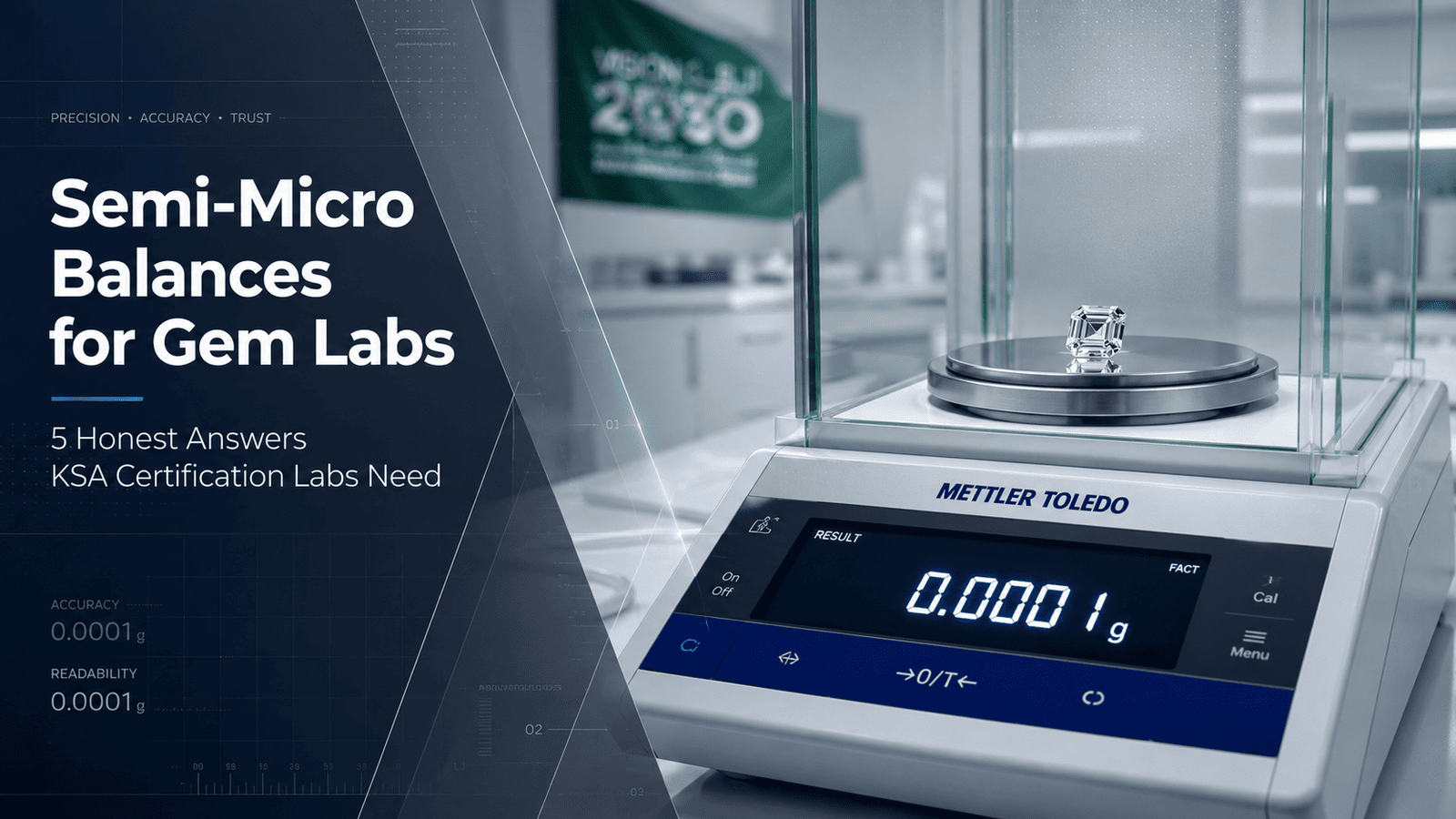
Picture this: a mid-size gem grading lab in Riyadh submits a certificate for a 0.47-carat round brilliant. The client disputes the weight. The lab's carat balance: a good one, Legal for Trade, internally calibrated, reads 0.472 carats. The client's own instrument reads 0.469. Three milligrams. Less than the weight of a small grain of rice. But that difference is the entire dispute, and neither party will back down without traceable, accredited documentation to settle it.
This is not a hypothetical. It's a situation that gem certification labs across Saudi Arabia are navigating more often now, as the Kingdom's jewellery and precious stones sector grows fast and the regulatory framework tightens around it. Semi-micro balances for gem labs have become a genuine topic of conversation, not just among pharma or research laboratories where this precision tier is standard, but inside gemological grading rooms, import inspection counters, and assay facilities that are quietly upgrading ahead of what the new compliance environment demands.
So, do you actually need one? The honest answer depends on what your lab does and who's watching. Let's go through it properly.
01 What Exactly Is a Semi-Micro Balance And How Is It Different from Your Carat Scale?
Most gem labs already have a carat balance. A good one reads to 0.001 carats, that's 0.0002 grams, or 0.2 milligrams. For retail trading, that's typically sufficient. OIML-certified Legal for Trade carat balances, like the Mettler Toledo JET series with FACT fully automatic internal adjustment, are built precisely for this purpose. The JET1603C, for instance, offers 1,600 ct capacity and 0.001 ct readability on a 4.5-inch colour touchscreen with three connectivity interfaces, everything a busy certification counter needs.
A semi-micro balance operates in a different league. The defining specification is a readability of 0.01 mg (0.00001 g), one hundredth of a milligram. The Mettler Toledo XRP205, for example, delivers 0.01 mg readability across a 220 g capacity range, while the WXTJ series, designed specifically for jewellery applications, pushes to 0.001 mg (1 microgram) on a 1.2 g range. To frame that in gemological terms: a 0.01 mg readability instrument can detect a weight difference of roughly 0.00005 carats. That's far beyond any carat trading dispute you'll encounter. It's the resolution that assay chemists, filtration labs, and high-end gem grading facilities use when accuracy isn't just commercially important; it's scientifically non-negotiable.
The draft shield isn't just a dust cover on a semi-micro balance, either. It's an active anti-convection enclosure. The SmartGrid weighing pan on the XPR series is specifically engineered to suppress air turbulence that would otherwise corrupt measurements at this sensitivity level. And StaticDetect, a feature that monitors electrostatic charge on samples and containers, matters enormously when you're working with faceted diamonds that build up static charge just from being handled.
Semi-micro balances for gem labs are not simply "more accurate carat scales." They represent a different instrument class, with different environmental requirements, different calibration obligations, and a meaningfully higher purchase and maintenance cost. Understanding that distinction is the starting point for everything else in this guide.
02 The Saudi Market Context: Why This Question Is Being Asked Right Now
Saudi Arabia's precious stones and jewellery sector is not a niche. According to Grand View Research, the Kingdom's jewellery market generated USD 5.67 billion in 2023 and is forecast to reach USD 7.8 billion by 2030, growing at a compound annual rate of 4.7%. Within that, TechSci Research specifically values the gold and diamond segment at USD 4.56 billion in 2024, projected to reach USD 8.34 billion by 2030 on a 10.59% compound annual rate. That scale of growth, combined with Vision 2030's push to position the Kingdom as a regional hub for luxury retail and ethical gemstone trading, means significantly more volume flowing through gemological certification infrastructure.
And then came October 2025. The Saudi Ministry of Commerce announced the enforcement of Cabinet Resolution No. 269, amending the Precious Metals and Gemstones Law, effective from October 11, 2025. Key changes include the removal of the four-carat tolerance allowance that previously permitted small weight deviations in declared gold purity, a mandatory identification tag on any item set with gemstones, and a prohibition on advertising precious metal or gemstone products without stating the type, weight, fineness, and price. Responsibility for supervising the manufacturing side transferred to the Ministry of Industry and Mineral Resources, while the Ministry of Commerce retained oversight of trade.
What this means for KSA gem certification labs is straightforward: the margin for error on documented weight just got tighter, and the audit trail supporting each certification result needs to be bulletproof. Labs that have been operating with loose calibration practices or instruments without accredited documentation are now visibly exposed in a way they weren't before October 2025.
“ Three milligrams, less than the weight of a grain of rice was the entire dispute. Neither party would back down without traceable, accredited documentation to settle it. — Section 01
03 The Compliance Picture: SASO, NMI, OIML, and What Your Lab Actually Needs
Here's where this gets specific to KSA gem labs and where we see a lot of confusion in the market. SASO (the Saudi Standards, Metrology and Quality Organization) defines calibration criteria for assay laboratories and coordinates the metrology infrastructure through the National Metrology Institute. Under the legal framework governing precious metals, accredited laboratories must test gemstones before they are sold commercially. The standard reference framework for this calibration work is OIML (International Organisation of Legal Metrology).
The key distinction most lab managers miss: there are two different weighing contexts in a gem lab, and they carry different requirements.
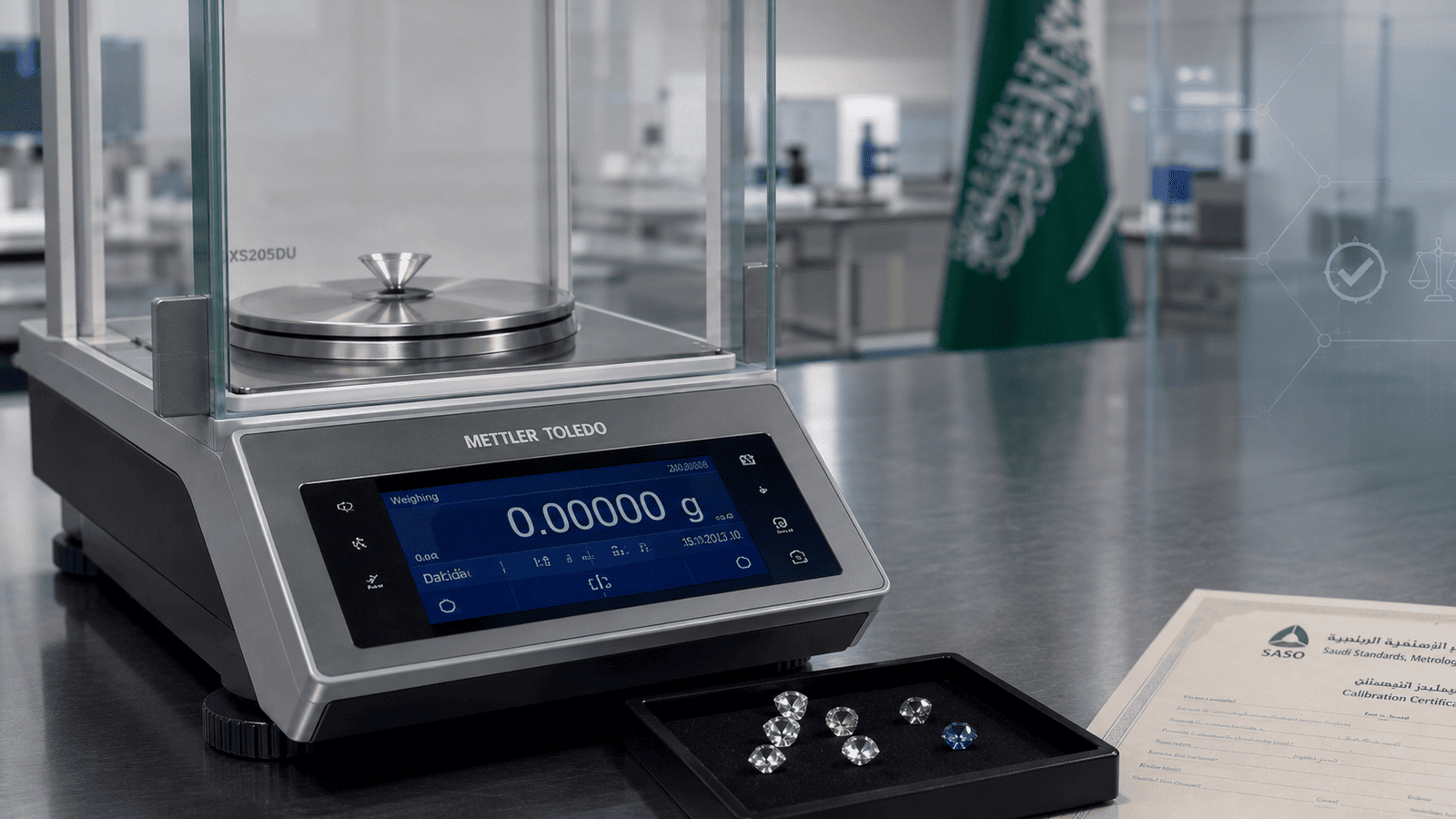
Context 1: Commercial trade transactions. When you're certifying a stone's weight for a commercial certificate that affects the buying or selling price, your balance must be Legal for Trade. In Saudi Arabia, this means OIML-certified with the appropriate class status (typically Class I for fine readability applications), internally calibrated, and supported by a current calibration certificate from an accredited provider. For most commercial carat certification work, a Legal for Trade carat balance at 0.001 ct readability meets this need. A semi-micro balance in this context is overkill for daily trading volume.
Context 2: Laboratory assay, quality control, and ISO 17025 accreditation. If your lab is seeking or maintaining ISO 17025 accreditation, or performing assay-level work; gold fineness determination, trace metal analysis, melee parcel verification, the instrument tier needs to match the measurement uncertainty budget. At this level, semi-micro balances are often not optional. They are specified by the method.
Common mistake
Labs frequently invest in a high-specification balance but fail to obtain a SASO NMI-traceable calibration certificate before putting the instrument into production service. An uncalibrated balance, regardless of how precise, is, for all compliance purposes, an uncalibrated balance. Under the revised Precious Metals and Gemstones Law, that documentation gap creates direct audit exposure. Schedule accredited calibration before the instrument goes live.
The ZATCA dimension adds another layer. The 15% VAT applicable to jewellery transactions in the Kingdom depends on accurate declared values. Where gem weight is part of the valuation basis; common for diamonds, rubies, emeralds, and other precious stones priced by carat, the documented weight on your certification report becomes part of the taxable transaction record. That's not a reason on its own to buy a semi-micro balance. But it is a reason to make absolutely certain your existing instruments are calibrated and traceable, with documentation your auditors can verify.
04 The 5 Questions That Determine Whether You Need a Semi-Micro Balance
Before you budget for a semi-micro balance, run through these five questions honestly.
1. Does your lab perform assay work or fineness determination?
Gold fineness assay, fire assay, and trace precious metal analysis all require measurement uncertainties that a standard carat balance cannot achieve. If assay work is any part of your service offering, a semi-micro balance is almost certainly needed.
2. Are you grading melee diamonds or very small loose stones regularly?
For stones below 0.10 carats, the weight difference between adjacent grade categories can be under 0.002 carats. A 0.001 ct carat balance handles this adequately for trading purposes. But if your lab produces grading reports that need to survive legal dispute and you're dealing in high-volume melee, a semi-micro balance provides the margin of certainty that protects your certificates in arbitration.
3. Are you seeking or maintaining ISO 17025 accreditation?
ISO 17025 requires that your measurement uncertainty is fully characterised and traceable to national standards. Many gem lab methods, when properly documented, specify a minimum balance readability. If your uncertainty budget demands 0.01 mg resolution, a carat balance won't get you there regardless of how often it's calibrated.
4. Do your clients include government bodies, customs authorities, or major retailers with their own compliance requirements?
Government procurement, port inspection, and customs valuation applications increasingly specify SASO NMI-traceable documentation. High-end jewellery retailers operating under Vision 2030 retail expansion have similarly raised their documentation standards. If your clients are in this category, a credentialled semi-micro setup differentiates your service in a way competitors may not be able to match quickly.
5. What is your current calibration infrastructure?
A semi-micro balance is not a plug-and-play upgrade. It requires an anti-vibration table (or dedicated isolation bench), a controlled environment away from HVAC airflow and direct sunlight, and regular calibration by a technician accredited to handle instruments in this precision class. If your lab doesn't currently have that infrastructure, the instrument acquisition cost is only part of the investment you're actually making.
If you answered yes to questions 1 through 3, a semi-micro balance is justified and probably essential. If you answered no to all of them, a well-specified Legal for Trade carat balance with proper calibration documentation and an annual service contract is likely the right investment right now.
05 Balance Tier Comparison for KSA Gem Labs
The table below gives indicative purchase price ranges for the major balance tiers relevant to gem lab use in the Saudi market. These are market estimates only, actual pricing depends on configuration, accessories, and service packages. Contact us for a formal quotation.
| Balance Tier | Best For | Readability | Est. Price (SAR) | Est. Price (USD) |
|---|---|---|---|---|
| JE/JET Carat Balance (Legal for Trade) | Commercial stone trading, retail verification | 0.001 ct / 0.1 mg | SAR 3,500 – 8,000 | $930 – $2,130 |
| XSR / MS Semi-Micro (Standard series) | Entry semi-micro, small batch assay, ISO 17025 basic compliance | 0.01 mg | SAR 18,000 – 30,000 | $4,800 – $8,000 |
| XPR Semi-Micro Excellence | Full ISO 17025 compliance, LabX data management, StaticDetect, accredited certification | 0.01 mg | SAR 30,000 – 55,000 | $8,000 – $14,650 |
| WXTJ Jewelry Microbalance | Ultra-precise assay, melee diamond grading, research-grade certification, 1 µg resolution | 0.001 mg | SAR 65,000 – 110,000 | $17,300 – $29,300 |
Prices are indicative market estimates only and should not be taken as quotes. Final pricing depends on model specification, software licensing, service contract, and site requirements. Contact us at Global Scales & Systems for a formal proposal tailored to your lab's configuration.
“ The instrument acquisition cost is only part of the investment. A semi-micro balance requires anti-vibration infrastructure, a controlled environment, and accredited calibration before it goes anywhere near production use. — Section 04
06 What the Specs Actually Mean for Your Lab Operations
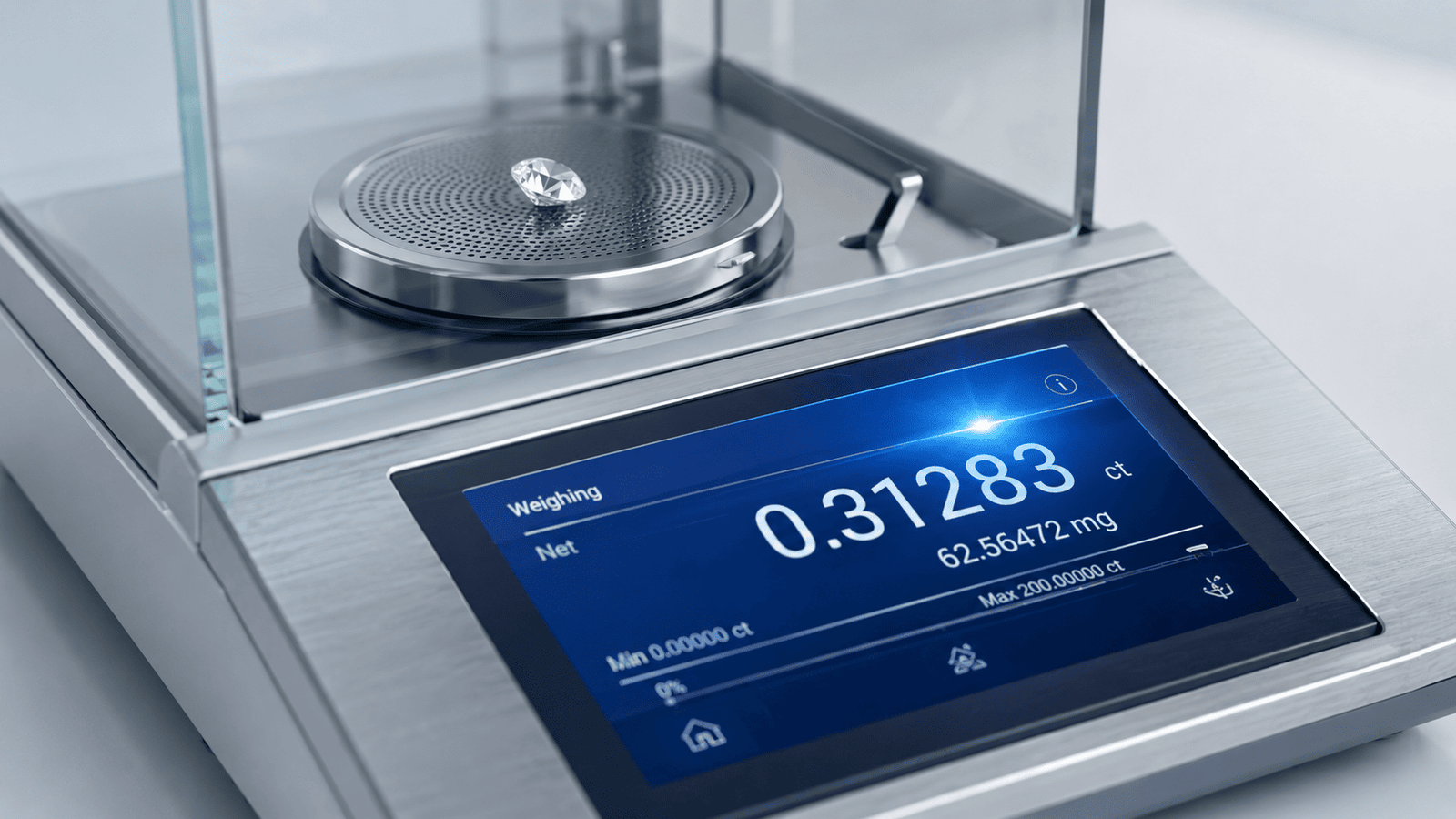
A spec sheet is one thing. Here's what those numbers translate to when your graders are running 40 to 80 stone certifications per day.
| Feature | What It Actually Means in Your Lab |
|---|---|
| StaticDetect (XPR series) | Alerts you when electrostatic charge on a stone or tray is corrupting your reading eliminating a hidden error source that catches gem labs off guard without any visible warning |
| FACT Fully Automatic Internal Calibration | The balance self-adjusts to ambient temperature changes throughout the day, with no technician intervention needed; critical in KSA labs where HVAC cycling creates thermal drift that compounds measurement error over a full day of use |
| SmartGrid weighing pan (XPR) | Perforated grid design suppresses air turbulence inside the draft shield, giving stable readings faster even when staff open the enclosure frequently during a busy certification shift |
| LabX software integration (XPR Excellence series) | Every weighing is logged with timestamp, user ID, and calibration status automatically, producing an audit trail that satisfies both ISO 17025 and SASO documentation requirements without any additional manual record-keeping |
| OIML Legal for Trade certification (JET / WXTJ) | The balance result is legally recognised for commercial transaction documentation under Saudi Precious Metals and Gemstones Law and ZATCA taxable value reporting — without this, your certificate may not hold up in a commercial or regulatory dispute |
| Dual-range readability (DR models) | A single instrument operates at 0.01 mg for small stones and 0.1 mg for larger items eliminating the cost of two separate instruments for labs handling varied stone sizes across the same workflow |
Pro tip
If your lab is currently using a semi-micro or analytical balancesemi-micro or analytical balance without LabX or equivalent data management software, you're creating the measurements but not the audit trail. Under ISO 17025 and the revised KSA Precious Metals Law, the audit trail matters as much as the measurement itself. Software licensing is worth building into your total cost of ownership calculation from day one.
07 A Note on Calibration: The Part Everyone Underestimates
We keep seeing this in KSA gem and jewellery labs: the instrument is excellent, but the calibration documentation isn't. A WXTJ or XPR balance that hasn't been calibrated by an NMI-traceable accredited service provider in the past twelve months is, for all compliance purposes, an uncalibrated balance. And under the October 2025 amendments to the Precious Metals and Gemstones Law, that's a documentation gap you don't want an inspector to find during an audit.
The ideal calibration schedule for gem lab balances operating in KSA conditions: external calibration every six to twelve months depending on use frequency, with internal calibration (automatic on all modern instruments in this class) verified against a reference mass set at the start of each grading shift. For labs seeking ISO 17025 accreditation, the calibration certificate needs to include measurement uncertainty values at the readability level of the balance. Not all service providers issue this by default, ask specifically.
Global Scales & Systems provides calibration services for laboratory precision and semi-micro balances with full SASO NMI-traceable documentation across KSA and the GCC. If your lab is upgrading instruments, commissioning a new facility, or bringing an existing balance back into compliance, calibration should be the first scheduled service item before the instrument goes into production use. We've seen labs wait until the first complaint to address this. It's the kind of thing that's very easy to fix in advance and very difficult to fix retrospectively.
“ A balance that hasn't been calibrated by an NMI-traceable provider in the past twelve months is, for all compliance purposes, an uncalibrated balance, regardless of how precise it is. — Section 07
08 Frequently Asked Questions
Below are the questions KSA gem lab managers most commonly ask when evaluating this decision.
What readability does a gem certification lab in Saudi Arabia need for commercial stone transactions?
For commercial carat certification and trade documentation, a Legal for Trade carat balance with 0.001 ct (0.2 mg) readability is the standard. OIML-certified balances at this readability satisfy the requirements of the Saudi Precious Metals and Gemstones Law for transaction documentation. You do not need semi-micro resolution (0.01 mg) for standard commercial carat trading purposes.
Does SASO require semi-micro balances for KSA gem labs?
SASO does not mandate a specific balance model. What it mandates is that the weighing instrument used in a certified lab context meets the relevant OIML class for its application, is calibrated by an accredited provider, and produces documentation traceable to national standards. Whether that means a carat balance or a semi-micro balance depends on your lab's scope, methods, and any ISO 17025 accreditation requirements.
How does ZATCA valuation affect which balance I need?
ZATCA collects 15% VAT on jewellery and precious stone transactions. The taxable value is based on the declared item value, which for gemstones includes the certified weight. Your weighing instrument isn't inspected by ZATCA directly, but your certification documentation is part of the supporting invoice trail. Any inconsistency between a gem weight on a certificate and independent verification could be a basis for a VAT dispute. Calibrated, traceable weighing instruments protect both parties.
Can I use the same semi-micro balance for assay work and carat certification?
Generally yes, but verify that your specific balance model carries OIML Legal for Trade approval for the carat range you're certifying. Some semi-micro analytical balances are calibrated in milligrams only. Instruments like the Mettler Toledo WXTJ3DU are specifically designed for jewellery use and carry both carat and gold balance configurations with OIML Legal for Trade availability. Make sure the display unit, resolution, and legal approval match your certification workflow before committing.
How often does a semi-micro balance need calibration in a Saudi gem lab?
At minimum, external calibration by an accredited service provider should occur every twelve months. For labs running daily production certification at high volume, a six-month cycle is preferable. Internally, every properly equipped semi-micro balancesemi-micro balance should be verified against a reference weight at the start of each shift. KSA's ambient temperature range creates more thermal drift than cooler climates, which makes FACT automatic internal calibration — a standard feature on both the XPR and WXTJ series, genuinely valuable here, not just a marketing specification.
What is the difference between an analytical balance and a semi-micro balance?
A standard analytical balance reads to 0.1 mg (four decimal places in grams). A semi-micro balance reads to 0.01 mg (five decimal places). For most commercial gem labs, the analytical tier sits between a high-quality carat balance and full research-grade precision. The semi-micro class is the right category for labs bridging commercial certification with scientific-grade documentation requirements: assay, ISO 17025, and government-linked inspection work.
Global Scales & Systems Co. Ltd., your reliable expert in industrial weighing scales, laboratory scales and compliance partnerlaboratory scales and compliance partner in Saudi Arabia and the GCC, supplying, installing, and servicing the full range of precision and semi-micro laboratory balances; including the XPR, WXTJ, and JET series with SASO NMI-traceable calibration and ongoing service contracts across Riyadh, Jeddah, the Eastern Province, and beyond. Reach out today for a formal quotation or calibration consultation tailored to your lab's requirements.
 Click to start chat