
7 Costly Common Truck Scale Errors in Saudi Logistics
Common truck scale errors quietly cost logistics firms money every shift. See the 7 biggest ones in KSA and how SASO-aligned calibration stops them.

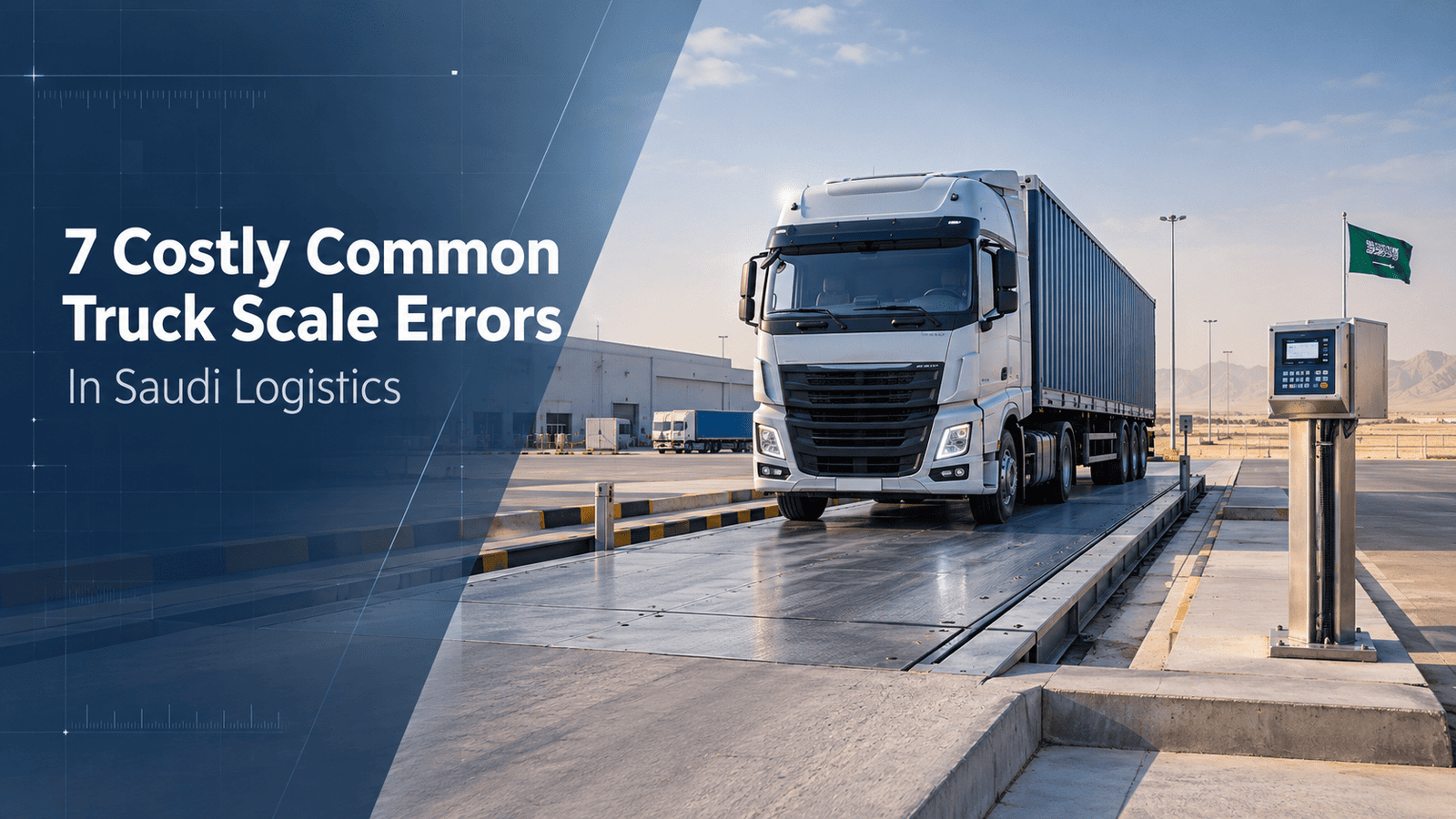
Picture a loaded truck rolling off your weighbridge with a clean ticket, then stopping at a roadside weigh station where the number reads higher. Who's wrong? Honestly, in a lot of yards nobody checks until money has already left the building. Common truck scale errors rarely announce themselves with an alarm or a dead display. They show up as a shipment that never quite reconciles, a customer claim about a dispatch, or a fine you didn't see coming.
In our experience, operations teams will chase drivers, loaders and ERP settings for weeks before anyone looks under the deck. The good news is that most of these errors are predictable, and almost all of them are preventable. Here are the seven we see most, what they cost, and what to do about each one.
01 Why Common Truck Scale Errors Hit Logistics Margins So Hard
The freight is on the road, so the money is at the gate
According to IMARC Group, Saudi Arabia's logistics market reached USD 55.29 billion in 2025, and roadways account for 59.08% of it. When most of the freight moves on trucks, the weighbridge at your gate is where tonnage turns into invoices. It's also where tonnage quietly leaks.
A small error, multiplied by every truck
Here's the thing nobody likes to say out loud: a scale doesn't have to be badly broken to cost you. It only has to be a little off, all day, in the same direction. The table below is plain arithmetic on assumed throughput (200 weighments a day, 300 operating days a year). These are illustrations, not client data.
| Error per weighment | Material mis-recorded per day | Material mis-recorded per year |
|---|---|---|
| 50 kg | 10 tonnes | 3,000 tonnes |
| 100 kg | 20 tonnes | 6,000 tonnes |
| 200 kg | 40 tonnes | 12,000 tonnes |
Whether that material is billed by you or to you, someone is absorbing it. If the error favours the customer, you eat it. If it goes against them, you've got a dispute waiting to happen.
Roadside enforcement doesn't care what your ticket says
The Roads General Authority's summary of the Saudi Highway Code, as reported by Riyadh Daily in September 2024, lists legal truck weights by axle count: 21 tons for two axles, 34 for three, 42 for four and 45 for five. The reported fine for going over is SAR 200 for every 100 kilograms, capped at SAR 100,000. Do the maths and one tonne over costs SAR 2,000. Now imagine a five-axle truck loaded right up to the limit on a yard scale that reads half a tonne light. That's a truck you believe is legal and that's actually SAR 1,000 over before it reaches the first checkpoint.
And checkpoints aren't rare. The authority operates more than 130 integrated weigh stations across the Kingdom's roads. Limits and fines can differ by crossing and do get updated, so confirm current figures before you build any loading policy around them.
02 Mechanical Errors: Debris, Binding and Worn Hardware
Most scale trouble starts with steel, dirt and movement, not electronics. These three are the cheapest to fix and the most often ignored.
Error 1: Build-up under and around the deck
A weighbridge deck sits on load cells that need room to move freely. When sand, stones, mud or rubbish pile up beneath or beside the platform, that movement gets restricted and the scale can read light. Waste Today points to the load cell area as a place where dirt and debris collect between checks. In the Kingdom, windblown sand is the obvious suspect (that's our observation from the field, not a statistic), so a quick look underneath belongs in your regular routine and shouldn't wait for the annual service.
Error 2: Binding and settled foundations
If a deck rubs against a bumper bolt, or a check rod seizes, the platform can't float the way it should. Waste Today notes that binding is a common cause of inaccurate readings and that a problem with check rods shows up as inconsistent weights from section to section. Foundations matter too. A cracked foundations can cause a scale to move or settle, which leads to chronic calibration errors. "Chronic" is the word to remember. You can recalibrate a scale on a Monday and watch the same error return by Friday if the structure underneath is the real problem.
Error 3: Worn load cell receivers and damaged cables
Load cell receivers are small parts doing brutal work, because they transfer the full force of every vehicle to the load cells. METTLER TOLEDO's Receiver Care brochure warns that neglecting them eventually hurts accuracy and can cause cable damage as well as premature load cell and receiver failures. Nobody budgets for a receiver. Everybody notices when a load cell fails because one wore out unnoticed. Receivers are the classic example of a cheap part that protects an expensive one.
03 Electrical Errors: Moisture and Lightning
When a truck scale starts drifting for no visible reason, the cause is often electrical. And electrical faults love to hide.
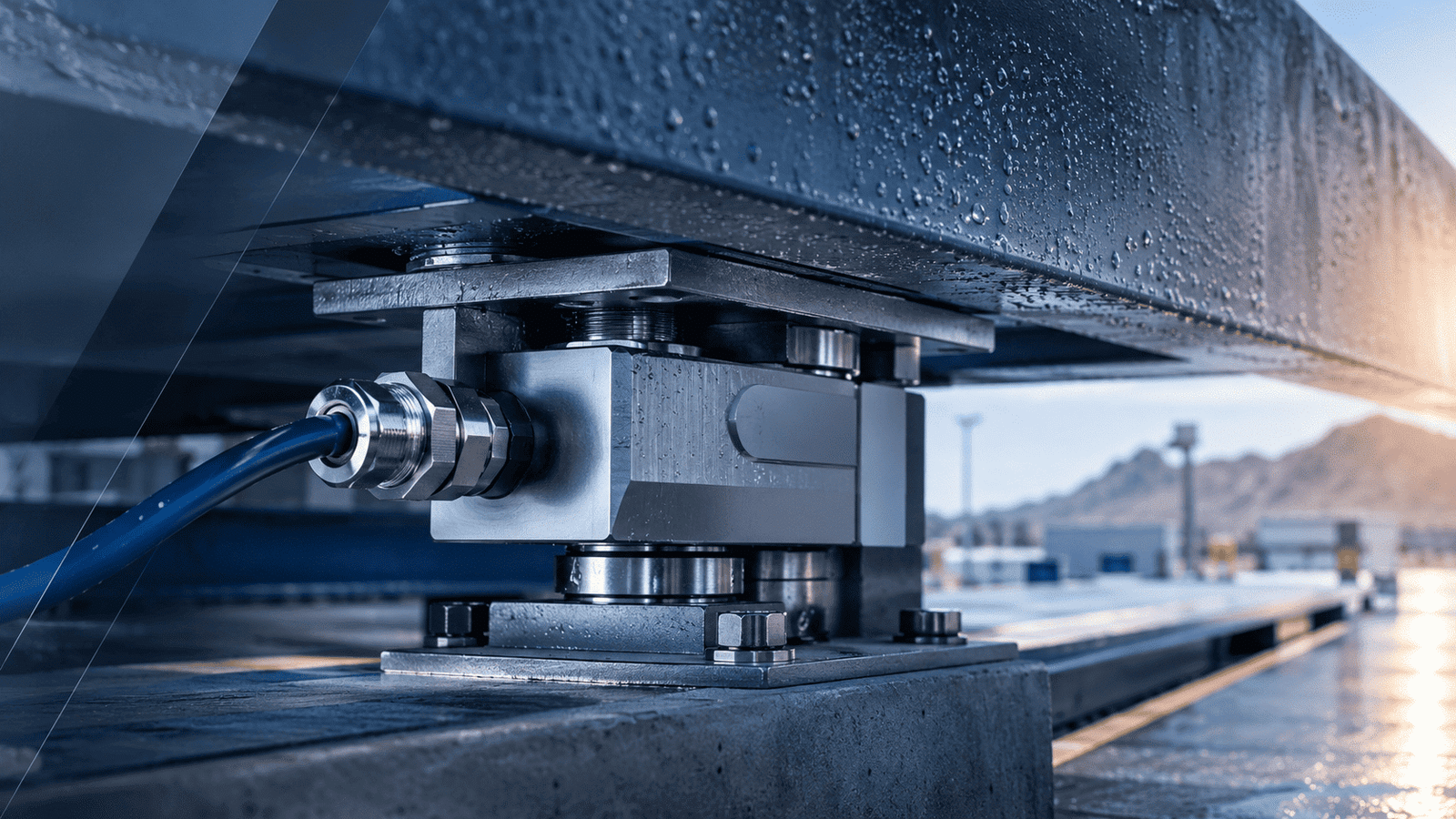
Error 4: Moisture in junction boxes and cable runs
Here's a figure worth knowing, with the right attribution. METTLER TOLEDO states that its historical service and repair data shows junction boxes are the leading cause of vehicle scale downtime across makes and models. The reason is simple: the boxes get opened for adjustments, which exposes sensitive connections to moisture and humidity, and errors and failures follow. That's a manufacturer's own service data, so read it as one credible source rather than a universal law. Still, it matches what we hear from service engineers everywhere.
The drift symptom
A display that wanders while the truck sits still is a classic sign of moisture somewhere in the load cell, cable or connection chain. Condensation inside a junction box is a common moisture problem, and humidity can corrode the copper in load cell cables and distort the signal. If your weights drift between morning and afternoon, why wouldn't you look there first?
Error 5: No plan for lightning and power surges
A lightning strike or a power surge can damage load cells, cables, junction boxes and other critical components, even on a properly grounded scale, according to METTLER TOLEDO's lightning protection notes. Storms are less frequent in much of the Kingdom than in wetter climates, but surges also arrive through the power supply, and a scale with no surge protection is one bad event away from a long outage. Ask any vendor what protects the load cells, the cables and the terminal, and ask what independent testing backs the claim.
04 Calibration and Compliance Errors: Where SASO and NMI Standards Come In
This is where common truck scale errors do their quietest damage. The hardware is fine, but the testing, records and legal verification aren't.
Error 6: Calibrating with a centred load and calling it done
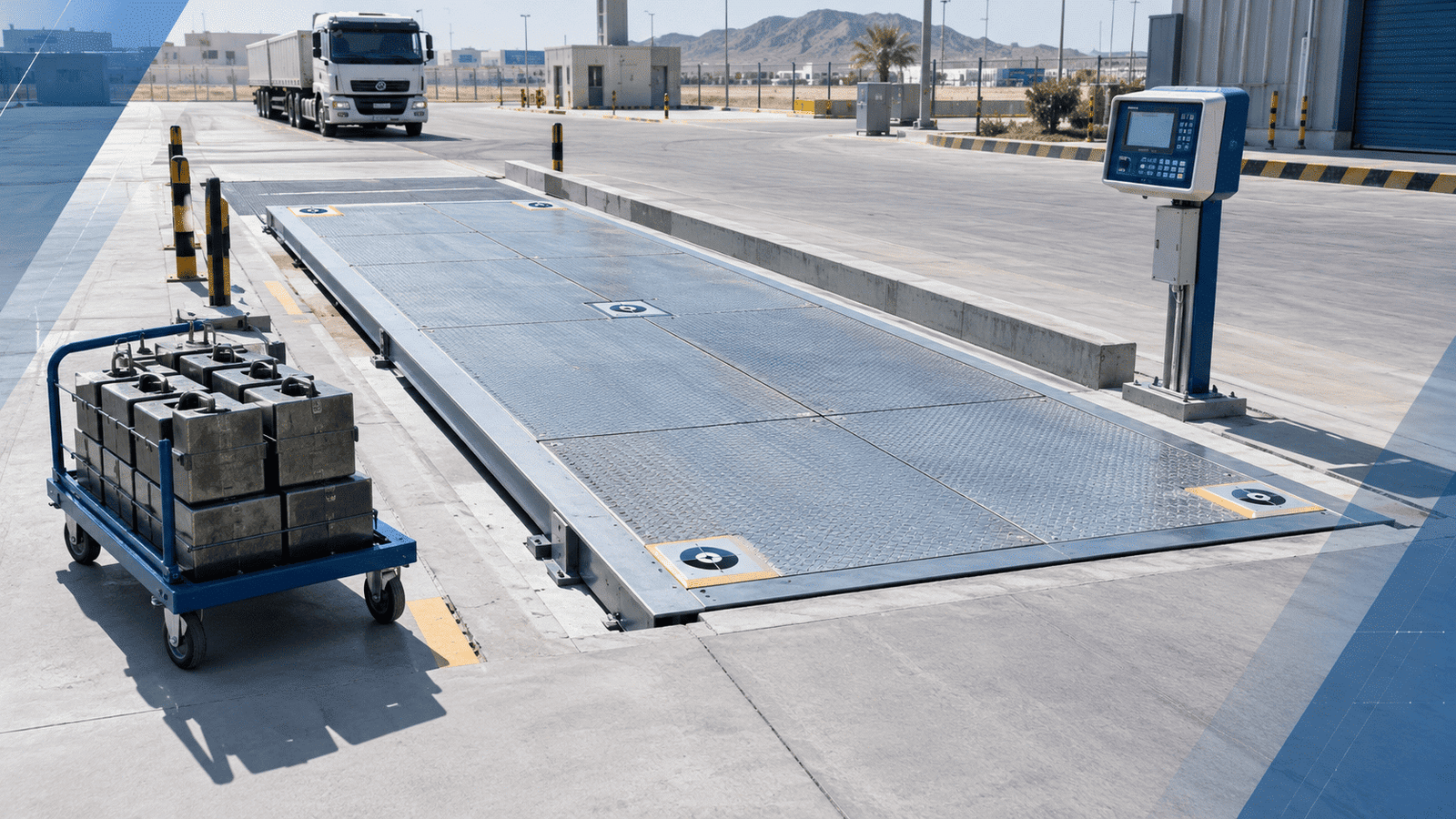
A scale can read correctly with a test load in the middle of the deck and still be wrong when the weight sits off-centre. That's an eccentric loading error, and trucks rarely park in the exact centre. A proper truck scale calibration should include corner tests, which means checking that weight is distributed evenly across the scale, plus a repeatability test to confirm the scale reads the same loaded weights consistently. If your last calibration certificate doesn't mention corner or section results, ask why.
Error 7: Treating SASO verification as paperwork
SASO runs the National Metrology Program, known as Taqyees, and Asharq Al-Awsat reports that establishments such as gas stations, commercial stores, food and catering centres and gold retailers must submit metrological verification requests through the Taqyees e-platform to avoid violations. The program covers technical tests and field verification for measuring instruments including commercial scales, and SASO has been qualifying private sector bodies to carry out verification work. Whether your particular truck scale falls under a given verification requirement depends on its category and use, so confirm the scope with SASO.
Then there's the tolerance trap. Australia's NMI R 76-1, which is based on OIML R 76-1, sets error limits on re-verification at twice those applied at initial verification. Read that carefully. A scale that passed on day one is allowed to be further off later and still pass an in-service check. Legal tolerance and commercial tolerance aren't the same thing, and if your margins are thin, you'll want to run tighter than the legal minimum.
The process errors that look like scale errors
Not every error lives in steel and wire. We often find the weighbridge is fine and the process around it isn't: a truck not fully on the platform, a reading captured before the display settles, a weight keyed in by hand, a wrong tare carried over from the last truck. None of these show up in a calibration test, because the scale did what it was told. Fixing them is mostly about layout, training and, where it makes sense, taking the human out of the loop with unattended weighing.
05 How the Right Truck Scale Design Removes Whole Categories of Error
Some errors are better designed out than maintained away. As Mettler Toledo's official partner in Saudi Arabia, Global Scales & Systems supplies and services systems built around that idea. Here's how specific design features line up with the errors above.
| Design feature | What It Actually Means for You |
|---|---|
| POWERCELL PDX load cell network with no junction boxes | Removes the component METTLER TOLEDO's own service data names as the leading cause of vehicle scale downtime |
| Hermetically sealed load cells, IP68 and IP69K class of protection (VTS107 specification) | Better resistance to moisture and washdown, which targets Error 4 directly |
| StrikeShield lightning protection | Multi-level protection for load cells, cables and terminal, so a surge is less likely to mean a long outage |
| Built-in load cell diagnostics | Continuous monitoring of environmental conditions and load cell performance, so drift gets flagged earlier |
| Periodic receiver care service | Worn receivers found and replaced before they damage cables or load cells |
“ No design removes the need for calibration, clean drainage, sound foundations and a sensible process. Good hardware shrinks your error list. It doesn't write it off. — Section 05
06 A Practical Routine to Catch Common Truck Scale Errors Early
You don't need a complicated programme. You need a habit. A simple routine looks like this:
- Weigh a known reference load on a schedule and log the result, so drift shows up as a trend instead of a surprise.
- Check the area under and around the deck for debris and standing water, and look at clearances around bumper bolts and check devices.
- Inspect junction boxes, cable entries and seals for moisture or damage.
- Review the last calibration report for corner, section and repeatability results, and don't stop at the final pass.
- Confirm your SASO verification status and records are current and easy to find.
How often should the deeper checks happen? There's no single right answer, because traffic, environment and the terms of your verification all matter. A thorough checkup roughly every six months as general good practice, which is a sensible starting point to discuss with your service provider, though it isn't a Saudi legal interval.
07 Choosing a Truck Scale Service Partner in KSA and the GCC
Look, if you're collecting quotes for truck scale maintenance right now, here's what to watch for. Ask whether corner, section and repeatability results are documented in every report. Ask who handles SASO verification and what happens if an instrument fails it. Ask where the spare load cells and receivers actually sit, because a scale that's down for weeks waiting on parts is a scale that's costing you. And ask whether the same team that installs the scale also services it.
Global Scales & Systems works as an industrial weighing partner across the GCC, with offices in Riyadh, Jeddah, Dammam and Dubai. Our job isn't to sell you a scale and disappear. It's to help you get the best out of your weighing investment: correct installation, disciplined calibration, clear compliance records and a service plan that keeps common truck scale errors from compounding. If you'd like a second pair of eyes on your weighbridge, we're glad to take a look.
08 FAQ: Common Truck Scale Errors
What are the most common truck scale errors?
The ones we see most are debris build-up under the deck, binding from worn check devices or settled foundations, worn load cell receivers and cables, moisture in junction boxes, surge or lightning damage, calibration that skips corner testing, and weak compliance records. Process mistakes such as partial platform loading and manual weight entry add to the list.
Why does my truck scale read differently from a roadside weigh station?
Several reasons are possible: drift from build-up or binding, an eccentric loading error, a calibration that wasn't tested across the whole platform, or a process issue like a truck not fully on the deck. Different instruments, conditions and test methods can also account for part of a gap. A documented comparison with a certified check weighment is the fastest way to find out.
What is the legal weight limit for a five-axle truck in Saudi Arabia?
The Roads General Authority's summary of the Saudi Highway Code, as reported by Riyadh Daily in September 2024, gives 45 tons for a five-axle truck. Limits and fines can vary by location and change over time, so verify the current rule before you rely on it.
What is a corner test on a truck scale?
It's a test where a known load is placed at different positions across the platform to check that the scale reads consistently wherever the weight sits. It exposes eccentric loading errors that a single centred test will miss.
Does my truck scale need SASO verification?
That depends on the instrument category and how it's used. SASO's Taqyees program handles metrological verification requests for measuring instruments including commercial scales, but you should confirm the scope for your specific truck scale with SASO. Global Scales & Systems can help you work out what applies and prepare the right records.
How often should a truck scale be calibrated in KSA?
We can't give one number that fits every site. Frequency depends on traffic volume, environment, how critical the weights are commercially, and any verification terms attached to your instrument. Discuss a schedule with your service provider and keep every report, including corner and repeatability results.
If you're planning a new installation or you suspect an existing one carries a few of the common truck scale installation errors above, talk to our team at Global Scales & Systems. From our offices in Riyadh, Jeddah, Dammam and Dubai, we help industrial sites choose, install and verify truck scale weighing systems, and we plan SASO and NMI compliance into the project from day one so the scale earns its keep from the first weigh-in.

 Click to start chat