
Checkweigher ROI in Industrial Packaging: How It Pays for Itself
A boardroom-ready cost-benefit model for operations directors who need to justify checkweigher capital spend to finance with real SAR numbers, payback periods, and the objections answered before they're raised.

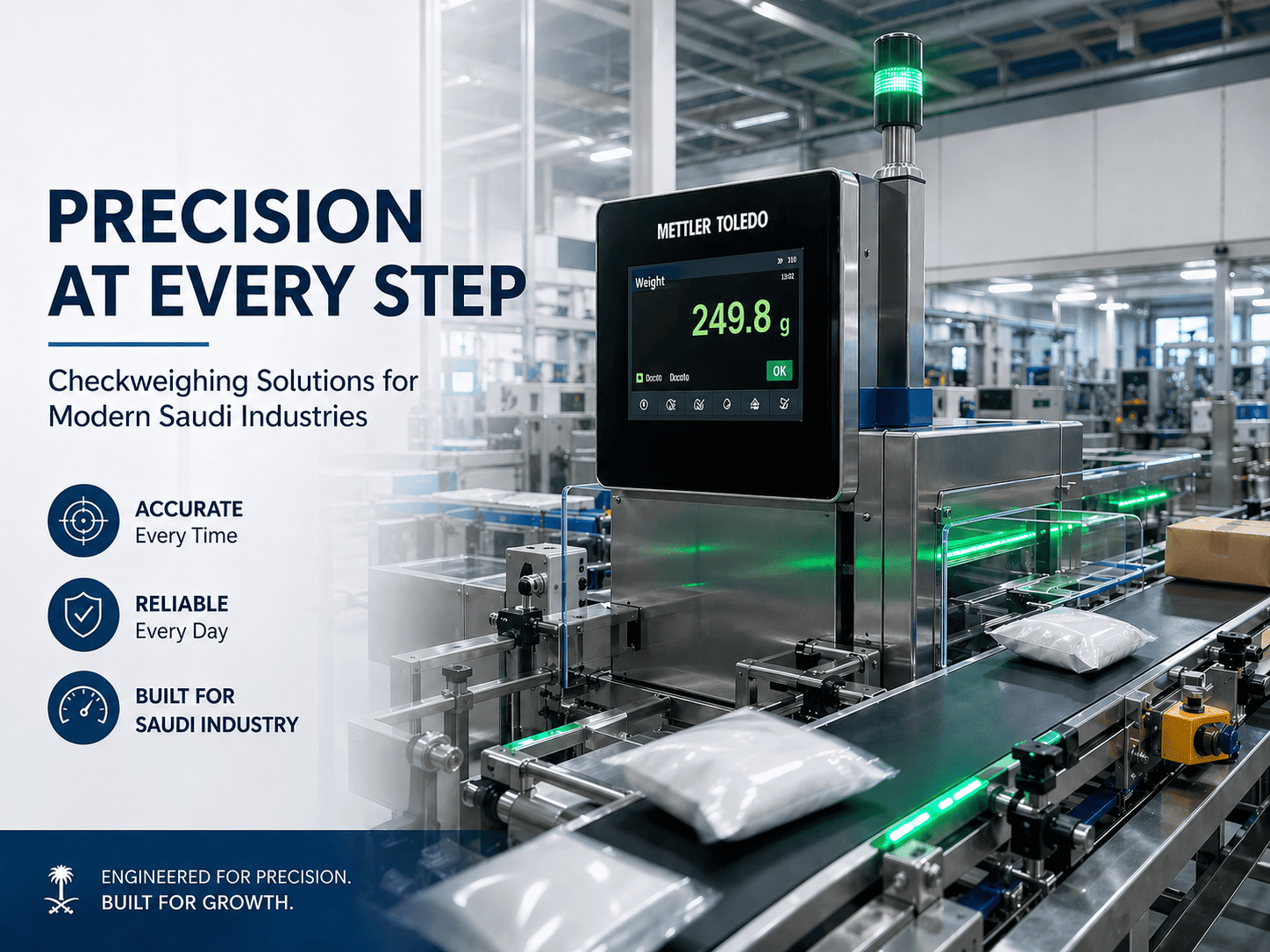
For every packaging line in every factory that is losing money right now. Not dramatically. Not in a way that shows up on a single invoice. But steadily, quietly, pack by pack, the give-away is compounding. Product overfilled by 1.5 grams here. A short-fill that triggers a retailer penalty there. A batch flagged during a SASO inspection that costs you a whole afternoon of rework. You will discover none of it feels catastrophic in isolation, and that's exactly why it never gets addressed. Until someone sits down and actually runs the numbers on checkweigher ROI, and suddenly the capital case writes itself.
This article is that exercise. We're going to walk through the full cost-benefit model, in SAR and USD, so that when you walk into a finance meeting or a board review, you're not asking for a checkweigher. You're presenting a business case with a payback period they can't argue with.
01 Why Industrial Packaging Lines Bleed Money Without a Checkweigher
Let's be direct about what's happening on an uncontrolled packaging line. Your filling machine has a tolerance. It's set to fill, say, 500g. But it doesn't hit 500g every single time. In practice, depending on the product (powder, granule, liquid, fragmented solid), your machine might swing 2 to 5 grams either side of target. Most production managers know this. What they often don't calculate is what that spread costs annually.
Here's a real-world worked example we use with clients across the GCC.
Say your line runs at 60 packs per minute. You run two shifts; 16 hours a day, 250 working days a year. That's 14.4 million packs per year. Your product costs SAR 30 per kilogram to produce. A 500g pack costs SAR 15 in raw material. If your average overfill is 2g per pack (which is actually conservative for many uncontrolled lines), your give-away loss looks like this:
| Variable | Value |
|---|---|
| Line speed | 60 packs/min |
| Operating hours | 16 hrs/day, 250 days/year |
| Annual pack volume | 14,400,000 packs |
| Average overfill per pack | 2g (on a 500g product) |
| Product cost | SAR 30/kg |
| Annual give-away loss | SAR 864,000 (~$230,000) |
SAR 864,000 per year. Wasted. Just on the overfill that nobody sees because it's spread across 14 million individual packs. And that's before you count short-fills, rejections, retailer chargebacks, or regulatory fines.
“ SAR 864,000 per year, wasted on overfill nobody sees because it's spread across 14 million individual packs. — Section 01
02 The Full Cost Stack: What You're Actually Losing
When we're building a checkweigher ROI case with a client, we look at five distinct cost categories. Finance directors are always surprised that give-away isn't even the biggest number.
1. Product Give-Away (Overfill Losses)
Covered above. This is the most quantifiable. It's pure product cost walking out the door in every pack that's slightly heavier than it needs to be. On high-value products: spices, pharmaceuticals, specialty chemicals; even 1g of overfill per pack can translate to hundreds of thousands of SAR annually.
2. Retailer Chargebacks and Trade Penalties
Major retailers across the GCC, and especially those aligned with GSAS and international private label standards, penalize suppliers for out-of-tolerance net content. Chargeback terms vary, but we've seen clients absorb SAR 50,000 to SAR 200,000 per year in retailer deductions before they could trace the root cause back to unchecked weight variation. That figure tends to concentrate people's minds.
3. Regulatory Non-Compliance Costs
In Saudi Arabia, SASO mandates that pre-packaged products comply with net quantity regulations. An inspection failure doesn't just mean a fine; it means product recall, destroyed stock, and the administrative cost of corrective action. We've seen smaller operations absorb six-figure losses from a single compliance event that a checkweigher would have caught before it left the line.
4. Manual Inspection Labor
Statistical sampling by a QC technician is not 100% inspection. Even a disciplined sampling plan at 1-in-100 packs misses a lot. A typical mid-range production facility running manual sampling spends SAR 120,000 to SAR 200,000 per year on quality labor that, when replaced with automated inline inspection, gets redeployed rather than eliminated.
5. Rework and Line Stoppages
When a short-fill or quality issue isn't caught inline, it gets caught later. In best-case scenarios, that means a rework run. In worst-case scenarios, it means destroying and remanufacturing packed product. The cost of a single rework batch on a high-speed FMCG line, including labor, material, and line time can easily run SAR 15,000 to SAR 50,000 per event.
Add these five categories together for a mid-size packaging operation and you're looking at total preventable losses of SAR 1.2 million to SAR 2.5 million per year. Honestly, that surprises people when they first see it laid out on a single page.
Common mistake
Most operations teams only quantify give-away loss when building a checkweigher case. That's the one number finance understands immediately, but it's rarely the largest cost. Retailer chargeback history and SASO non-compliance event logs often dwarf the overfill number. Pull those figures from your finance team before you build the ROI model. The case gets stronger, not weaker.
03 Checkweigher ROI: Building the Boardroom Model
Here's the model structure we recommend when presenting to a finance committee or operations board. Keep it to one page. Three columns: Cost Category, Annual Loss (Current State), Annual Saving (With Checkweigher). Then a fourth row for investment and payback. Finance committees approve single-page ROI models faster than they approve 20-page feasibility studies.
| Cost Category | Annual Loss (Est.) | Estimated Recovery |
|---|---|---|
| Product give-away (overfill) | SAR 864,000 | 60–80% (SAR 518K–691K) |
| Retailer chargebacks | SAR 100K–200K | 70–90% (SAR 70K–180K) |
| SASO non-compliance events | SAR 150K–500K | 85–95% (SAR 127K–475K) |
| Manual inspection labor | SAR 120K–200K | 40–60% redeployment value |
| Rework and line stoppages | SAR 75K–250K | 70–85% (SAR 52K–212K) |
| Total Preventable Loss | SAR 1.3M–2.15M | SAR 767K–1.56M recoverable |
Against an equipment investment of SAR 90,000 to SAR 250,000 (depending on throughput and configuration), a conservative payback period comes out at 4 to 14 months. That's the number you put in the executive summary. Finance committees understand payback periods. They approve capital when it's under 18 months.
“ A conservative payback period of 4 to 14 months. That's the number you put in the executive summary. — Section 03
04 Checkweigher Pricing in the GCC: What to Budget
Before you can close the ROI loop, you need a realistic investment figure. Here's a budget guide based on configurations we supply through Global Scales & Systems, Mettler Toledo's official partner in Saudi Arabia.
Note: Figures below are indicative budget ranges for planning purposes only. Final pricing depends on speed, product type, integration requirements, and site conditions. Contact us for a formal quotation.
| Configuration | Throughput / Use Case | Price Range (SAR) | Price Range (USD) |
|---|---|---|---|
| Entry-level static checkweigher | Low-speed lines, manual trigger | SAR 30,000–55,000 | $8,000–$14,700 |
| Inline automatic (mid-range) | Food, pharma, FMCG under 100 ppm | SAR 75,000–130,000 | $20,000–$34,700 |
| High-speed industrial | 200–600 ppm, multi-lane packaging | SAR 130,000–250,000 | $34,700–$66,700 |
| Harsh environment / HC Series | Petrochemical, cement, wet environments | SAR 180,000–350,000+ | $48,000–$93,300+ |
Most FMCG and food production clients in KSA fall in the SAR 75,000 to SAR 180,000 range. Against the loss figures above, that's a return of 4 to 1 in year one. And the machine keeps running for a decade.
05 Mettler Toledo Checkweigher Performance: What Global Scales Supplies
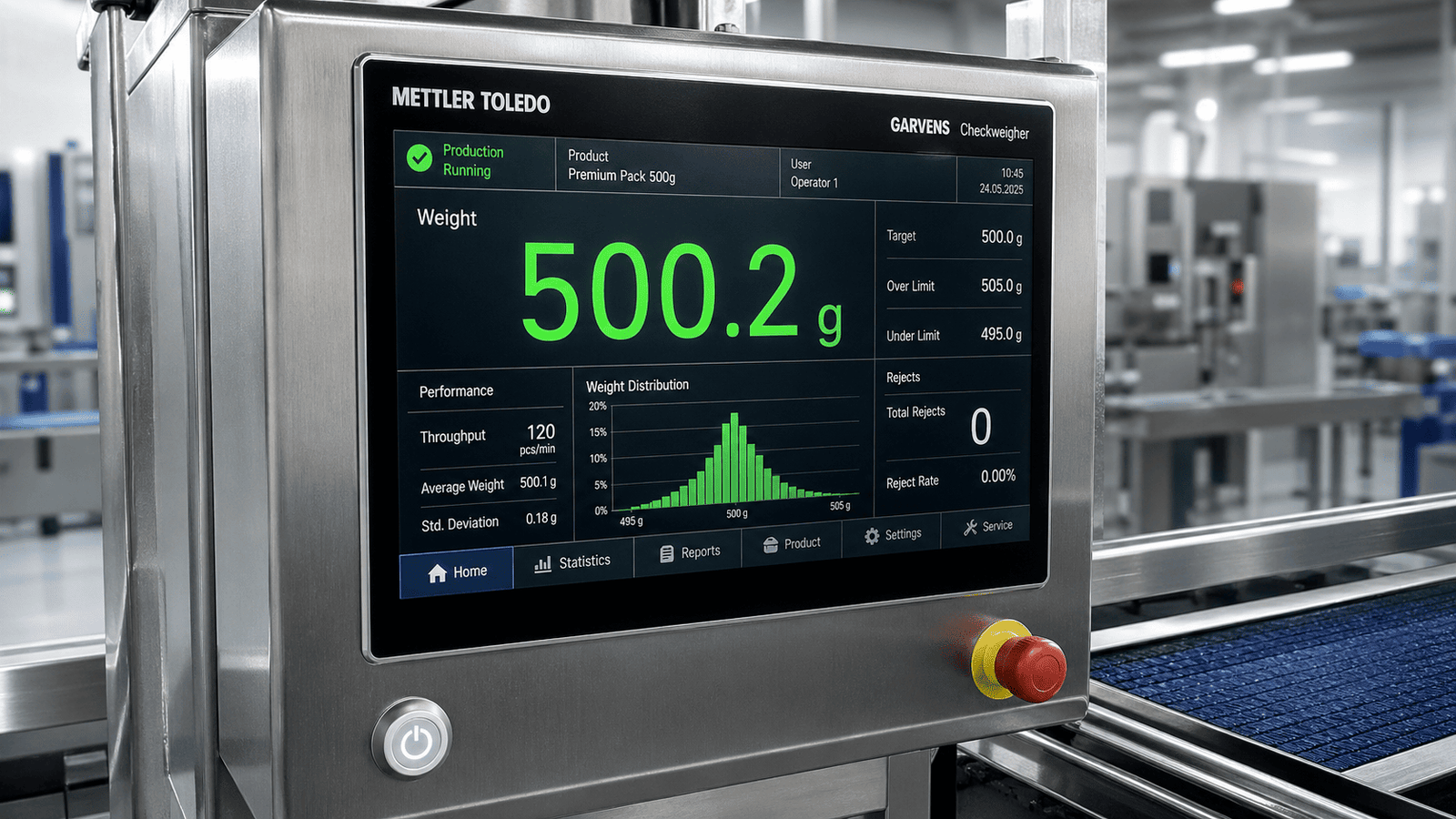
As Mettler Toledo's official partner in Saudi Arabia, Global Scales & Systems supplies the full range of MT inline checkweighers built for GCC industrial conditions. Here's how the key specs translate directly into financial outcomes.
| Feature | What It Actually Means for Your P&L |
|---|---|
| 100% inline inspection at rated line speed | No statistical gaps. Every pack is checked. Your give-away drops immediately from day one. |
| Automatic weight feedback to filler | The checkweigher talks to your filling machine in real time, correcting drift before it compounds. Give-away tightens continuously. |
| OIML and SASO-compliant precision | Your output is defensible in an inspection. No surprises during SASO audits or retailer quality visits. |
| OEE reporting and trend analytics | You can see drift developing before it becomes a problem. Predictive, not reactive. |
| IP-rated enclosures for harsh environments | In a facility operating at 40 to 50 degrees Celsius, with dust, moisture, or cleaning cycles, the machine keeps running. Downtime is not part of the ROI equation. |
| Rejection mechanism integration | Short-fills and over-limits are physically removed from the line automatically. No manual sorting, no missed rejects passing QC. |
One thing worth being clear about: the automatic weight feedback function is where the real money is. A checkweigher that only rejects is a cost reduction tool. A checkweigher that feeds data back to the filler and continuously adjusts your target weight is a margin expansion tool. The difference in annual give-away savings between a passive reject-only setup and an active feedback setup can be SAR 200,000 to SAR 400,000 on a single high-throughput line.
Pro tip
When specifying a checkweigher, always confirm whether it includes active filler feedback, not just rejection. A passive reject-only unit saves cost at purchase but leaves the largest portion of give-away savings on the table. The difference in annual savings between the two configurations typically outweighs the price gap within the first quarter of operation.
06 The Finance Director's Objections (and How to Answer Them)
We hear the same four objections in every capital approval conversation. Worth preparing for before you walk in.
"Can't we just tighten the filler calibration instead?"
You can, and you should. But a tighter filler target without 100% inspection downstream means you're relying on the filler never drifting. All filling machines drift. Temperature, humidity, wear, product density variation, all of it causes drift. A checkweigher catches drift continuously. Calibration alone doesn't.
"Our QC team already does sampling."
Sampling at 1-in-50 or 1-in-100 has an enormous statistical gap. If your short-fill rate is 0.5% of production, a 1-in-100 sample misses the majority of them. And a SASO inspector doesn't care about your sampling plan if the product on shelf is underweight.
"The line is only running at 70% capacity. We don't need it yet."
This one is backwards. At 70% capacity, you have more room to optimize. The give-away savings are real regardless of whether the line is running at full speed. And if you're planning to grow volume, which, if Vision 2030 supply chain investment is feeding your pipeline, you almost certainly are, installing now means the machine pays back before you scale up.
"What's the maintenance cost?"
For a Mettler Toledo inline checkweigher, annual service and calibration costs typically run SAR 8,000 to SAR 20,000 depending on configuration and contract type. That's included in the multi-year ROI model and doesn't materially affect the payback period.
“ Installing now means the machine pays back before you scale up, not after. — Section 06
07 Implementation: What to Expect on the Ground in KSA
Installation of an inline checkweigher in a Saudi industrial facility is typically a 3-to-5 day project. The key planning considerations are worth knowing upfront.
The physical integration into the conveyor line needs to be scoped in advance, including belt height, gap dimensions, and reject chute positioning. In older facilities, this occasionally requires minor civil works. Not common, but worth checking upfront.
Power supply requirements need to be confirmed. Most units run on standard 220V/50Hz, but high-speed variants may require a dedicated circuit. Your electrical contractor should verify this during the site survey.
Calibration and commissioning after installation typically takes one full day with a certified Mettler Toledo service engineer. This is where the machine gets set to your specific product parameters, rejection tolerances, and feedback loop thresholds. Don't skip this step or hand it to an uncertified technician. The accuracy certification from this session is your SASO documentation.
Training for your line operators takes half a day. The interface on MT checkweighers is straightforward, which operators appreciate. And the OEE reporting dashboard, accessed via the control panel or a connected PC is where your QC manager will want to spend time understanding trend data.
08 Frequently Asked Questions
The questions we get most often from operations and procurement managers evaluating checkweighers in the GCC.
How quickly does a checkweigher pay for itself?
For a mid-size food or FMCG packaging line in Saudi Arabia, the typical payback period is 6 to 14 months. High-throughput lines with expensive products can see payback in 3 to 5 months. The key driver is give-away reduction: the higher your overfill rate today, the faster the machine pays back.
What is the typical give-away reduction from installing a checkweigher?
In our experience working with clients across the GCC, automatic inline checkweighers with filler feedback typically reduce product give-away by 60 to 80% within the first month of operation. The continuous feedback loop to the filling machine progressively tightens the weight distribution around target.
Does a checkweigher help with SASO compliance in Saudi Arabia?
Yes, directly. SASO's pre-packaged goods regulations require that net content declarations are accurate within defined tolerances. A certified inline checkweigher running 100% inspection provides both the compliance mechanism and the audit trail to demonstrate conformity. It's the strongest single investment you can make for net content regulatory compliance.
What's the difference between a checkweigher and a filling machine calibration?
Calibration sets your filler's target. A checkweigher confirms every output and corrects drift in real time. They serve different functions and are not substitutes for each other. A well-calibrated filler running without a checkweigher will still drift, and you won't know until a sample inspection catches it, or a retailer does.
Can checkweighers integrate with our existing packaging line controls?
Yes. Mettler Toledo checkweighers support industry-standard communication protocols including OPC-UA, Modbus, and Ethernet/IP. Integration with your existing SCADA or production management system is standard. In most installations, the checkweigher feeds data directly into the production reporting layer with no custom development required.
Is checkweigher ROI only relevant for food and pharma?
Not at all. While food and pharma are the most commonly cited cases because of strict net content regulations, we work with clients across cement, chemicals, specialty materials, and industrial components who are experiencing identical give-away and compliance dynamics. Any industrial packaging operation where product is sold by weight is a candidate.
09 Making the Case: What Your Approval Document Should Include
If you're taking this to a finance committee or board approval, the document structure that works best has three sections.
First: the loss quantification. Run the give-away model with your actual line speed and product cost figures. Add chargeback and compliance cost estimates from your last 12 months of records. This is your "current state cost" baseline.
Second: the investment summary. One table. Configuration, price range, annual maintenance cost, installation estimate. Total capital requirement.
Third: the return model. Year 1 through Year 5. Year 1 net saving (savings minus investment). Years 2 through 5 cumulative return. Add a payback period line. That's it. One page. Finance directors approve single-page ROI models faster than they approve 20-page feasibility studies.
Global Scales & Systems builds these documents with clients. If you're at the pre-approval stage and need a customized model with your specific line parameters, reach out and we'll run the numbers together before you go into the meeting.
When you're looking at a piece of capital equipment, the question isn't really "can we afford to buy it?" It's "can we afford to keep running without it?" On that question, for most packaging operations across the GCC, the checkweigher ROI case is not even close.
Global Scales & Systems Co. Ltd is Mettler Toledo's official partner in Saudi Arabia and the GCC, supplying inline checkweighers, weighbridges, calibration services, and industrial weighing systems to manufacturing, food production, pharma, logistics, and resource sector clients across the region. Contact our team for a site-specific ROI assessment and quotation.

 Click to start chat