
9 Common Industrial Scale Installation Mistakes to Avoid
Common industrial scale installation mistakes can cost you accuracy and SASO compliance. See 9 costly errors across truck, platform and floor scales.

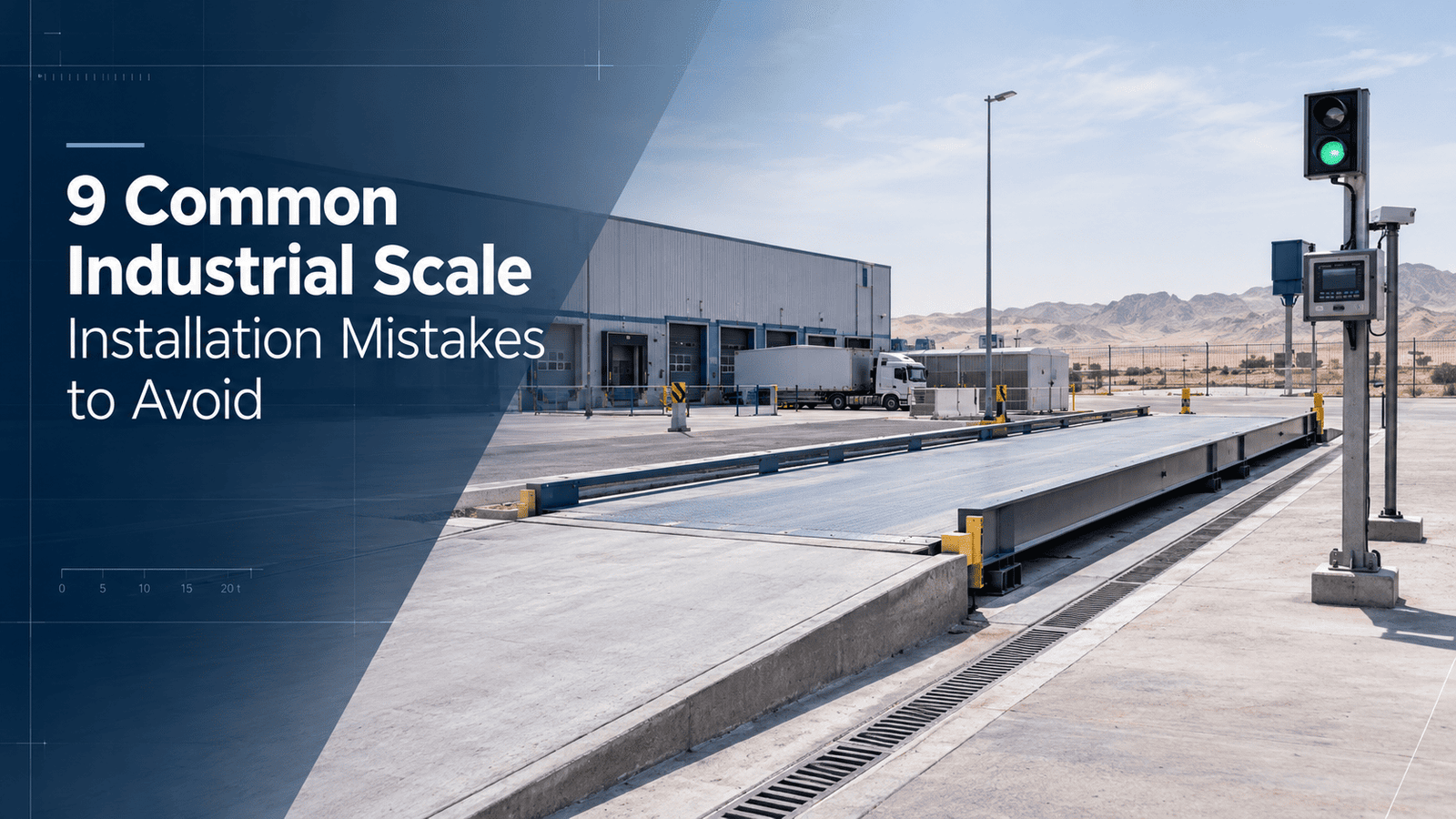
Picture a scale that passed its first weigh-in. Everyone signed the handover sheet, the contractor packed up, and the queue kept moving. Eight months later the same empty vehicle reads differently on consecutive mornings, a verification visit is two weeks away, and nobody can say whether the culprit is the slab, the load cells, or a cable somebody ran too close to the gate. Sound familiar?
Most of the common industrial scale installation mistakes behind that story are cheap to prevent on day one and painfully expensive to chase later. They hit truck scales, yes, but they hit platform scales, floor scales, and hopper or tank weighing systems just as often. Here are nine we keep seeing across the Kingdom, and what to do about each one.
01 Why Common Industrial Scale Installation Mistakes Show Up Months Later
A scale that reads correctly against test weights on handover day has proven one thing: it read correctly on handover day. It hasn't proven that the slab drains, that the cable is protected, or that the electronics will cope with a July afternoon. Installation errors work slowly. Concrete moves, water finds gaps, heat cycles the components, and a small offset turns into a dispute at the gate.
The day-one test hides slow problems
Here's the thing nobody in this industry likes to admit: a badly installed scale can look healthy for weeks. Drift, intermittent errors and failed verifications arrive long after the installer has left site, and by then the argument over who's responsible is harder than the fix. We keep seeing that argument play out, and nobody enjoys it.
Saudi conditions leave less room for error
Start with the weather. In July 2026 the National Center for Meteorology confirmed to Arab News that the temperature reached 50 C in Al-Ahsa, with much of the Eastern Province facing 49 to 50 degrees. Now compare that with the paperwork. OIML R 76 type certificates for non-automatic weighing instruments commonly list a temperature range of minus 10 to plus 40 degrees Celsius, and a July 2025 NMi Certin certificate is one example.
“ Air temperature isn't the whole story, because a steel deck sitting in direct sun can run hotter than the air above it. — Section 01
That doesn't make a certified scale unusable in Dammam or Al-Ahsa. It does mean you should read the certified range for your exact model, then plan shade, enclosure choice and cable routing around real site conditions.
02 Foundation and Site Mistakes
Mistake 1: Skimping on the foundation and the drainage
Of all the common industrial scale installation mistakes, this is the one that costs the most to undo. Truck scales get the attention here, and rightly so. Mettler Toledo describes the foundation as the lowest load-bearing part of the scale and says any imperfection can cause weighing errors and accelerated wear. Its engineering specifications go further, calling for a foundation that runs the full length and width of the platform, is reinforced in all load-bearing areas, and includes an approach at each end.
The foundation type matters too. Mettler Toledo lists three: pier, beam slab and pit. A pit must allow a minimum depth for a technician to reach components and can collect debris. In a webinar for scale buyers, the company adds that above-ground foundations can offer advantages for drainage, cleanout, and access to components, while pit-style foundations may be needed where space for vehicle approaches is limited.
Drainage is mandatory
In my experience, the Saudi version of this mistake is a pit that has no real plan for sand, dust and washdown water. Plan the drain before you pour, not after the first flooded service visit.
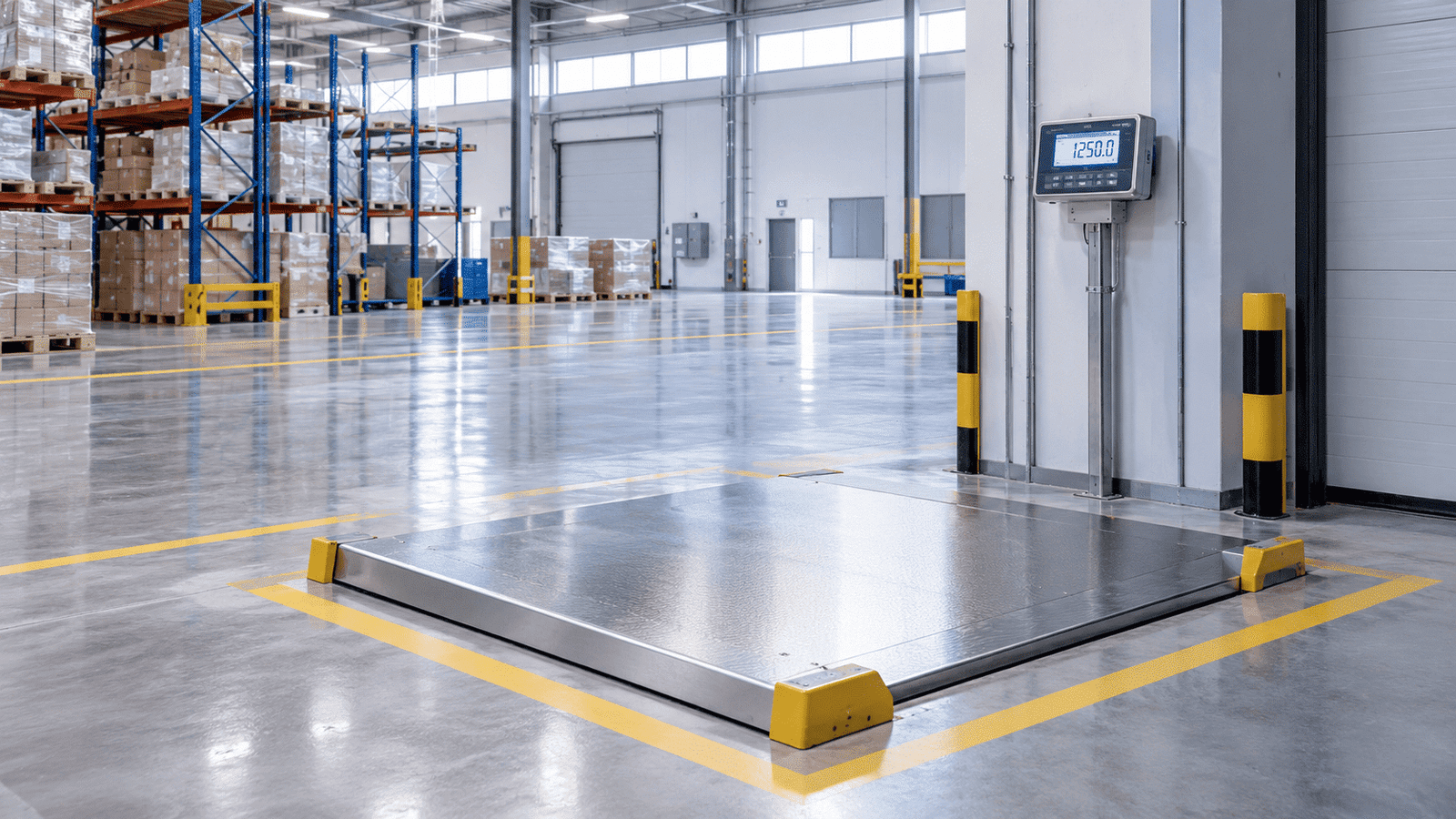
Smaller scales aren't immune. A floor or platform scale set into a pit needs a flat, square, drained recess, and a pit that isn't any of those gives you the same grief at a smaller size. One habit pays off on every project: have your scale supplier review the foundation drawing before concrete is ordered.
Mistake 2: Choosing the wrong spot for the scale
Location is one of the common industrial scale installation mistakes that no amount of calibration can fix. Put a floor scale next to a press, a conveyor drive or a compressor and you've bought yourself a noisy reading. Mettler Toledo's guidance for floor scales starts with flat, even ground that isn't affected by vibrations from surrounding machinery, and its quick guide for platform and bench scales lists a level floor with no vibration or drafts as a site requirement.
Then there's traffic. A scale sitting in a forklift route without protection will get hit eventually. Side guards that shield load cells from side impacts appear on industrial floor scales such as the 2256MS, and a protected scale beats a repaired one every time.
For weighbridges, think about the approach. Give vehicles a straight, level run onto the platform. If drivers have to turn or brake on the deck, you'll see it in your weights.
Mistake 3: Specifying for the brochure instead of the site
Heat, dust, washdown and hazardous areas decide which scale you should buy in the first place. Mettler Toledo notes that stainless steel floor scales suit heavy washdown and that hazardous area-approved versions exist. Even the junction box matters: the 2256MS data sheet lists a stainless steel AJB015 box rated IP65 and a cable-free AJB569-D rated IP69K, and those two ratings suit very different cleaning routines.
Check the certified temperature range, the ingress rating and any hazardous-zone requirement against the site before anything gets ordered.
03 Mechanical Mistakes Under and Around the Platform
Mistake 4: Letting something touch the scale
A weighing platform has to move, even if only by a fraction of a millimetre. Anything that touches it carries part of the load away from the load cells, and the error is invisible until it isn't. The usual suspects are debris packed into the gap, floor coatings or concrete that crept over the edge, conduit and hoses clamped to both the platform and the surrounding structure, and guard rails bolted to the wrong side.
Tank, hopper and silo systems add their own version. Rigid piping, ladders and conduit connected to a weighed vessel can carry load that never reaches the load cells, so the error changes with product level and temperature. Flexible connectors and free-hanging supports solve most of it. Walk the whole installation with a torch before handover and look for contact points, because they're easy to spot when you're hunting for them and almost impossible to find from a reading on a screen.
Mistake 5: Skipping level and load-sharing checks
Level is the first thing to check on a surface-mounted scale, and it takes minutes. Mettler Toledo's VLX floor scale card tells the technician to adjust the feet until the bubble in the level is centred. That's it. Yet we still find scales that were never levelled because the floor "looked flat."
Load sharing is the second check. Place the same test load at the centre and then at each corner of the platform, and compare readings. If they disagree, fix it before calibration, not after, because calibrating over a corner error just hides it at one spot on the deck.
04 Electrical, Cabling and Lightning Mistakes
Mistake 6: Exposed junction boxes and careless cable runs
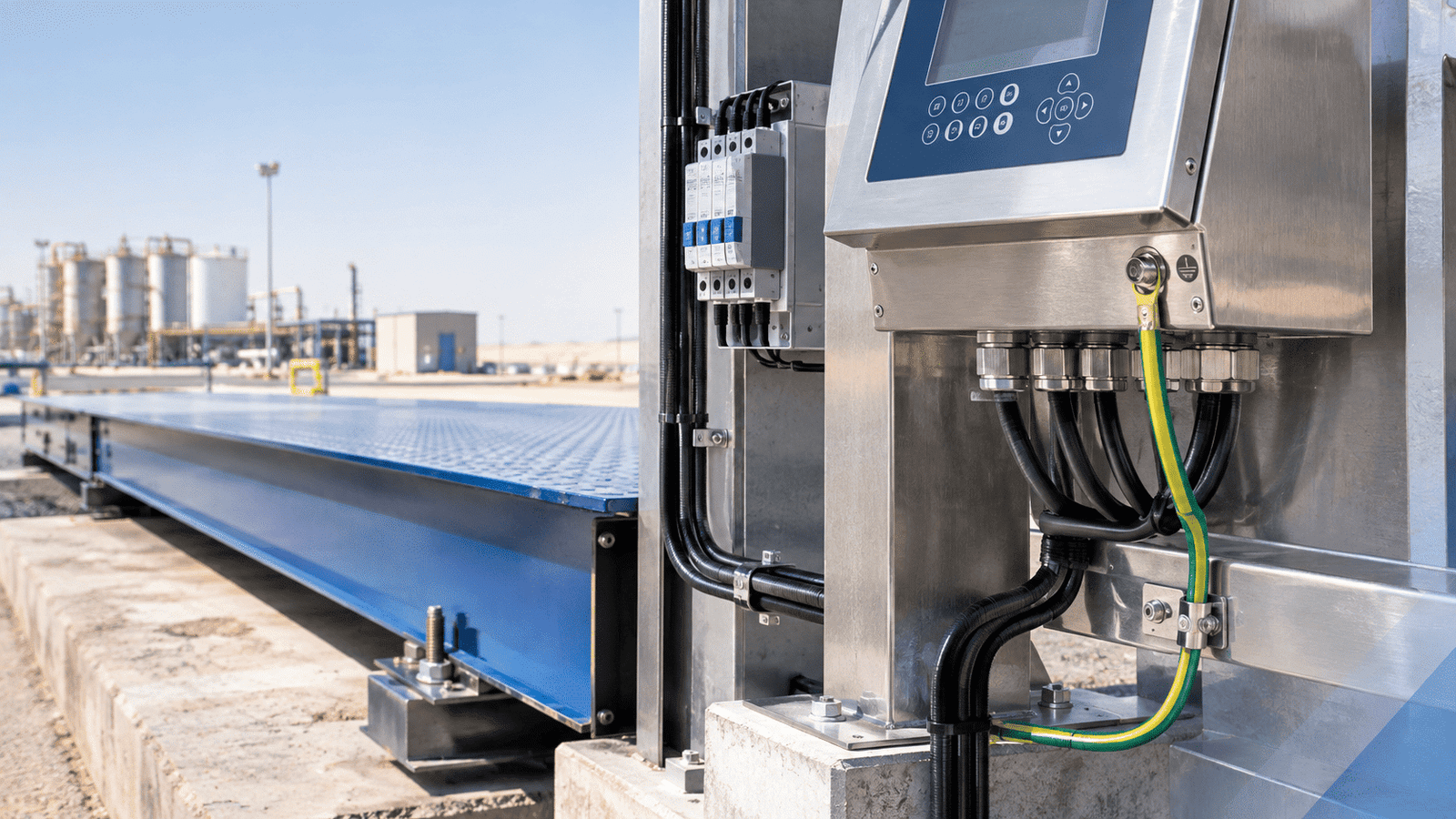
Cables are the quiet failure point, and cabling sits high on any list of common industrial scale installation mistakes. Mettler Toledo's own installation guidance for floor scales says to route the connection cable to the indicator so that it's protected from possible damage. Simple advice, often ignored. Cables lying where vehicles or forklifts run get crushed. Glands left loose let in water and fine dust. Signal cables bundled with heavy power cabling pick up noise that shows up as a reading that wanders.
The same goes for junction boxes on conventional analog systems. When Mettler Toledo launched its POWERCELL PDX system, it explained that junction boxes are wired at the construction site, exposed to the weather, and are the most common source of truck and rail scale failures. The fewer exposed connections you have, and the better you seal and protect the ones you can't avoid, the fewer weekend call-outs you'll fund.
Mistake 7: Weak grounding and no surge plan
Grounding looks like a minor detail until it isn't. Even the quick guide for a bench-style platform scale includes a step for securing the grounding cable to the grounding post, and larger systems deserve more attention, not less. A surge can damage load cells, cables, terminals and the PC at the end of the chain, and the repair bill rarely matches the price of doing grounding properly in the first place.
On the lightning side, Mettler Toledo reports that independent testing showed its POWERCELL PDX system with StrikeShield surviving lightning strikes up to 80,000 amperes. As Mettler Toledo's official partner in Saudi Arabia, Global Scales & Systems can specify that protection where the application calls for it.
05 Calibration and Setup Mistakes
Mistake 8: Rushing calibration and leaving setup on factory defaults
Setup errors are some of the most overlooked common industrial scale installation mistakes. Factory configuration isn't your configuration. Mettler Toledo's installation notes for its Spider VLF floor scales explain that the scale is configured at the factory with a set verification scale interval, which can be changed in service mode. So check capacity and scale interval against what your process needs and against what will be verified, before anyone touches a test weight.
Calibrating before the site is finished: Calibrate last. Not before the slab has fully cured, not before the cables are fixed and the enclosure is closed, and not before the area around the scale is finished. A calibration done on a half-built site describes a half-built site. Write down the as-left readings at handover, too, because they become the baseline for every future check.
Capacity and resolution that don't match the job: Why does this matter? Because an oversized scale reads coarsely at the loads you actually weigh, while an undersized one gets overloaded. Look at your typical load, your heaviest load and the tolerance you care about, then pick the capacity and division to suit.
06 Compliance Mistakes in Saudi Arabia
Mistake 9: Treating SASO and NMI compliance as paperwork after the install
Compliance is where common industrial scale installation mistakes become expensive in the Kingdom. A correct installation and a compliant installation aren't the same thing. SASO's own paper in the OIML Bulletin describes the TAQYEES legal metrology program as a lifecycle that runs through verification body licensing, type approval, initial verification, customs integration, market utilization, and ongoing verification and maintenance. The scope covers fuel dispensers, weighing instruments and utility meters, and the same paper reports that the program has facilitated verification of 100,000 weighing instruments since launch.
Buying an instrument without type approval: Per the same paper, type approval is how SASO confirms a measuring instrument model meets the technical and legal metrology requirements before it enters the market, and the customs integration step is meant to let in only instruments holding valid type approval and initial verification certificates.
Using the scale before initial verification: Initial verification confirms each instrument's accuracy and conformity before its first use. The scale isn't ready for commercial weighing just because it reads sensibly.
Breaking seals without a maintenance permit: Swapping a load cell, replacing a terminal or opening a sealed enclosure can break a metrological seal. The program issues maintenance permits for work that requires opening seals, and it requires post-maintenance verification afterwards.
Forgetting periodic verification and stickers: Periodic verification re-checks instruments at defined intervals. In the TAQYEES workflow the owner registers the organization, branches and instruments on the platform, selects a licensed verification body, pays the fee, books a visit, and receives a certificate and a verification sticker. Per the paper, that sticker carries a QR code that inspectors, businesses and consumers can scan for verification status and validity.
07 A Pre-Commissioning Checklist
Here's a quick reference you can hand to your contractor and your operations team. It covers every scale type, from weighbridges to floor, platform and hopper systems.
| # | Mistake | What goes wrong | What to do before handover |
|---|---|---|---|
| 1 | Weak foundation or poor drainage | Weighing errors, accelerated wear, flooded pits | Review the foundation drawing with your supplier before concrete is ordered; plan drainage |
| 2 | Wrong location | Vibration noise, impact damage, poor approach | Choose flat, vibration-free ground; protect from traffic; allow a straight approach |
| 3 | Specified for the brochure | Corrosion, ingress, wrong hazard rating | Match temperature range, IP rating and zone rating to the site |
| 4 | Something touching the scale | Hidden load paths, errors that change with level | Check clearances; use flexible connections on vessels |
| 5 | No level or load-sharing check | Readings that change with load position | Level the scale; compare centre and corner readings |
| 6 | Exposed cables and junction boxes | Intermittent faults, water ingress | Protect and seal every run; keep signal and power cables apart |
| 7 | Weak grounding, no surge plan | Damage to cells, cables and terminals | Document the grounding scheme and surge protection |
| 8 | Rushed calibration or default setup | Wrong capacity or interval, weak baseline | Calibrate last with traceable weights; record as-left readings |
| 9 | Compliance as an afterthought | Rejected instrument, idle scale, seal problems | Confirm type approval; book initial verification; calendar periodic verification |
Pro tip: Questions worth asking your installer
Before you appoint anyone, ask a few direct things: Who reviews the foundation drawing? Which scale types have they installed, beyond truck scales? How do they handle grounding and surge protection? What does their handover pack include, and who coordinates verification? Look, if you get vague answers to three of those four, keep looking.
08 Frequently Asked Questions
What are the most common industrial scale installation mistakes?
The most common ones are a weak or poorly drained foundation, a poor location, specifying the wrong scale for the environment, objects touching the platform, skipped level and load-sharing checks, exposed cables, weak grounding, rushed calibration, and treating compliance as an afterthought.
Do platform and floor scales need the same care as truck scales?
The scale is smaller, but the logic is the same. Flat ground, no vibration, a protected cable run, correct setup and a verified result matter just as much on a floor scale as on a weighbridge. Mettler Toledo's own floor scale guidance begins with flat, even ground away from vibration.
Can I install an industrial scale myself?
Some smaller units come with simple instructions, but installation guides for industrial scales are written for trained technicians, and legal-for-trade scales still need verification. For anything large, outdoors or used for trade, bring in a qualified team and plan the verification at the same time.
Does a new scale in Saudi Arabia need verification before use?
Under the TAQYEES lifecycle described by SASO, initial verification is performed before an instrument's first use, and instruments are re-verified periodically afterwards. Exact requirements depend on the instrument category and application, so confirm with SASO or a licensed verification body.
What happens if I replace a load cell or open the seals?
Work that requires opening metrological seals needs a maintenance permit, and the instrument has to go through post-maintenance verification before it returns to service. Tell your maintenance team before they start.
How often should an industrial scale be re-verified?
Periodic verification happens at defined intervals, and the interval depends on the instrument and its use. Ask your licensed verification body for the schedule that applies to your scale, and run your own routine accuracy checks between official visits.
If you're planning a new installation or you suspect an existing one carries a few of the common industrial scale installation mistakes above, talk to our team at Global Scales & Systems. From our offices in Riyadh, Jeddah, Dammam and Dubai, we help industrial sites choose, install and verify weighing systems, and we plan SASO and NMI compliance into the project from day one so the scale earns its keep from the first weigh-in.

 Click to start chat