
Common Mistakes in Industrial Scale Installation and Setup: 7 Costly Errors That Quietly Eat Your ROI
From premature foundation pours and rigid load cell mounts to unverified handover packs; how to prevent the civil, mechanical, and SASO/Taqyees compliance errors that cost Saudi plants millions in rework and downtime.

Saudi Arabia | Weighbridges, Truck Scales & Commissioning
The truck is loaded, the driver’s waiting, and the indicator reads 200 kg light. Nobody notices for three weeks. By then you’ve under-billed forty-two loads, your dispatch clerk has stopped trusting the printout, and the calibration certificate in the site office is dated eleven months ago. That’s how most weighing failures actually arrive, not with a bang, but as a slow drift nobody owns.
Here’s the uncomfortable part. In our experience across plants from Dammam to Jeddah, the scale itself is rarely the problem. The common mistakes in industrial scale installation and setup happen long before anyone presses a button: a foundation poured to the wrong drawing, a load cell bolted down rigid, a junction box sitting in a puddle, a calibration signed off with borrowed test weights. Each one is cheap to prevent and brutal to fix.
This is what we’ve learned watching those mistakes get made, and paid for.
01 Why Installation Errors Cost More Than the Scale Itself
Start with the money, because that’s what gets a plant manager’s attention.
The global industrial weighing equipment market was valued at USD 5.5 billion in 2025 and is projected to reach USD 8.8 billion by 2033, growing at 6.1% CAGR, according to Grand View Research. Weighbridges and truck scales alone account for roughly 34% of product-type share, per Future Market Insights. That’s a lot of steel going into the ground across the region; and a lot of it going in badly.
Now the local picture. Saudi Arabia’s logistics market reached USD 55.29 billion in 2025 and is forecast to hit USD 83.41 billion by 2034 at a 4.67% CAGR, per IMARC Group. The transport and logistics sector overall climbed to SAR 188.3 billion in 2025 and is projected at SAR 355.6 billion by 2030, according to Argaam sector analysis.
More tonnage moving means more weighings. More weighings means every percentage point of scale error compounds faster than it used to. A 0.5% error on a 40-tonne load is 200 kg. Run that across a busy gate and you’re not talking about a rounding issue anymore; you’re talking about a line item.
And the fix is never just the part. It’s the part, plus the crane, plus the civil crew, plus the re-verification, plus the days the gate was down.
The Mistake Nobody Budgets For: Treating Installation as a Delivery
Procurement teams are measured on unit price. Installation gets bundled into “supply and install” and awarded to whoever’s cheapest on the day. Then the deck arrives, the civil contractor has already poured to a drawing from a different revision, and everyone stands around pointing at each other in 46°C heat.
We keep seeing this. The scale is a capital asset with a fifteen-to-twenty-year design life. The installation is the thing that decides whether you get fifteen years or fifteen months.
“ The scale is a capital asset with a fifteen-to-twenty-year design life. The installation is the thing that decides whether you get fifteen years or fifteen months. — Section 01
02 Site Preparation Errors: Your Foundation Decides Everything
If you only fix one thing on this list, fix this one. Everything downstream inherits the foundation’s problems.
Pouring Before the Deck Drawing Is Frozen
The single most expensive mistake we see. A weighbridge foundation isn’t a slab; it’s a dimensional commitment. Anchor bolt positions, pit depth, drainage falls, approach ramp gradients, the gap between deck and apron. Get any of those wrong and you’re not adjusting, you’re demolishing.
The sequence should be: confirm the exact model and deck length, get the manufacturer’s foundation drawing stamped against that model, then pour. Not the other way around. We’ve watched a site re-pour an 18-metre foundation because the delivered deck was 500 mm longer than the civil package assumed. That’s not a variation order. That’s a month.
Ignoring What the Ground Does When It Gets Wet
The Eastern Province doesn’t get much rain. When it does, it arrives fast and it goes wherever gravity says. A pit-mounted weighbridge with a drainage fall running the wrong way becomes a sump. Water sits under the deck, humidity climbs inside the junction boxes, and eighteen months later you’re replacing load cells and wondering why.
Surface-mounted decks avoid the pit problem but introduce another: the approach slab. If the apron settles differentially from the deck, every truck that crosses the joint delivers a shock load to the load cells. You’ll see it as repeatability drift long before you see a crack.
Forgetting the Trucks Have to Get There
Turning radius. Queue length. Whether a 6-axle trailer can straighten out before it hits the deck. Whether the driver has anywhere to go after weighing. These sound like traffic engineering, not metrology; but a scale that trucks approach at an angle gets side-loaded, and side load is a load cell’s least favourite thing.
We’ve seen a perfectly good weighbridge deliver garbage readings for a year because the approach was 1.5 metres too short and every truck arrived mid-turn.
Curing Time Treated as a Suggestion
Concrete reaches design strength on a curve, not a calendar. Loading a foundation early; even with an empty deck; introduces settlement you’ll never fully calibrate out. If the programme is tight, the answer is a longer programme, not a faster cure.
Common mistake
Pouring civil works to a preliminary drawing or loading green concrete early to hit a gate-opening deadline. Confirm the exact model and stamped manufacturer foundation drawing before pouring, and allow full design concrete cure before placing the deck.
03 Load Cell Alignment and Mounting Pitfalls
Load cells are precision instruments that only work when the force arrives exactly where the manufacturer intended. Everything else is a slow-motion failure.
Off-Centre Loading
The force has to pass through the cell’s central axis. When it doesn’t, you get uneven strain, hysteresis, and readings that don’t repeat. The scale will still display a number. It’ll just be a number you can’t defend.
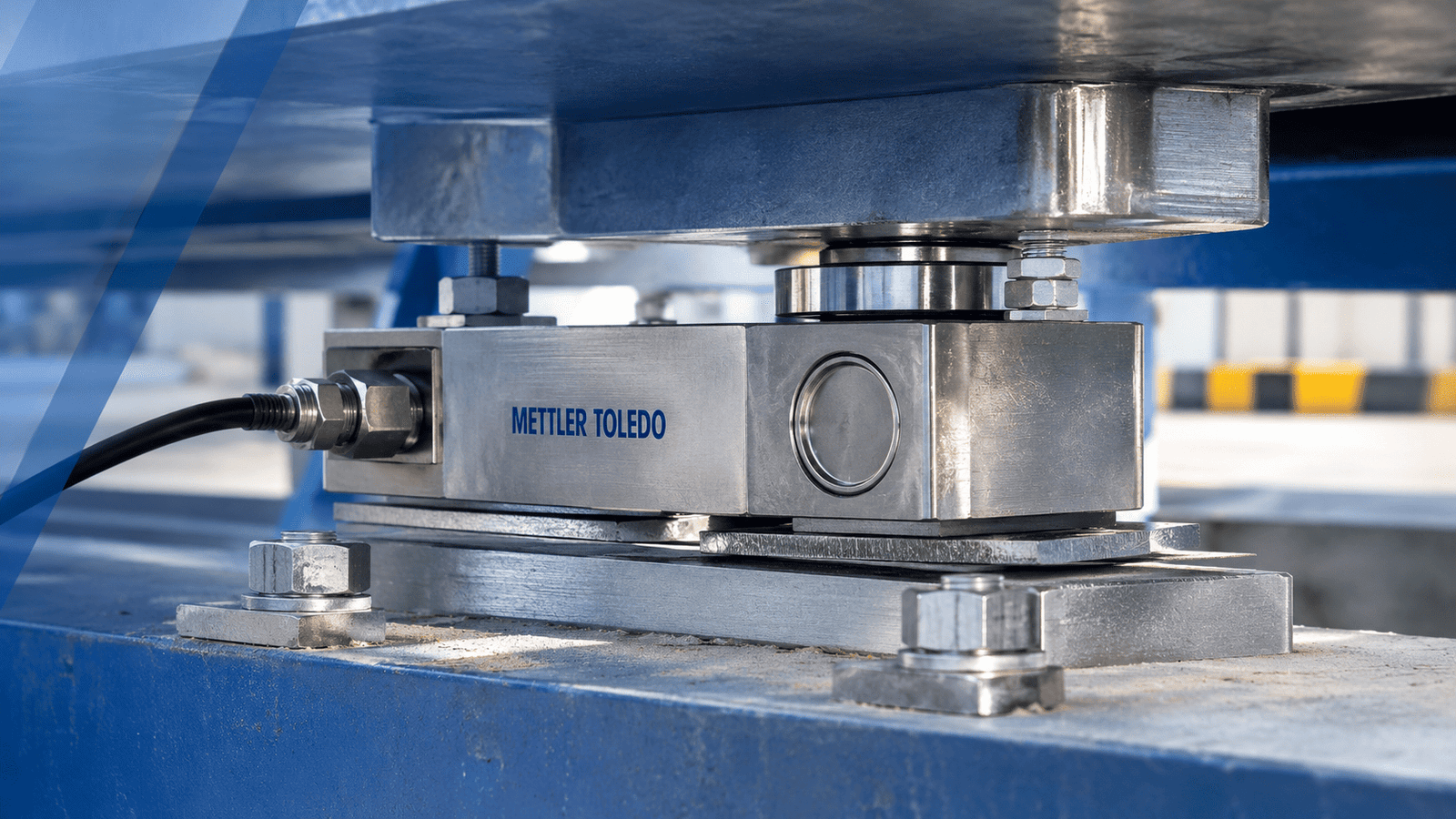
The fix is mechanical, not electronic: self-aligning load buttons, spherical washers, guided load introduction. Proper mounting kits exist for exactly this reason. Use them.
Rigid Mounting in a Place That Moves
Steel expands. Concrete moves. A deck in direct Saudi sun can swing through a significant temperature range between 5 a.m. and 2 p.m. If the load cells are bolted down with no allowance for that movement, the expansion has to go somewhere; and it goes into the cell as binding, torque, or zero drift.
This is why floating mounts and sliding bearings exist. A weighbridge needs to be able to breathe in the horizontal plane while staying rigid vertically. Get that backwards and you’ll chase a zero that won’t hold, all year, in every season.
Uneven Contact Surfaces
A load cell sitting on a base that isn’t flat, level, and clean is a load cell under stress concentration. It’ll read fine at commissioning and start drifting within months as the contact point fatigues. Check flatness. Shim where needed. Clean the mounting area before the cell goes down, not after.
Cable Strain and the Routing Nobody Documents
Load cell cables get pulled tight, bent at sharp angles, and zip-tied to whatever’s nearby. Then the deck moves and the cable takes the load instead of the cell. Or moisture wicks in through a compromised gland and you get an intermittent fault that only appears at 3 a.m.
Leave a service loop. Route away from vibration. And write down where the cables actually went, because the next technician won’t guess right.
EMI From the Obvious Sources
Welding sets, VFDs, high-power cables running parallel to signal cable. We’ve seen a scale read perfectly until the adjacent conveyor starts, then jump 40 kg. Shielded cable, separate routing, single-point grounding. Boring, and non-negotiable.
04 Wiring, Junction Boxes and the Grounding Oversights
This is the least glamorous section of the article and the one that causes the most callouts.
Junction Boxes Specified for the Wrong Environment
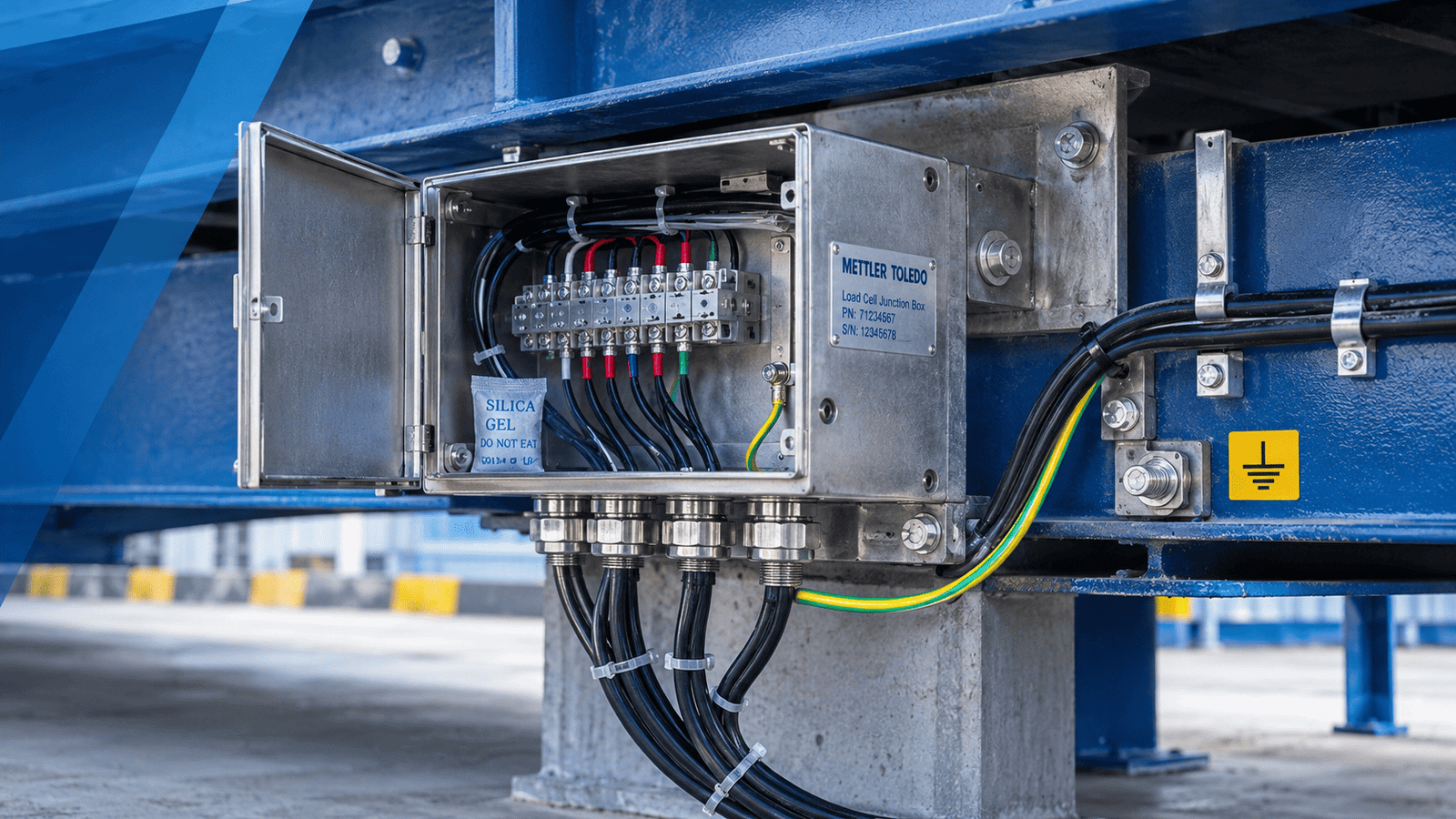
A standard IP65 box is fine in a covered plant. It is not fine on a weighbridge deck in a coastal industrial zone where washdown, dust, and salt air all arrive together. Water gets in, the summing board corrodes, and the whole system starts reading low and drifting.
Specify the box for the actual environment, mount it where water can’t pool, and use the desiccant. Then check it at every service visit; not just when something breaks.
Grounding Done Once, Badly
Proper grounding is a system, not a rod in the dirt. The indicator, the junction box, the deck, and the building earth all need to sit at the same potential. Get it wrong and you get circulating currents, noise on the signal, and a scale that behaves differently depending on what else is running.
No Surge Protection, in a Country With Lightning
Saudi Arabia gets thunderstorms, and an industrial yard is a large conductive structure with cables running into a control room. A lightning strike nearby induces a surge down the load cell cabling and takes out cells, junction boards, and sometimes the indicator.
This is why Mettler Toledo builds StrikeShield lightning protection into POWERCELL PDX load cells. It’s not a marketing line; it’s the difference between a storm you sleep through and a storm that costs you a week.
Digital vs Analogue, and the Summing Problem
Analogue systems sum every load cell’s signal in a junction box. One wet cell drags the whole system’s reading down, and you find it by disconnecting cells one at a time. Digital load cells like POWERCELL PDX report individually, so the system tells you which cell is failing before it fails. On a multi-cell weighbridge, that’s the difference between a planned swap and an unplanned outage.
05 Pre-Commissioning and Calibration Failures
You’ve built it properly. Now the part where people cut corners because the gate needs to open.
Confusing Calibration With Verification
These get used interchangeably in conversation, and that’s a problem. Calibration is the technical act: comparing readings against traceable reference weights and adjusting the instrument. Verification is the legal step: a recognised body confirms the instrument meets the Kingdom’s requirements and issues the certificate that makes it legal for trade.
Saudi Arabia’s legal metrology system runs on that distinction. The Law of Measurement and Calibration, issued under Royal Decree No. M/51 in 2013, gives SASO authority over statutory calibration. Beneath SASO sits the National Measurement and Calibration Center, the country’s reference-level metrology authority since 1986, per GULFMET.
A scale can be perfectly calibrated and still not legal for trade. Plenty of sites learn that the hard way.
Calibrating on Top of an Unresolved Fault
If a load cell is binding, a junction box is wet, or the deck is fouling the pit wall, calibration is theatre. You’ll adjust the span to compensate for a mechanical problem, get a passing number, and watch it walk away within weeks.
Fix the hardware first. Then calibrate. Then verify.
Test Weights That Aren’t Traceable
Borrowed weights, uncalibrated weights, weights that have been sitting on a pallet in the yard for four years. If the reference isn’t traceable, the certificate isn’t worth the paper. This is the first thing an auditor asks about and the most common gap we find.
Skipping the Tests That Catch Real Problems
A proper commissioning run isn’t one load in the middle of the deck. It’s zero, then increasing load, then decreasing load, then eccentricity; front, back, left, right; then repeatability, then return to zero. OIML R76 sets out the test regime for non-automatic weighing instruments, including temperature effects, eccentricity, discrimination and repeatability, per the OIML R76-1 recommendation.
Most commercial weighbridges in the Kingdom sit in OIML Accuracy Class III. That class exists because of the load ranges and conditions these instruments actually work under. It is not a licence to skip the eccentricity test.
Ignoring Temperature Effects Until Summer
A scale commissioned in January at 18°C and never re-checked will behave differently in August at 48°C. OIML R76 includes a dedicated temperature-effects test for a reason. If your commissioning report doesn’t reference ambient conditions, ask why.
“ A scale can be perfectly calibrated and still not legal for trade. Fix the hardware first, then calibrate, then verify. — Section 05
06 The Compliance Layer Most Installations Get Wrong
Installation doesn’t end at “it weighs.” It ends at “it’s legal.”
Type Approval Is Not Your Instrument’s Approval
A new weighbridge model entering the Kingdom needs a National Type Approval Certificate before it can go into service. Per Taqyees, SASO’s Legal Metrology Program, that process currently runs around SAR 5,000 with a stated turnaround of 10 business days.
Here’s the trap. Type approval covers the model. It does not cover your installed instrument, and it does not replace verification once the scale is in service taking real loads.
Periodic Verification Has a Clock on It
Taqyees requires periodic verification of instruments in service, and the validity of that verification is one year. One year. Not “whenever the audit is coming.”
There’s a detail in the same service conditions that catches people out: moving a weighing device off accuracy class II to another site after verification causes it to lose its legal characteristics. Relocate a verified scale without re-verifying, and you’ve got an unverified scale with a certificate that no longer applies.
The Interval You Choose vs the Interval You’re Given
The statutory minimum is one thing. What your site actually needs is another. As a working baseline we recommend a full recalibration at least annually for standard industrial use, tightening to every six months for high-throughput sites; busy logistics hubs, quarries, construction yards where trucks cross the deck dozens of times a day.
And some events should trigger an immediate re-check regardless of the calendar: the deck has been moved or re-set, any load cell, junction box or indicator has been repaired or replaced, the site has seen flooding or severe weather, readings have started drifting against a known reference, or a SASO audit is approaching.
07 What a Proper Handover Actually Looks Like
The last mistake is the quietest one: accepting a scale that works today with no evidence it’ll work in three years.
A handover pack should contain as-built drawings that match what’s in the ground, the foundation design and pour records, load cell serial numbers mapped to positions, the commissioning test results including eccentricity and repeatability, the calibration certificate with traceable test weight references, the verification certificate, junction box and cable routing documentation, spare parts list, and a named contact for service.
If any of that is missing, you don’t have a commissioned scale. You have a scale that happens to be switched on.
Feature to Outcome: What the Spec Actually Buys You
| Feature | What it actually means on your site |
|---|---|
| POWERCELL PDX 10-year warranty | No calibration-related load cell replacement surprises for a decade; the warranty outlasts most maintenance contracts |
| Built-in predictive diagnostics | The system flags a degrading cell before it fails, so you replace on a planned shutdown instead of a Friday night |
| StrikeShield lightning protection | A nearby strike doesn’t take out your cells, your junction board and your gate for a week |
| Digital load cells, individually addressed | No summing junction to mask a wet cell; you know which one is bad, first time |
| IND9U unattended terminal, IP69K stainless | Washdown and dust don’t kill the terminal; drivers weigh in and out without a gatekeeper |
| DataBridge software (SS/MS/ES) | Up to 50% faster transaction processing, and weight data lands in your ERP instead of a clipboard |
As Mettler Toledo’s official partner in Saudi Arabia, Global Scales & Systems supplies and commissions these systems; but the honest point is simpler than the brand. The spec only pays off if the foundation, the mounting, the wiring and the verification are done to match it.
What Each Mistake Actually Costs
Indicative market estimates for budgeting only; not a quotation. Real figures move with deck size, site access, and scope.
| Failure | Typical trigger | Indicative cost (SAR) | Indicative cost (USD) |
|---|---|---|---|
| Foundation re-pour, 18 m surface deck | Deck delivered before civil drawing sign-off | 85,000–180,000 | $23,000–48,000 |
| Full load cell replacement, 8-cell weighbridge | Water ingress or lightning surge | 28,000–65,000 | $7,500–17,000 |
| Junction box and cabling rework | Wrong IP rating, no surge protection | 6,000–18,000 | $1,600–4,800 |
| Re-verification after failed initial verification | No traceable test weights on site | 4,000–12,000 | $1,100–3,200 |
| Lost throughput, per day | Unplanned scale outage at a busy gate | 15,000–60,000 | $4,000–16,000 |
Read that table again and notice the pattern. The cheapest line item is the one that happens most often, and the most expensive one is almost always caused by a decision made in a meeting six months earlier.
08 Getting It Right the First Time
Look; if you’re getting three quotes right now, here’s what to watch for. Ask each vendor for the foundation drawing tied to the exact model they’re quoting. Ask who pours, who sets the anchor bolts, and who signs off the levels. Ask what test weights they’ll bring and whether the calibration is traceable. Ask whether the price includes initial verification through Taqyees, or whether that’s your problem afterwards.
The answers separate the suppliers from the installers. And they’ll tell you, before you sign, whether you’re buying a weighing system or a delivery.
“We say this with full confidence; على المكشوف, transparently; because we’ve been called in to fix both kinds. The ones installed properly rarely call us. The ones installed cheaply call us every year.”
Global Scales & Systems; Engineering & Commissioning TeamPro tip
Never sign off a weighbridge handover without a complete dossier: stamped as-built drawings, foundation pour logs, load cell serial maps, OIML R76 eccentricity and repeatability test sheets, traceable calibration certificates, and initial Taqyees verification documentation.
09 FAQ: Industrial Scale Installation and Setup in Saudi Arabia
How long does industrial scale installation take in Saudi Arabia?
A surface-mounted weighbridge typically runs four to eight weeks from foundation pour to verification, depending on concrete cure, deck size, and how fast Taqyees verification can be scheduled. Pit-mounted decks and sites with difficult access run longer. Floor scales and platform scales are usually a single day plus calibration. The foundation cure is the part people underestimate; it can’t be compressed without consequences.
Is SASO certification required for truck scales in Saudi Arabia?
Yes, if the scale is used for commercial transactions. The model needs a National Type Approval Certificate, the installed instrument needs initial verification before it enters service, and it needs periodic re-verification thereafter. Verification validity is one year. Operating an unverified scale in trade exposes you to fines and can hold shipments at a customs gate.
What’s the difference between calibration and verification?
Calibration is the technical comparison against traceable reference weights, with adjustment as needed. Verification is the legal confirmation by a recognised body that the instrument meets the Kingdom’s requirements, which produces the certificate or sticker that makes it legal for trade. You need both. A calibrated scale that hasn’t been verified is still not compliant.
Why do my scale readings drift in summer?
Almost always thermal. Steel decks expand, foundations move slightly, and load cells see temperature swings well beyond what a January commissioning captured. Rigid mounting makes it worse, because expansion has nowhere to go except into the cell as binding. Floating mounts, self-aligning load buttons, and a temperature-effects check at commissioning all reduce it. If drift persists, suspect a mechanical fault before you touch the calibration.
Can I move a verified scale to another site?
You can move it, but it loses its legal characteristics. Taqyees states that transferring a weighing device off accuracy class II to another site after verification causes it to lose legal status. In practice, any relocation means re-verification at the new location before commercial use. Budget for it in the project, not after.
How often should a weighbridge be calibrated?
Annually is the working baseline for standard industrial use, and every six months for high-throughput sites. On top of that, recalibrate immediately after any load cell, junction box or indicator work, after the deck is moved or re-set, after flooding or severe weather, or whenever readings disagree with a known reference load. Calibrating on top of an unresolved hardware fault wastes everyone’s time.
What IP rating should a weighbridge junction box have?
It depends on the environment, not on a default. A covered indoor installation can work with IP65. An exposed deck in a coastal or dusty industrial zone needs considerably more, and the mounting position matters as much as the rating; a well-sealed box sitting in a puddle still fails. Match the enclosure to washdown, dust and salt exposure, then inspect it at every service visit.
10 Plan Your Scale Installation or Site Audit With Our Engineers
Planning a new weighbridge or troubleshooting an existing installation that won’t hold zero? Our engineering and metrology teams in Riyadh, Jeddah, and Dammam handle civil drawing sign-off, Mettler Toledo POWERCELL PDX commissioning, traceable calibration, and initial Taqyees verification from start to handover.
Planning a Weighbridge or Industrial Scale Installation?
Get stamped foundation drawings, turnkey mechanical commissioning, and SASO/Taqyees verification support from our engineers in Riyadh, Jeddah, and Dammam.
Book an Installation ConsultationNeed traceable calibration or troubleshooting for an existing truck or floor scale? Explore our accredited calibration and weighbridge solutions.
Explore Calibration Services
 Click to start chat