
How to Calibrate a Weighbridge in Saudi Arabia: A Complete, Reliable 7-Step OIML Guide
A step-by-step OIML guide covering SASO/NMI compliance, test procedures, calibration frequency, and legal metrology for industrial truck scales in KSA.

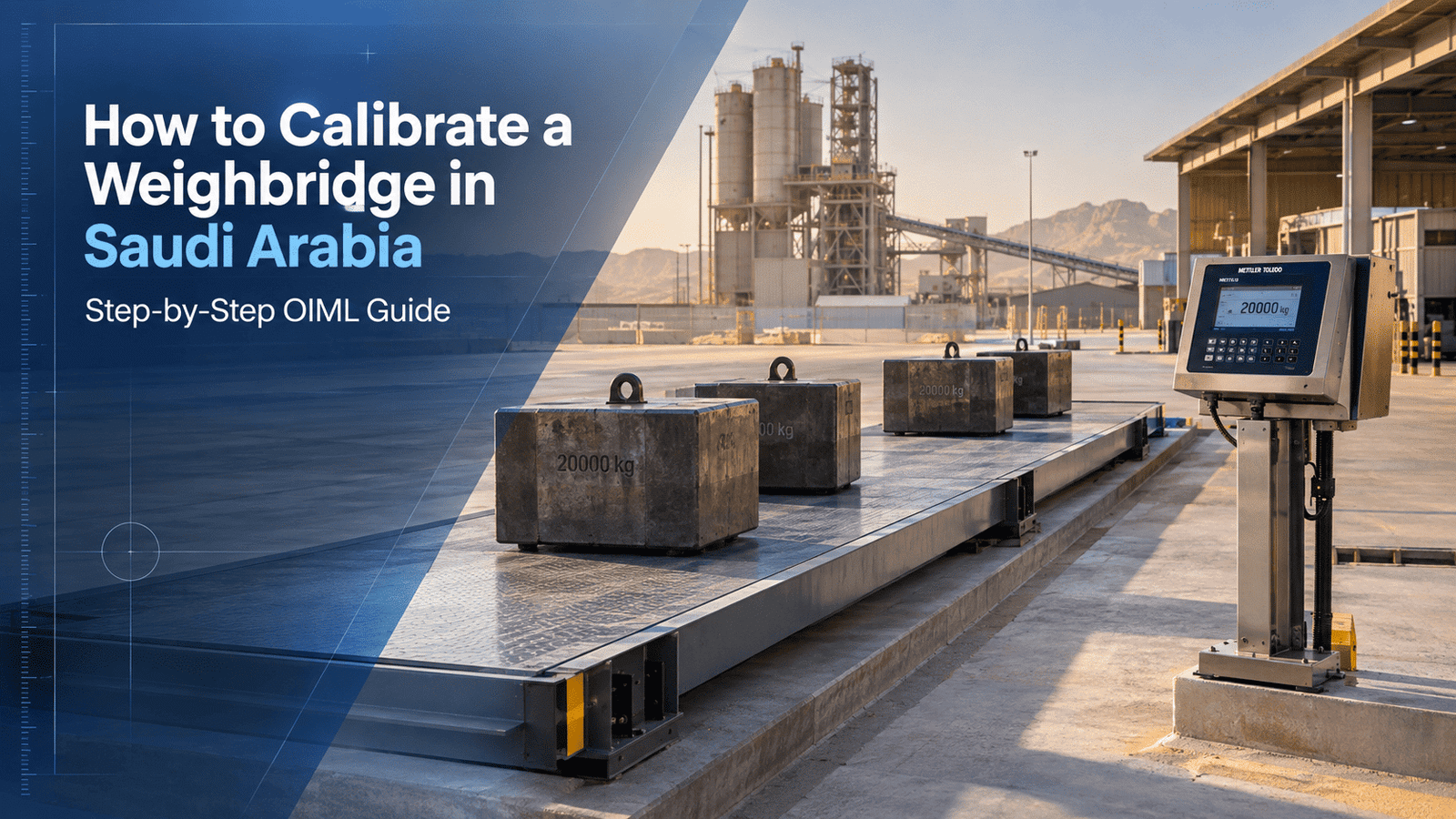
A truck rolls onto your weighbridge, the indicator settles, and the number it shows becomes a legal record the moment it prints. That number decides what your customer pays, what your logistics team reports, and whether your facility passes its next SASO inspection without a fine attached. If you've ever wondered how to calibrate a weighbridge properly in Saudi Arabia, and not just have someone glance at it once a year, this guide walks through the actual OIML-aligned process, step by step, the way we run it in the field across the Kingdom.
In our experience working with operations teams from the Eastern Province to Riyadh, most weighbridge problems don't start with a broken load cell. They start with a calibration that was rushed, skipped, or done by someone without traceable reference weights. Here's the thing nobody in this industry likes to admit: a weighbridge can look perfectly fine, display a clean round number, and still be wrong by a margin that costs you real money or gets your certificate rejected at audit.
01 Why "Calibration" and "Verification" Get Confused
Look, these two words get used interchangeably in casual conversation, and that's a problem when you're trying to stay compliant. Calibration is the technical process of comparing your weighbridge's readings against certified reference weights and adjusting the system so those readings are accurate. Verification is the legal step that follows: a SASO-recognized body confirms your calibrated instrument meets the Kingdom's approved technical requirements and issues the label or certificate that makes it legal for trade.
“ Calibration is the technical process. Verification is the legal step that makes it legal for trade. — Section 01
Saudi Arabia's legal metrology system runs on this distinction. The Law of Measurement and Calibration, issued under Royal Decree No. M/51 in 2013, gives the Saudi Standards, Metrology and Quality Organization (SASO) authority over statutory calibration in the Kingdom. Underneath SASO sits the National Measurement and Calibration Center (NMCC), which has functioned as the country's reference-level metrology authority since it was established in 1986, according to the Gulf Association for Metrology (GULFMET). NMCC's laboratories are internationally accredited under ISO/IEC 17025:2017 and cover more than 245 measurement services, spanning mass, temperature, dimension, and electrical quantities, per figures published through the Asia-Pacific Metrology Programme.
That's the chain of authority a proper calibration sits inside. It's not a formality, and honestly, that's the part most vendors gloss over when they're trying to close a sale.
02 Where Saudi Arabia's Weighbridge Standards Actually Come From
SASO doesn't write its own weighing standards from scratch. As a member of the International Organization of Legal Metrology (OIML), it aligns its technical requirements for weighing instruments with OIML R76, the international recommendation governing non-automatic weighing instruments, which is the formal category that weighbridges and truck scales fall under. OIML R76 sets out the metrological and technical requirements these instruments must meet, including how they're classified by accuracy (Class I, II, III, and IIII), and it standardizes the test methods used to prove an instrument performs correctly, covering weighing performance, temperature effects, eccentricity, discrimination, repeatability, and several other conditions, according to the official OIML R76-1 recommendation.
In practice, most vehicle weighbridges operating commercially in the Kingdom, whether at a logistics depot, a cement plant, or a port terminal, fall under OIML Accuracy Class III. That classification isn't arbitrary. It reflects the load ranges, resolution, and operating conditions these instruments actually work under in the field.
Saudi Arabia's own enforcement arm for this is Taqyees, SASO's National Standardization and Calibration Program. Taqyees was launched under the National Transformation Program 2020 and handles the legal metrological control, initial verification, and periodic re-verification of measuring instruments used in commercial exchange, weighbridges included, according to Taqyees's own published FAQ. If you're bringing a new weighbridge model into the Kingdom for the first time, it needs a National Type Approval Certificate before it can enter service, and that process currently costs around 5,000 SAR with a stated turnaround of 10 business days, per Taqyees's official service page.
Common mistake
We keep seeing this same issue with new operators, particularly in fast-growing sectors: they assume a weighbridge is compliant because it's a recognized brand. Type approval covers the model. It doesn't cover your specific installed instrument, and it doesn't replace periodic verification once the scale is in service and taking real loads, day after day, in 45°C summer heat.
03 How Often Does a Weighbridge Actually Need Calibration?
There's no single number stamped into Saudi law that applies to every site, and I wouldn't be surprised if you think there is . What Taqyees does require is periodic verification of instruments in service, on top of the initial verification a new weighbridge undergoes before commercial use. Beyond that statutory minimum, the interval you choose should reflect how hard the scale actually works.
As a general baseline across the region, we mostly recommend a full recalibration at least once a year for standard industrial use, tightening to every six months for high-throughput sites such as busy logistics hubs, quarries, or construction yards where trucks cross the deck dozens of times a day. On top of a fixed schedule, a handful of events should trigger an immediate re-check regardless of when the last one happened:
- The weighbridge has been physically moved or the platform has been removed and reinstalled
- Any load cell, junction box, or indicator has been repaired or replaced
- The site has experienced flooding, an earthquake tremor, or unusually severe weather
- Readings have started drifting or disagreeing with a known reference load
- The facility is approaching a SASO audit or a customer compliance review
“ Calibrating on top of an unresolved hardware fault is a waste of everyone's time. — Section 03
Heat is a genuine factor here too, and it's one that gets underestimated. Ambient temperatures regularly climb past 45°C across the Eastern Province and Central Region in summer, and that kind of sustained thermal load places real stress on load cells and electronic components over time, which is exactly why OIML R76 includes a dedicated temperature-effects test in the first place.
04 How to Calibrate a Weighbridge in Saudi Arabia: The Step-by-Step Process
This is the part most guides skip over or oversimplify. A proper calibration isn't "drive a loaded truck over it and see what the screen says." It's a sequence of specific tests, each one designed to catch a different type of error. Here's how it actually runs.
Step 1: Pre-Calibration Functional Check and Warm-Up
Before any weight goes near the platform, the technician lets the system power on and stabilize, typically for around an hour, so the electronics settle to their normal operating temperature. During this window, every load cell, junction box, cable connection, and the indicator or software display gets a visual and functional inspection. Anything loose, corroded, or throwing an error code gets flagged and fixed before testing continues. Calibrating on top of an unresolved hardware fault is a waste of everyone's time, and it produces a certificate that won't hold up anyway.
Step 2: Select Certified, Traceable Test Weights
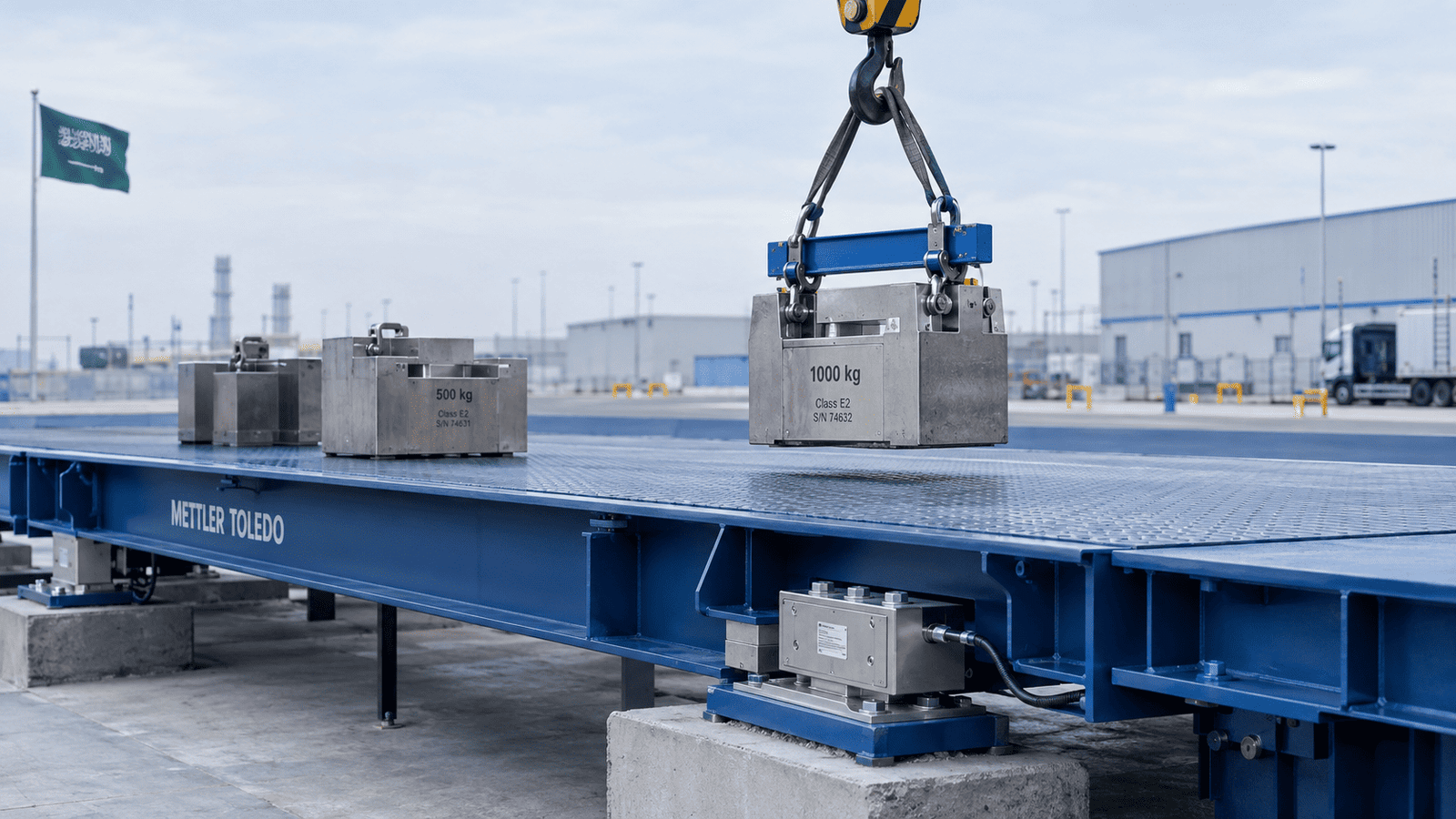
The technician then brings in certified reference weights, or in the case of larger capacity weighbridges, a certified test truck loaded with weights of known, documented mass. These reference weights need to be traceable back through SASO's NMCC to the national measurement standard. Weights that aren't traceable, or that have exceeded their own recalibration interval, invalidate the entire exercise before it starts. This is one of the fastest ways to spot a shortcut provider: ask to see the traceability certificate for their test weights, not just their own calibration certificate.
Step 3: Set Zero and Run the No-Load Check
With no load on the platform, the system is set to true zero. This sounds trivial and it isn't. A weighbridge that's drifted off zero will carry that error across every single weighing it performs afterward, whether the truck on it weighs two tonnes or forty.
Step 4: Run the Weighing Performance Test
Reference weights are applied in progressive stages, starting light and building up toward the scale's maximum capacity, with the indicated reading recorded and compared against the known applied weight at each stage. This is the core OIML R76 weighing performance test, and it's where you find out whether the instrument tracks accurately across its full working range, not just at one convenient load point.
Step 5: Run the Eccentricity (Corner and Section) Test
A weighbridge deck typically rests on multiple support points, and each one needs to read consistently regardless of where a vehicle's axles happen to land on the platform. The eccentricity test applies a known load to each corner or section of the deck individually and checks that every point produces a matching reading. This is the test that catches a tilted platform, an unevenly settled foundation, or a load cell that's quietly underperforming compared to its neighbors, none of which would necessarily show up if you only ever tested the center of the deck.
Step 6: Run the Repeatability Test
The same load gets applied and removed several times in a row, with the reading recorded on each pass. If the numbers bounce around instead of landing consistently, something in the mechanical or electronic chain is unstable, and that instability will show up as inconsistent trade weights the moment real trucks start crossing the scale.
Step 7: Adjust, Re-Verify, and Certify
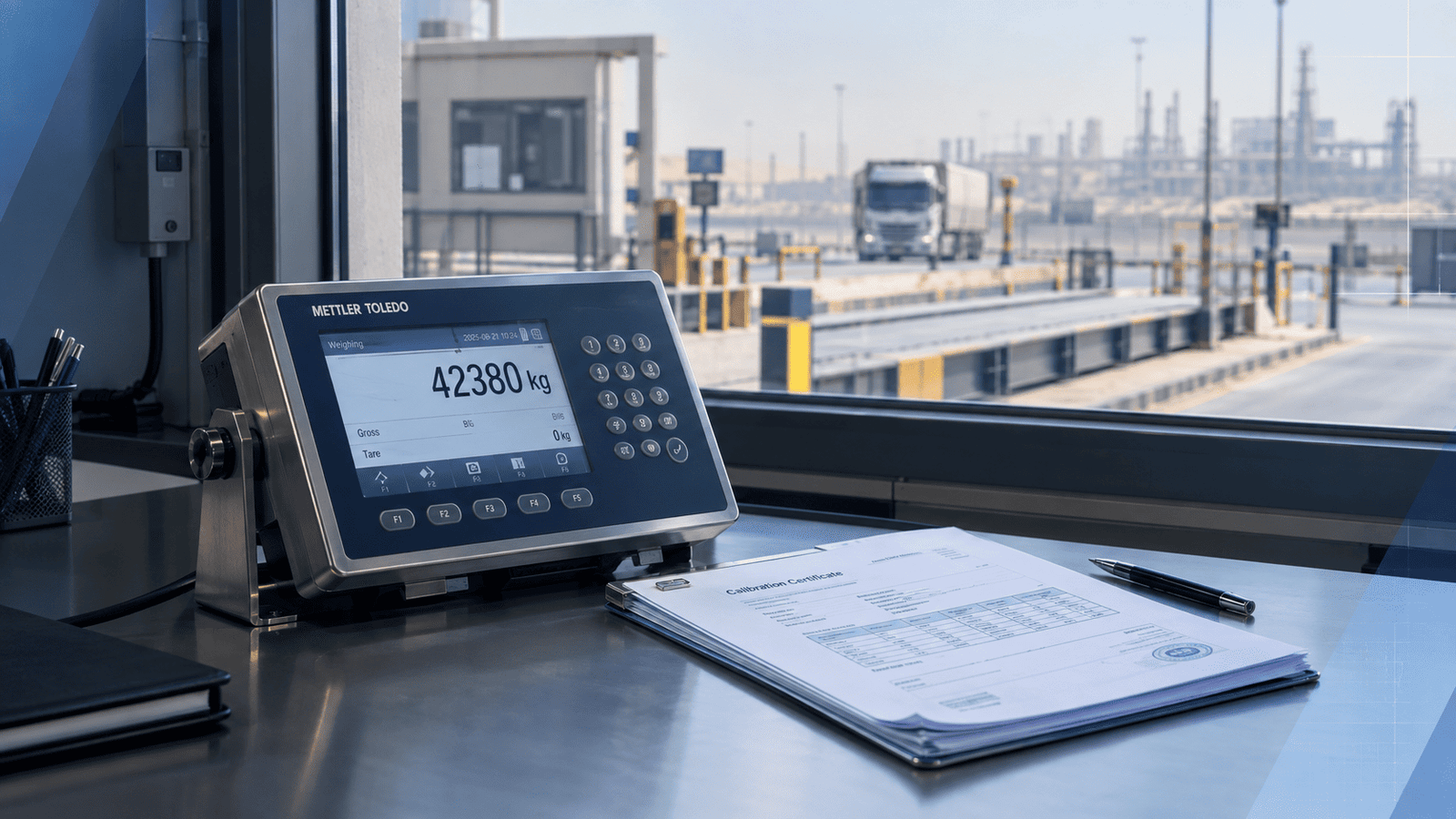
If any test result falls outside the Maximum Permissible Error for the instrument's accuracy class, the technician adjusts the calibration or span settings and repeats the relevant tests until the readings hold within tolerance. Once everything checks out, the result gets documented in a calibration report, and where legal-for-trade status applies, the instrument moves into SASO's verification process for its Taqyees label. That label, not the calibration report alone, is what confirms the weighbridge is legally cleared for commercial use in the Kingdom.
| OIML R76 Test | What It Actually Checks |
|---|---|
| Weighing performance | Accuracy across the full load range, from light to maximum capacity |
| Eccentricity (corner/section) | Whether every part of the deck reads consistently, regardless of where the load sits |
| Repeatability | Whether the same load produces the same reading every time |
| Zero-setting | Whether the baseline reading holds true with no load applied |
| Temperature effects | Performance stability under real ambient conditions, relevant given KSA's summer heat |
| Discrimination | The instrument's ability to detect small changes in load |
| Time-dependence | Whether the reading stays stable once a load has settled on the platform |
05 What Invalidates a Weighbridge Calibration in Practice
Honestly, most of the invalid certificates we come across weren't caused by bad equipment. They were caused by shortcuts in the process itself. A few of the recurring ones:
- Reference weights that weren't traceable to NMCC, or whose own certification had lapsed
- Calibration performed on a windy day with a light-capacity scale, which can throw off low-end readings
- Skipping the corner or section test and only checking the center of the platform
- A calibration completed after a repair or platform reinstallation, but never re-submitted for SASO verification
- Test vehicles that weren't centered or evenly loaded across the deck during the check
None of these are complicated to avoid. They just require a technician who follows the full sequence instead of the fast version.
06 Choosing a Calibration Partner in Saudi Arabia
Look, if you're evaluating who calibrates your weighbridge, here's what actually matters. Ask whether their reference weights are traceable through SASO's NMCC. Ask whether the individual technician, not just the company, is qualified under Taqyees to perform verification. Ask to see a sample calibration report before you commit, and check that it documents every test in the sequence above rather than a single reading.
As Mettler Toledo's official partner in Saudi Arabia, Global Scales & Systems approaches calibration the same way we approach any weighing installation: as a compliance obligation first, and a service second. We've built our calibration work around the SASO and OIML framework specifically because operators across the Kingdom, from Riyadh to Jeddah to Dammam, need certificates that actually hold up when they're checked. Vision 2030's push into logistics, industrial diversification, and non-oil manufacturing is only adding weight to that need. Saudi Arabia is projected to hold roughly 3.20% of the global industrial weighing scales market, a share that's expanding as construction, logistics, and manufacturing investment grows, according to Cognitive Market Research's industry analysis. More weighbridges going into service means more instruments that need to be calibrated correctly the first time, not corrected after an audit flags them.
Pro tip
Ask to see a sample calibration report before you commit, and check that it documents every test in the OIML sequence rather than a single baseline reading.
07 Frequently Asked Questions
How much does it cost to calibrate a weighbridge in Saudi Arabia?
Costs vary by capacity, location, and whether it's a routine recalibration or an initial verification tied to a new installation. The one fixed, published figure is the National Type Approval fee for bringing a new instrument model into the Kingdom, which is 5,000 SAR with a 10-business-day turnaround through Taqyees. For a specific quote on your weighbridge, it's best to contact a SASO-recognized provider directly.
Is SASO verification mandatory for a weighbridge used in commercial trade?
Yes. Any weighbridge used to determine the weight of goods in a commercial transaction in Saudi Arabia falls under SASO's legal metrology framework and must carry a valid type approval and verification label through the Taqyees program.
How long does calibrating a weighbridge take?
A full OIML-aligned calibration, including warm-up, all test stages, and documentation, typically takes several hours depending on the weighbridge's capacity and how many reference weights need to be positioned. Larger capacity scales tested with a loaded test truck can take longer than smaller platforms tested with stacked weights.
What's the difference between initial verification and periodic verification?
Initial verification happens before a new weighbridge enters commercial service, confirming the specific installed instrument meets its approved type. Periodic verification is the recurring re-check performed on instruments already in service, at intervals the operator sets based on usage and risk, on top of any statutory requirement.
Can I calibrate my own weighbridge without a SASO-recognized technician?
You can run internal accuracy checks with your own certified test weights as good operational practice between formal calibrations. However, for the legal verification that keeps the instrument compliant for trade, the work needs to be performed and certified by a body qualified under SASO's Taqyees program.
Does extreme heat affect weighbridge calibration accuracy in Saudi Arabia?
Yes. Sustained high ambient temperatures, which regularly exceed 45°C across the Eastern Province and Central Region in summer, place real thermal stress on load cells and electronic components, which is why OIML R76 includes temperature-effects testing as part of an instrument's evaluation. Contact us at Global Scales and System Co. Ltd for professional calibration services and precise industrial weighing scales (weighbridges) that's reliable and gets the job job even in the harshest of environments.
Contact us at Global Scales and System Co. Ltd for professional calibration services and precise industrial weighing scales (weighbridges) that's reliable and gets the job job even in the harshest of environments.

 Click to start chat