
In-House vs. Third-Party Calibration: 5 Costly Compliance Risks GCC Companies Discover Too Late
In-house calibration looks cheaper, until a failed SASO audit or retroactively disputed custody-transfer record hits. Here's the honest comparison every operations and QC manager in Saudi Arabia needs before deciding.

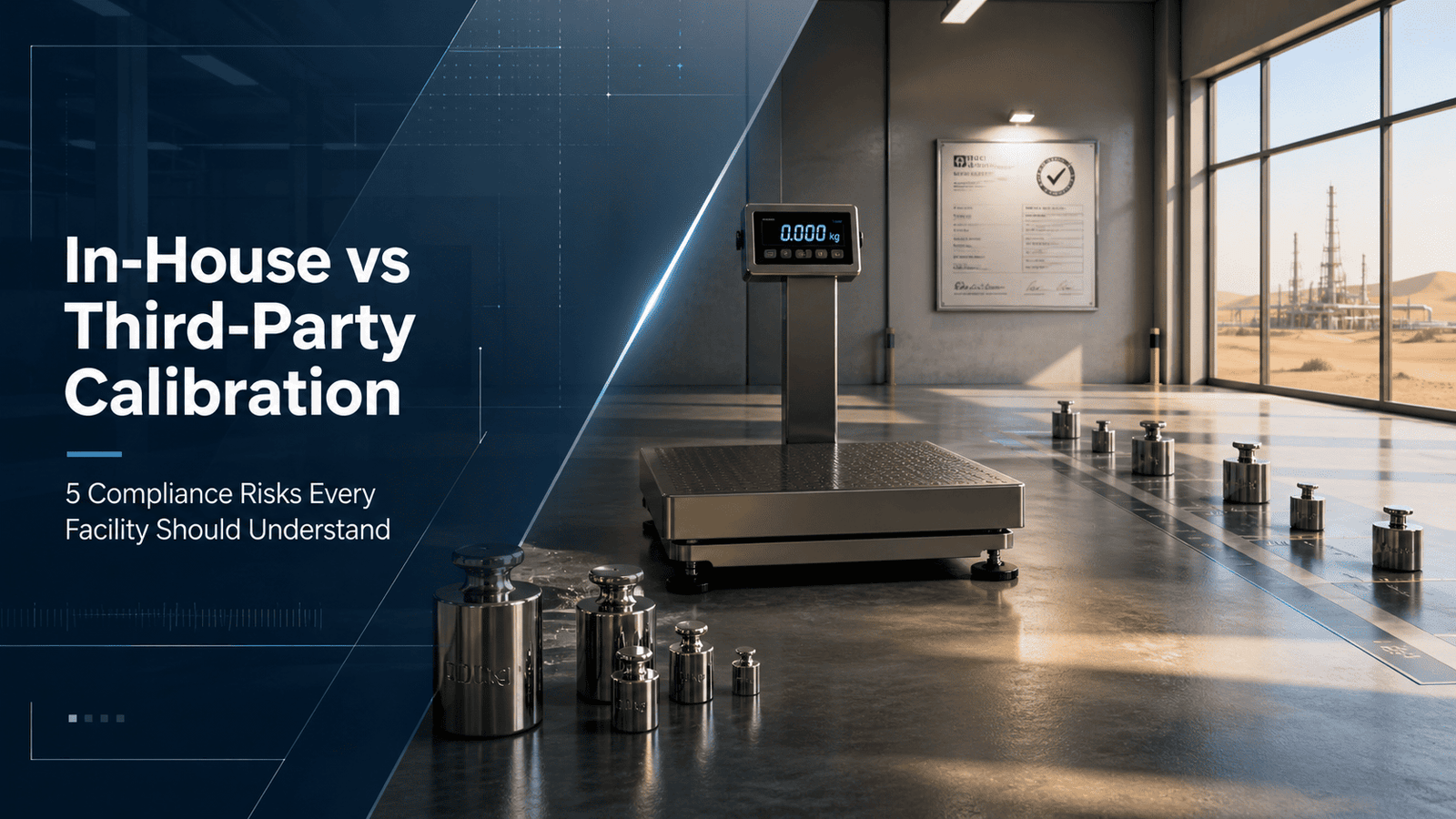
A procurement manager at a mid-sized cement company in the Eastern Province once told me something I haven't forgotten: "We had an in-house calibration team for six years. Thought we were saving money. Then SASO came." The audit flagged three weighbridges. The certificates were technically issued, but the reference standards used hadn't themselves been calibrated in over two years. Every measurement recorded in that period was legally suspect and the financial exposure from delayed shipments, ZATCA invoice disputes, and potential fines was orders of magnitude larger than what third-party calibration would've cost over that entire six-year stretch.
This is the article I wish someone had handed that procurement manager before he set up that in-house program. If you're currently running calibration in-house, evaluating your options, or just trying to understand your compliance exposure under Saudi and GCC regulations, read this carefully. Calibration services in Saudi Arabia sit at the intersection of technical precision, legal liability, and commercial risk in a way most vendors never explain properly.
01 What "Calibration" Actually Means and Why the Definition Matters for Compliance
Before we get into the comparison, let's be honest about something the industry often glosses over. The word "calibration" gets used loosely. Someone adjusts a scale so it reads zero. Someone presses a tare button. Someone compares a weight to a reference and writes a number down. Is that calibration?
Technically, sometimes. Legally? Rarely.
In Saudi Arabia, the body that governs legal metrology is SASO: the Saudi Standards, Metrology and Quality Organization. Under SASO and the broader Gulf Conformity framework, calibration for legal-for-trade instruments (weighbridges, checkweighers, retail scales, tank gauges used in custody transfer) must meet specific requirements:
- The calibration must be performed using reference standards with unbroken traceability to national or international measurement standards (BIPM / SASO NMI)
- The calibration certificate must clearly state the measurement uncertainty not just a pass/fail
- The person performing the calibration must be demonstrably competent
- For legal-for-trade instruments, periodic reverification is required even alongside in-house adjustment
That last point is where a lot of companies quietly fall short. They have someone check the scale, issue an internal document, and file it as a calibration record. It looks right. But when you trace that certificate back; what standards were used? When were those standards last calibrated? By whom? To what ISO 17025-accredited lab?
This is the traceability chain. And it's the thing that breaks first in an in-house program, often without anyone noticing, until an audit.
02 The Real Appeal of In-House Calibration (And Why It's Not Wrong)
Let's be fair, there are genuinely good reasons to bring calibration in-house, and dismissing the approach entirely would be dishonest. We work with companies across the GCC, logistics operators in Riyadh, food manufacturers in Jeddah, petrochemical facilities in Jubail, and for some of them, a hybrid model makes complete sense.
Speed
If you're running a checkweigher line producing 200 units per minute, waiting two days for a third-party technician for a routine zero-point check isn't practical. Your production team should absolutely be performing daily verification checks and operational adjustments. That's not calibration in the formal sense, but it's essential and totally appropriate to do internally.
Cost at Scale
A large logistics operation with 15 weighbridges across three sites running daily shifts will spend meaningfully more on third-party calibration visits than a smaller operation. At sufficient scale, the economics of training an internal metrologist and investing in certified equipment can work.
Institutional Knowledge
Your internal team knows your equipment, your operational quirks, your shift patterns. A well-trained in-house technician catches things an external technician visiting twice a year might miss.
None of this is wrong. The problem isn't the concept of in-house calibration, it's the execution gaps that create compliance exposure. And those gaps are more common than most companies admit.
“ Your calibration program can look completely valid on paper while being technically non-compliant and nobody knows until a SASO auditor asks one question about your reference standards. — Section 03
03 The 5 Compliance Risks That Show Up in Practice
Here's what we actually see in the field not theory. These are patterns that come up regularly across KSA and the wider GCC. The companies involved aren't careless. Most of them had calibration programs that genuinely seemed to be working. The risks are structural, not negligent.
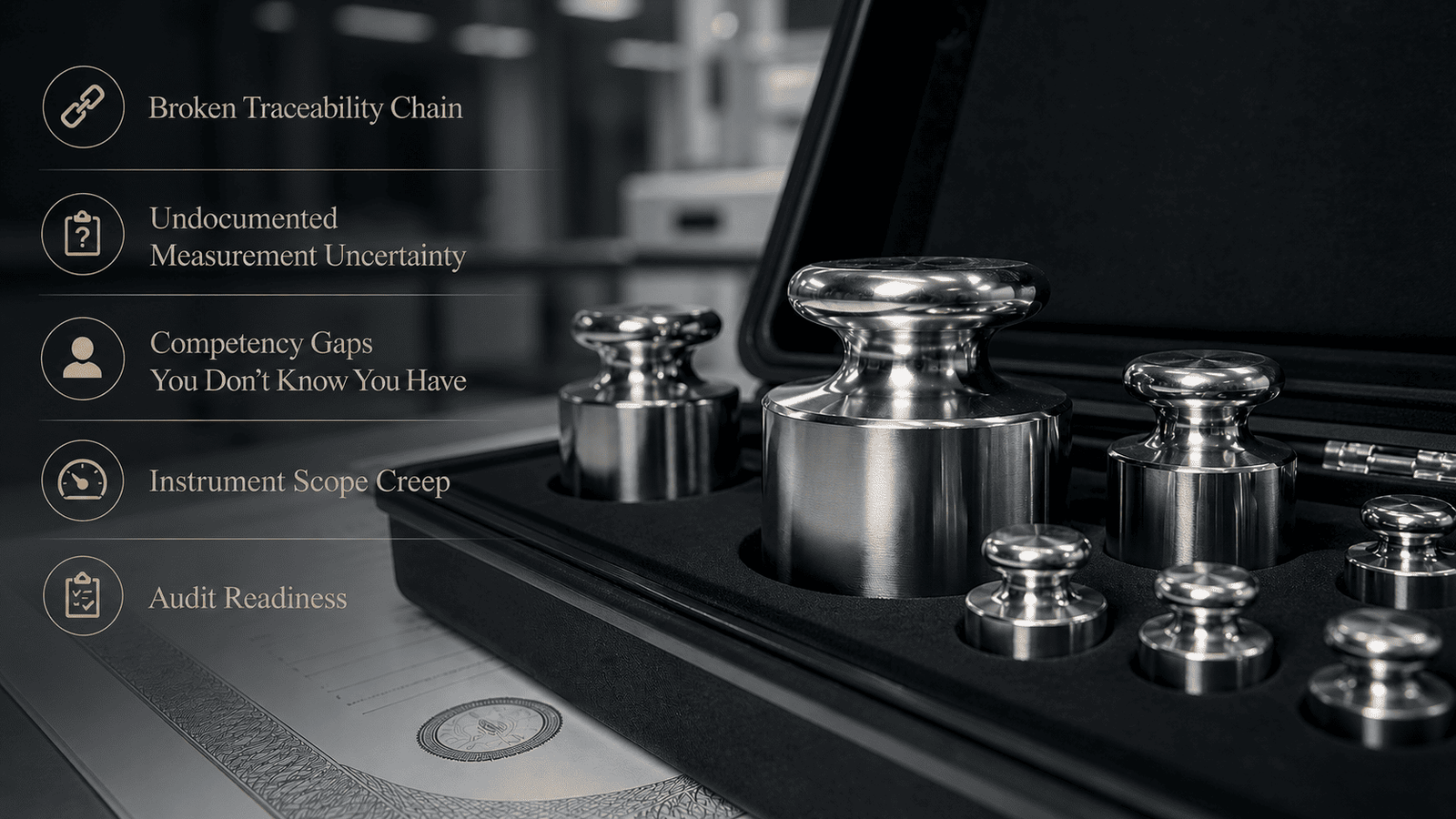
Risk 1: Broken Traceability Chain
Common mistake
Many in-house programs calibrate the instrument but forget to maintain the meta-step: periodically sending their own reference standards to an ISO 17025-accredited lab for external recalibration. Those reference weights sit in a case for two or three years, never verified, while continuing to be treated as authoritative. SASO auditors know to ask for this documentation specifically.
This is the big one. Your technician uses reference weights to calibrate your scale. But those reference weights, when were they last calibrated? By whom? To what standard?
For the calibration to be metrologically valid, you need an unbroken chain: your scale → your reference weights → a certified lab's standards → national standards → international standards (SI units via BIPM). If any link breaks, the whole chain fails. Maintaining that traceability chain in-house requires periodic external calibration of your own reference standards by an ISO 17025-accredited laboratory: a cost and administrative responsibility that many in-house programs absorb poorly.
Risk 2: Undocumented Measurement Uncertainty
A calibration certificate that doesn't state measurement uncertainty isn't technically a calibration certificate under ISO 17025. It's a verification record at best. This matters in two situations: regulatory audits and commercial disputes.
If a buyer or regulatory body questions the accuracy of a custody-transfer measurement; oil quantity, cement tonnage, pharmaceutical batch weight, and your certificate doesn't state measurement uncertainty, you have a documentation problem on top of a technical one. Third-party accredited labs are required to state measurement uncertainty on every certificate they issue. In-house programs often don't, either because the team doesn't know how to calculate it properly, or because the equipment used doesn't have the sensitivity to quantify it.
Risk 3: Competency Gaps You Don't Know You Have
Calibration is not just pressing buttons. It requires understanding of metrology principles, environmental correction factors; temperature matters enormously in KSA, a 50°C ambient on a concrete slab versus a 25°C climate-controlled room can affect a load cell reading measurably and the proper statistical treatment of measurement data.
In-house programs often rely on one person who was trained years ago, whose training may have been informal, and who may have left or rotated roles without a proper knowledge transfer. When that person goes, the institutional knowledge goes with them. We've seen this at two separate facilities in the past eighteen months; both had functioning-looking in-house programs and significant documentation gaps when reviewed against SASO requirements.
Risk 4: Instrument Scope Creep
This one's subtle. Your in-house program was set up to handle platform scales and checkweighers. Over time, the scope expands: someone asks the calibration tech to "check" the silo load cell system, then the RFID truck scale, then the batching system. Each has different calibration requirements, different reference standard needs, and potentially different regulatory frameworks.
An in-house technician calibrated for one instrument class may have no formal competency for another. But because they're the closest thing to an expert on-site, the scope drifts. Certificates still get issued. And compliance exposure widens without anyone making a deliberate decision to take on that risk.
Risk 5: Audit Readiness: The Gap Between Records and Evidence
SASO and SFDA auditors don't just want to see a certificate. They want to see a calibration management system: a register of instruments, calibration due dates, traceability documentation, records of who performed each calibration, and evidence that out-of-tolerance findings triggered corrective action.
In-house programs that evolved organically, rather than being designed to comply with a regulatory framework from the start, almost always have documentation gaps. Spreadsheets with missing columns. Certificates issued on template documents that don't meet technical requirements. No formal calibration procedure. No out-of-tolerance protocol. When this gets flagged in an audit, the pain isn't just the finding itself; it's the retroactive question: if your calibration program wasn't compliant, which measurements made under that program are valid? That can implicate production records, dispatch documentation, custody-transfer receipts.
04 When Third-Party Calibration Is the Smarter Call
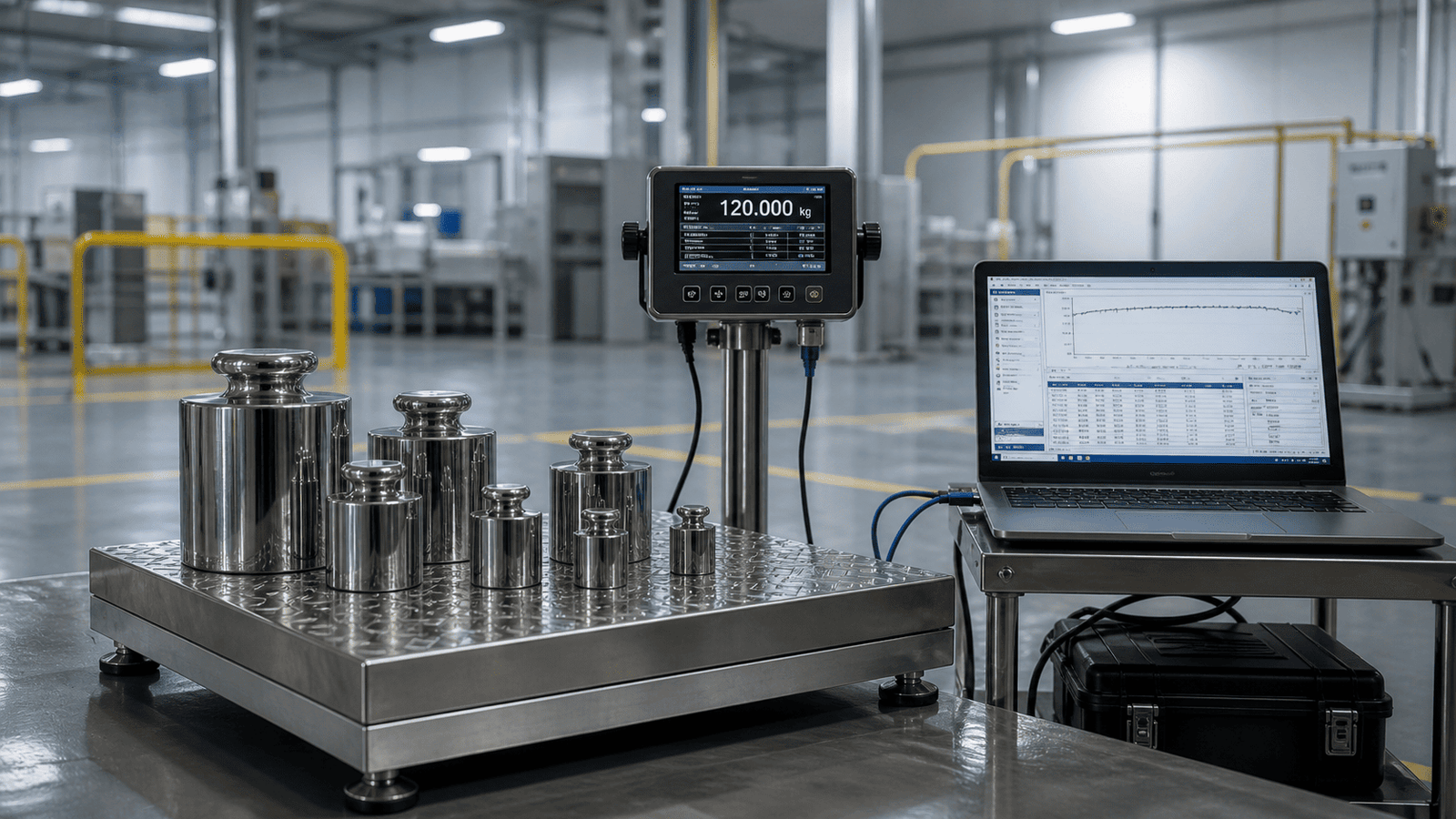
Third-party calibration from an accredited provider eliminates most of the risks above by design. Here's what you're actually buying and why each element matters specifically in the Saudi regulatory context.
ISO 17025 accreditation means the lab's technical competency, equipment, traceability chain, and procedures have been independently assessed against an international standard. The calibration certificate it issues is, in that sense, self-evidencing. You don't need to prove the calibration was done correctly; the accreditation does that work for you.
Measurement uncertainty is documented on every certificate, as required by the standard. No ambiguity, no gap in the paperwork that a SASO auditor can use to question the validity of your records.
The traceability chain is maintained by the lab; not by you. That's their problem, their cost, their audit responsibility. You're not exposed to the administrative risk of forgetting to send your reference weights out for recalibration.
Competency is the lab's responsibility. If a technician leaves, their training and qualifications system handles the replacement. You're not exposed to the key-person risk that quietly hollows out so many in-house programs.
Audit-ready documentation comes standard. The certificate format already meets what SASO auditors expect to see. For legal-for-trade instruments: weighbridges, truck scales, checkweighers used in commercial transactions — third-party calibration from an accredited provider is often not just smarter, but necessary to satisfy SASO reverification requirements.
“ For legal-for-trade instruments in KSA, third-party accredited calibration isn't just smarter — it's often the only way to satisfy SASO reverification requirements. — Section 04
05 A Practical Calibration Model for GCC Operations
The honest answer is this: most well-run industrial operations in Saudi Arabia use a hybrid model. And that's probably right. The internal team handles day-to-day monitoring and operational checks; things that keep production running. The accredited third-party handles the formal calibration events that generate legally valid certificates and maintain regulatory compliance. The two functions complement rather than compete.
| Calibration Activity | Appropriate Owner | Frequency |
|---|---|---|
| Daily zero check & tare verification | Internal operations team | Daily / per shift |
| Operational span check (in-tolerance confirmation) | Internal technician | Weekly |
| Formal calibration with measurement uncertainty | Accredited third-party provider | Per SASO schedule (typically 6–12 months) |
| SASO reverification / legal-for-trade stamp | SASO-authorised body | As mandated by instrument type |
| Reference standard recalibration | Accredited external lab | Annually |
| Weighbridge annual inspection + certificate | Accredited third-party | Annually (minimum) |
| Post-repair / post-installation calibration | Accredited third-party | After every intervention |
The distinction is simple in practice: internal checks keep things running, external accredited calibration keeps you compliant. Both matter. Neither replaces the other.
06 What to Ask Any Calibration Provider in Saudi Arabia
If you're evaluating calibration services in Saudi Arabia; renewing a contract, getting competitive quotes, or assessing a new provider, here are the questions that separate real competency from paper compliance.
What is your ISO 17025 accreditation scope? Ask specifically. An accreditation certificate covers defined instrument types and measurement ranges. If your weighbridge has a 60-tonne capacity and their accreditation only covers up to 20 tonnes, that's a fundamental mismatch.
What SASO authorisation do you hold for legal-for-trade instruments? Calibration and SASO reverification are different things. Make sure you understand which one you're buying, and whether the provider is authorised to deliver both.
Can you show me your reference standard calibration certificates? Any credible provider will have these immediately available. If there's hesitation or delay, that's your answer.
What's your procedure when a calibration finds an out-of-tolerance condition? This tells you more about their metrological rigour than almost any other question. A real calibration process has a documented corrective action procedure. A form-filling exercise doesn't.
Pro tip
Ask to see a sample calibration certificate before you engage any provider. A compliant certificate under ISO 17025 must state the measurement uncertainty, the reference standards used with their traceability, the environmental conditions at the time of calibration, and the identity of the technician who performed it. If the sample certificate is missing any of these, don't sign the contract.
Do your certificates state measurement uncertainty? They should. If they don't, the certificates aren't technically compliant with ISO 17025. Full stop.
07 How Global Scales & Systems Approaches Calibration in the GCC
At Global Scales & Systems, we built our calibration practice around one principle: compliance isn't a box to tick, it's a liability to manage. That distinction sounds semantic. In practice, it changes everything about how we work.
We're not a weighing equipment supplier that offers calibration as an afterthought. Calibration and compliance consulting is a core service line, one we've developed specifically for the regulatory realities of Saudi Arabia and the wider GCC. That means SASO, SFDA for food and pharma clients, and the specific documentation requirements that surface in ARAMCO, SABIC, and Vision 2030 Giga-Project supply chain audits.
In practical terms, this is what that looks like for our clients:
- Full calibration management: we maintain your instrument register, track calibration due dates, and proactively schedule visits; so your team doesn't have to manage spreadsheets or chase certificates
- Traceable certificates on every job: every calibration certificate we issue states measurement uncertainty, references our accredited standards, and is formatted to satisfy SASO auditor expectations
- Site-specific compliance gap assessments: for clients transitioning from in-house to third-party, or simply wanting to know where they stand before an audit, we conduct a structured review of your current calibration program against the applicable regulatory framework
- Weighbridge and truck scale specialists: our technicians work specifically with industrial weighing systems: platform scales, weighbridges, checkweighers, silo load cell systems, not general lab instruments. That specialisation matters when you're calibrating a 60-tonne weighbridge in a Jubail industrial facility at 48°C
And where we supply Mettler Toledo weighing systems, we calibrate them too with the original equipment knowledge that matters for systems like POWERCELL® PDX® load cells, which have built-in diagnostics that interact directly with how calibration data is interpreted. Getting that right requires knowing the system, not just the procedure.
08 FAQ: Calibration Services in Saudi Arabia
The questions we get most often; answered directly.
Is third-party calibration legally required in Saudi Arabia?
For legal-for-trade instruments; scales and weighing systems used in commercial transactions, custody transfer, or regulated processes, SASO requires periodic reverification by an authorised body. In practice, this means you need at least some involvement from an authorised third-party provider, even if you supplement with internal checks. For non-commercial instruments (internal process controls, for example), in-house calibration is permissible if properly managed and documented.
How often do weighbridges need to be calibrated in KSA?
At minimum annually but the actual schedule depends on the instrument type, usage intensity, and applicable SASO product standard. High-throughput weighbridges at ports or mining operations may require more frequent formal calibration. The other thing most companies miss: calibration is also required after any repair, modification, or relocation of the system not just on a time-based schedule.
What's the difference between calibration and verification?
Calibration determines the relationship between a measurement instrument's output and the true value — and quantifies any deviation with measurement uncertainty. Verification checks whether an instrument is within acceptable tolerance limits. They're related but not the same. For SASO compliance purposes, you generally need both: formal calibration that establishes the technical baseline, and operational verification checks in between.
What happens if my calibration certificates aren't SASO-compliant?
At minimum, you risk an audit finding and a requirement to recalibrate. More seriously, if the non-compliance affects legal-for-trade measurements, you could face challenges to historical transaction records; invoices, custody transfer documents, production batch records. For companies in regulated sectors like food, pharma, or customs-controlled goods, the downstream exposure is significant.
Can Global Scales & Systems calibrate equipment we didn't buy from you?
Yes. Our calibration services aren't limited to equipment we supply. We calibrate platform scales, weighbridges, checkweighers, and industrial weighing systems regardless of manufacturer. The practical requirement is that we're calibrating within our accredited scope and we'll confirm that before committing to a job.
How do I know if my current calibration certificates are legally valid?
The fastest check: pull your most recent certificate and verify: (a) it was issued by an ISO 17025-accredited provider, (b) it states measurement uncertainty, (c) it references the calibration standards used and their traceability, and (d) it was issued within the calibration interval required for your instrument type. If you're unsure, we offer a straightforward compliance review; we'll assess your current documentation and tell you exactly where you stand. We are just a link away, reach out now to stay complliant.
All calibration schedules, SASO requirements, and regulatory interpretations referenced in this article reflect guidance current as of 2026. Regulatory frameworks evolve — always verify requirements with SASO or an accredited calibration body for your specific instrument type and use case.

 Click to start chat