
Weighbridge Software Integration in Saudi Arabia: The Complete Guide to a Smarter Weighbridge Management System
What weighbridge software integration actually means, what a modern weighbridge management system should do for your operation, and what separates a genuinely connected setup from one that just looks good in a vendor presentation.

A truck pulls up to the gate. The driver hands over a paper docket. Someone types the tare weight into a spreadsheet. And somewhere, in accounting, in dispatch, in the compliance office, three different people are waiting on that number. By the time it gets to them, it's an hour old, manually transcribed twice, and one of them is already on the phone asking where it is.
This is still how a lot of operations run in Saudi Arabia. Not because people don't know better but because weighbridge software Saudi Arabia deployments have historically been treated as an afterthought, bolted on after the hardware decision was already made. That's the wrong order. And it costs companies real money, real time, and real headaches during ZATCA audits.
This guide is about getting it right: understanding what weighbridge software integration actually means, what a modern weighbridge management system should do for your operation, and what separates a genuinely connected setup from one that just looks good in a vendor presentation.
01 What Software Integration Actually Means at the Scale Level
Let's clear something up first. When a sales rep says a weighbridge is "software-integrated," that can mean almost anything, from a basic USB data export to a fully live API connection pushing transaction data into your ERP in real time. The gap between those two things is enormous.
True integration means your weighbridge management system talks to your other business systems without human intervention. Weight data captured at the platform flows automatically into your ERP (SAP, Oracle, or whatever you're running), your gate management platform, your ZATCA e-invoicing module, and your internal reporting dashboards. No manual re-entry. No paper trail gaps. No version mismatch between what logistics recorded and what finance is billing.
In my experience working with clients across the Eastern Province and Riyadh, the biggest integration failures aren't technical, they're architectural. The weighbridge gets installed, the software gets configured in isolation, and six months later someone discovers the data isn't flowing into SAP because nobody mapped the fields correctly at commissioning. That's a system design problem, not a software problem.
“ The biggest integration failures aren't technical — they're architectural. — Section 01
02 Why KSA Operations Have Specific Integration Demands
Saudi Arabia isn't a generic market and your weighbridge setup shouldn't be either. A few things make the local context genuinely different.
ZATCA compliance. The Zakat, Tax and Customs Authority's phased e-invoicing rollout means your weighbridge transaction data needs to feed into a tax-compliant invoice chain. If your weighbridge management system can't generate or interface with Fatoora-compliant records, you've got a compliance gap. This isn't hypothetical; we're already seeing clients scramble to retrofit integration because their original setup predates Phase 2.
Multi-site visibility. A lot of heavy industry in KSA runs operations across multiple sites: a plant in Jubail, a terminal in Dammam, a logistics hub near King Abdullah Port. A weighbridge management system without centralised, cloud-accessible dashboards means someone is still aggregating Excel exports by hand every month. That's not a 2026 operation.
High-volume unattended throughput. Logistics operators and container terminals in particular are processing hundreds of truck movements per day. That volume demands automation. We are talking RFID integration, automatic number plate recognition (ANPR), and zero-touch transaction completion. Which is exactly why the IND9U Unattended Terminal from Mettler Toledo exists. It's IP69K rated, stainless steel enclosure, handles RFID in and out in a single pass without a single staff member involved. As Mettler Toledo's official partner in Saudi Arabia, Global Scales & Systems deploys these specifically in scenarios where speed and reliability cannot be compromised.
Common mistake
Weighbridge software Saudi Arabia deployments are still frequently treated as an afterthought: configured after the hardware is already installed. If your ERP integration isn't scoped before commissioning, you may discover mid-project that your chosen terminal doesn't support the communication protocols your IT environment requires. Always spec the full system together before any purchase order is signed.
03 The DataBridge Software Stack: A Closer Look
Here's the thing that surprises most procurement teams when they go through a proper product demo: the software tier you choose fundamentally changes what your operation can do.
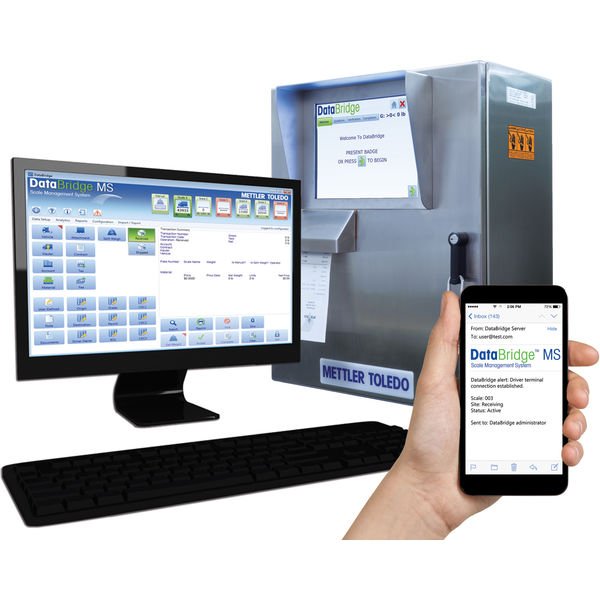
Mettler Toledo's DataBridge platform comes in three tiers: Standard (SS), Multi-Scale (MS), and Enterprise (ES). The differences matter.
| Tier | Best Fit | Key Capability |
|---|---|---|
| DataBridge SS | Single-site, lower volume | Core transaction management, basic reporting |
| DataBridge MS | Multi-scale single site | Centralised control of multiple platforms, consolidated reporting |
| DataBridge ES | Multi-site enterprise | Full ERP integration, API connectivity, advanced analytics, user role management |
The ES tier is what most large KSA operations should be looking at and independently verified data puts the improvement in transaction processing speed at up to 50% compared to legacy or manual systems. That's not a marketing claim, that's time-motion data from live installations. And yes, DataBridge can interface with SAP. It's one of the most common integration paths we set up.
04 What a Good Weighbridge Management System Actually Looks Like
If you're evaluating systems right now or if you're trying to figure out whether your current setup is genuinely fit for purpose, here's what I'd check.
Real-time data capture. Every transaction: gross weight, tare weight, net weight, timestamp, vehicle ID, operator, should be captured and stored the moment the truck lifts off the platform. Not batched nightly. Not exported on request. Live!
Driver and vehicle identity verification. RFID-based or PIN-based vehicle identification ties each weighment to a known asset. This isn't just about efficiency, it's a fraud control mechanism. Substituting a lighter vehicle, overloading between check points, or manipulating tare data are all much harder when every transaction is tagged to a verified identity.
Audit trail integrity. Your system should be tamper-evident. Every edit, override, or manual correction should be logged with a user ID and timestamp. This matters enormously during regulatory audits or any dispute with a contractor.
ERP/WMS connectivity. The weighbridge management system should be an input node to your larger business systems, not a silo. If your operations team is manually copying weight data into SAP Purchase Orders or Goods Receipts, that's a broken architecture.
Remote diagnostics. POWERCELL® PDX® load cells, the technology inside Mettler Toledo's industrial weighbridges, have built-in predictive diagnostics. That means your maintenance team (or Global Scales' service engineers) can identify load cell performance degradation before it becomes a calibration failure or a line stoppage. The 10-year warranty on these cells is only meaningful if you're monitoring them. Remote diagnostics is how you do that.
“ A system that captures data but doesn't connect to your business systems isn't solving the problem; it's just creating a cleaner paper trail. — Section 04
05 Software Integration Pricing Context: What to Budget
There's a wide range depending on what you're connecting and how complex your existing IT environment is.
| Integration Scope | Est. Investment (SAR) | Est. Investment (USD) |
|---|---|---|
| Standalone DataBridge SS (single site, no ERP) | SAR 8,000–18,000 | $2,100–$4,800 |
| DataBridge MS + basic reporting module | SAR 18,000–38,000 | $4,800–$10,100 |
| DataBridge ES + SAP/Oracle integration | SAR 38,000–90,000 | $10,100–$24,000 |
| Custom enterprise API (ZATCA, ANPR, full automation) | SAR 90,000+ | $24,000+ |
* These figures represent budget guidance only and do not constitute a formal quotation. Contact Global Scales & Systems for a site-specific assessment.
A few notes on what drives cost upward: legacy IT environments where the ERP is heavily customised, sites without stable network connectivity (cellular fallback adds cost), multi-site deployments requiring centralised server setup, and ANPR camera integration (hardware + licensing).
Pro tip
Before requesting a software integration quote, audit your network infrastructure first. A weighbridge at the edge of a mining site or remote port terminal needs reliable connectivity and discovering this gap during commissioning (rather than scoping) is one of the most common causes of project delays and unplanned cost overruns in KSA deployments. Scoping connectivity as part of the initial RFQ saves significant time and money.
06 Common Integration Mistakes; And How to Avoid Them
We keep seeing the same four mistakes across otherwise well-run operations.
1. Buying the software after the hardware. The weighbridge terminal you choose determines a lot about what software integration is possible. If you buy a terminal from a generic manufacturer without verifying its communication protocols, you may find your ERP integration requires expensive custom middleware. Always spec the full system together.
2. Skipping the network infrastructure assessment. A weighbridge at the edge of a mining site or a remote port terminal needs reliable connectivity to be useful. Cellular, dedicated LAN, or a hybrid fallback? This needs to be scoped before installation, not discovered during commissioning.
3. Underspeccing user access controls. Who can void a transaction? Who can adjust a tare weight? Who gets the nightly report? If your weighbridge management system doesn't have granular role-based access controls, you've got a governance problem waiting to happen.
4. Ignoring calibration data integration. Calibration records for SASO compliance need to be accessible and traceable. Ideally, your weighbridge software logs calibration events with certification references so you're not hunting for paper certificates during an audit. This is one of those things nobody thinks about until the auditor is in the room.
07 Feature → Operational Benefit: What the Specs Mean in Practice
Spec sheets rarely translate themselves into operational terms. Here's what the key Mettler Toledo features actually mean for your day-to-day operation.
| Feature | What It Actually Means for You |
|---|---|
| POWERCELL PDX 10-year warranty | No surprise calibration failures or load cell replacement costs for a decade |
| Built-in predictive diagnostics | Maintenance is planned, not reactive — no unscheduled downtime |
| IND9U RFID unattended operation | Zero staff required at the scale — trucks process themselves, 24/7 |
| DataBridge ERP integration | Weight data appears directly in SAP/Oracle — no manual re-entry, no reconciliation headaches |
| StrikeShield lightning protection | KSA's frequent dry-season electrical storms won't kill your load cells |
| Tamper-evident audit trail | Fraud protection and ZATCA compliance in a single system feature |
“ Zero staff required at the scale. Trucks process themselves, 24/7. — Section 07
08 FAQ: Weighbridge Software Integration in Saudi Arabia
The questions we get most often; answered directly.
What is a weighbridge management system and do I need one?
A weighbridge management system is the software layer that captures, stores, and routes transaction data from your truck scale. If you're processing more than a handful of truck movements per day or if your operation needs to feed weight data into invoicing, ERP, or compliance reporting; yes, you need one. A bare terminal with no management software is a measurement device. A weighbridge management system turns it into a business intelligence asset.
Can weighbridge software integrate with SAP in KSA?
Yes. Mettler Toledo's DataBridge ES tier supports SAP integration via standard APIs and data exchange formats. The complexity (and cost) of the integration depends heavily on how your SAP environment is configured. Global Scales & Systems handles these integrations as part of full-system deployments.
Is weighbridge software required for ZATCA compliance in Saudi Arabia?
ZATCA e-invoicing doesn't mandate a specific weighbridge software, but your invoice chain needs to be traceable and Fatoora-compatible. If your weighbridge generates transaction records that feed into billing, those records need to be audit-compliant. A weighbridge management system with tamper-evident logs and proper timestamp data is the practical way to meet that requirement.
How long does it take to integrate a weighbridge management system with an existing ERP?
For a standard SAP or Oracle integration using DataBridge ES, you're typically looking at 3–8 weeks from project kick-off to go-live, depending on the complexity of your ERP customisation and the availability of your IT team for field mapping and UAT. Simpler setups (local database, CSV export integration) can be operational in days.
What happens to weighbridge data if the internet connection goes down?
A properly configured system stores transactions locally at the terminal and syncs to the central server when connectivity is restored. Data loss due to connectivity interruption shouldn't happen in any modern weighbridge software Saudi Arabia deployment. So if a vendor can't confirm offline transaction buffering, that's a red flag.
How often does weighbridge software need to be updated in KSA?
Software updates are typically annual for major platform versions and more frequent for security patches. As Mettler Toledo's official partner in Saudi Arabia, Global Scales & Systems provides update support as part of our maintenance contracts, which also means compatibility with ZATCA regulatory changes is handled proactively, not after the fact.
09 Getting the Integration Right the First Time
Look, if you're currently running a weighbridge on spreadsheets or a disconnected legacy system, the upgrade case is straightforward. You're carrying operational and compliance risk every single day that isn't necessary.
But even for operations that have some form of existing software, the question is whether it's genuinely integrated or just digitally isolated. A system that captures data but doesn't connect to your business systems isn't really solving the problem, it's just creating a cleaner paper trail.
The right weighbridge software Saudi Arabia deployment starts with a proper scope of what needs to connect, what compliance requirements need to be met, and what the throughput demands are. That's a conversation before a quote, not after.
Global Scales & Systems, as Mettler Toledo's official partner in Saudi Arabia, has been handling exactly these integration projects across logistics, oil and gas, cement, and port operations throughout the Kingdom and the wider GCC. We bring the hardware expertise and the software integration capability and we stay involved through commissioning, training, and long-term service.
For a no-obligation technical review of your current weighbridge setup or a full integration scope for a new project, contact our team directly.

 Click to start chat