
SASO verification, OIML Class II accuracy, and the Taqyees initiative explained; everything you need to stay compliant and protect your trading licence.

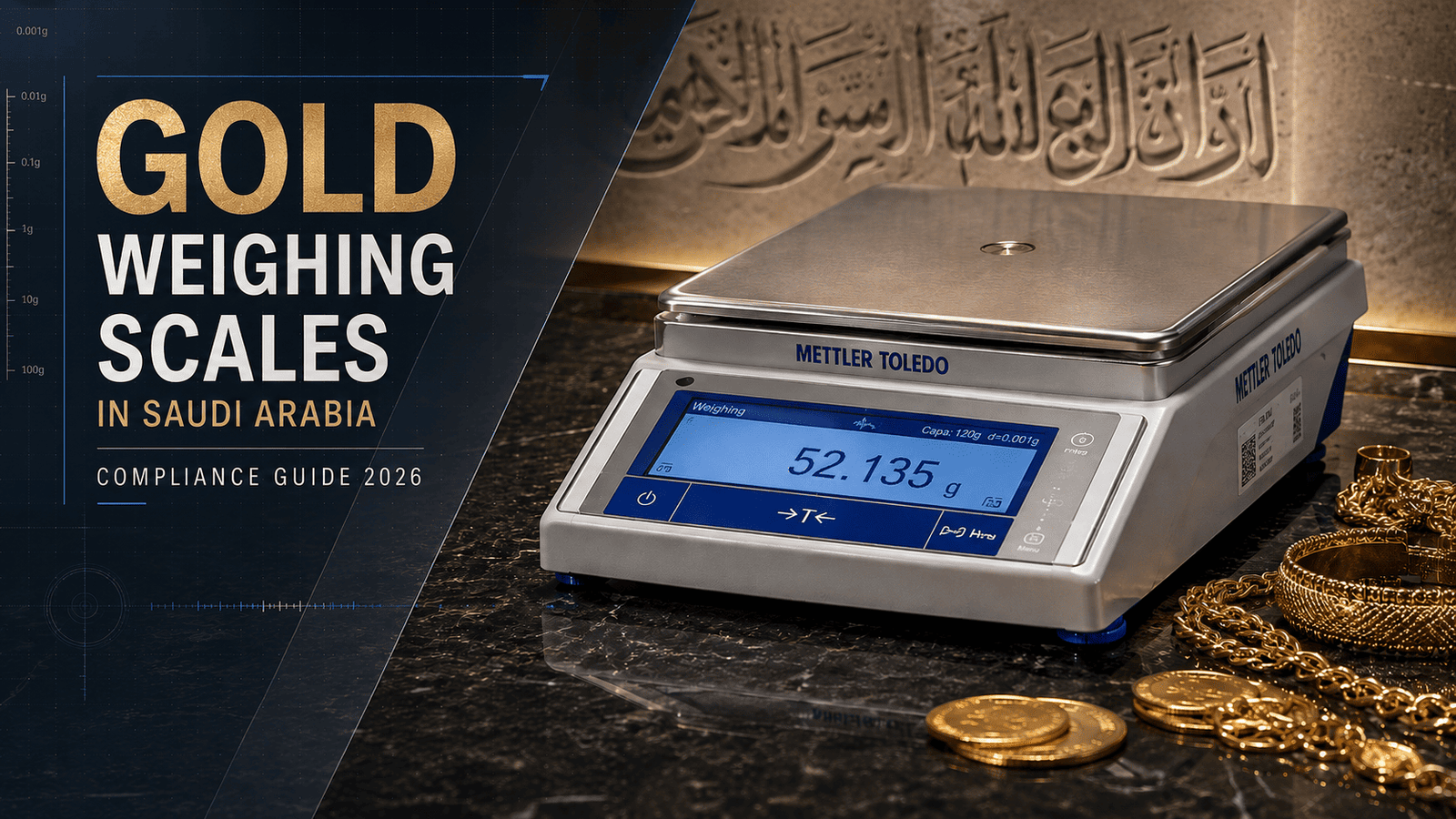
Walk into any gold souk in Riyadh, Jeddah, or Al-Khobar and you'll see hundreds of transactions being settled by weight every single day. A bracelet sold by the gram. A dowry set priced by tola. An investment bar verified before purchase. Every one of those transactions depends on one thing: an accurate, legally verified gold weighing scale.
And here's what surprises most shop owners when they first hear it; operating the wrong scale, or a correctly-made scale that hasn't been properly calibrated, isn't just a quality problem. Under Saudi law, it can result in a trading licence suspension. Getting gold weighing scales in Saudi Arabia right is a compliance issue as much as a commercial one, and the regulatory pressure is increasing.
Gold isn't ordinary retail merchandise. It's simultaneously a luxury product, a cultural institution, and a store of financial value and the Kingdom's legal framework treats it that way.
According to ResearchAndMarkets via Globe Newswire, Saudi Arabia's gold and diamond jewellery market was valued at USD 4.56 billion in 2024 and is projected to reach USD 8.34 billion by 2030, growing at a compound annual rate of 10.59%. That's not a niche trade. It's a significant economic sector. And within that sector, the weight measurement sitting between a buyer and a seller is the single most consequential data point in any transaction.
Saudi Arabia's Law of Precious Metals and Gemstones is explicit: it is a violation to deceive or cheat in the type, weight, or purity of precious metals. The word "weight" sits right there alongside purity not as an afterthought, but as a first-order legal standard. Penalties for violations range from fines to outright suspension of the trader's licence.
This isn't theoretical risk. A survey conducted by the UAE's Emirates Authority for Standardization and Metrology (ESMA) found that 35% of randomly selected gold weighing scales from jewellery shops across the country exceeded the maximum permissible error under technical regulation. Thirty-five percent. In a GCC region where metrology standards are broadly aligned and regulators share data, that number should be sobering for any KSA jeweller who hasn't had their scale formally verified.
The takeaway isn't that most scales are broken. It's that most scales drift; slowly, silently, undetectably without proper testing. And in a gold trade context where prices regularly exceed SAR 300 per gram, even a 0.05g error per transaction isn't a rounding inconvenience. It's a systematic discrepancy running through every sale.
Most jewellers know SASO as the body that certifies products at the port. What fewer realise is that SASO is also Saudi Arabia's legal metrology authority; responsible for verifying that measuring instruments used in trade are accurate and conform to approved type specifications. This is separate from product certification. It's about the instruments themselves.
SASO is a full member of both the International Organization of Legal Metrology (OIML) and the International Bureau of Weights and Measures (BIPM). That membership isn't ceremonial, it means SASO adopts international metrology recommendations as the technical basis for its own regulations. When OIML sets a standard for non-automatic weighing instruments (which is exactly what your gold jewellery scale is), SASO's framework follows suit.
The practical arm of SASO's legal metrology programme is Taqyees — a national initiative specifically addressing the verification of measuring instruments in trade. SASO has engaged directly with the National Committee for Jewellery and Gemstones at the Federation of Saudi Chambers to discuss the specific challenges the gold sector faces when complying with Taqyees calibration requirements. That engagement; which included the Governor of Saudi Standards himself, signals how seriously the regulator is treating this space.
What does Taqyees mean practically? Your gold scale must be of an approved instrument type, properly verified before first use, and submitted for periodic re-verification at intervals specified by the authority. A scale that hasn't gone through this process isn't a compliant instrument, regardless of how accurately it appears to read on any given day.
And the "it reads correctly" defence won't hold at an inspection. A scale can read correctly today and drift out of tolerance tomorrow due to temperature changes, dust ingress, or battery fluctuation. Compliance means documented verification, not just a number on a screen.
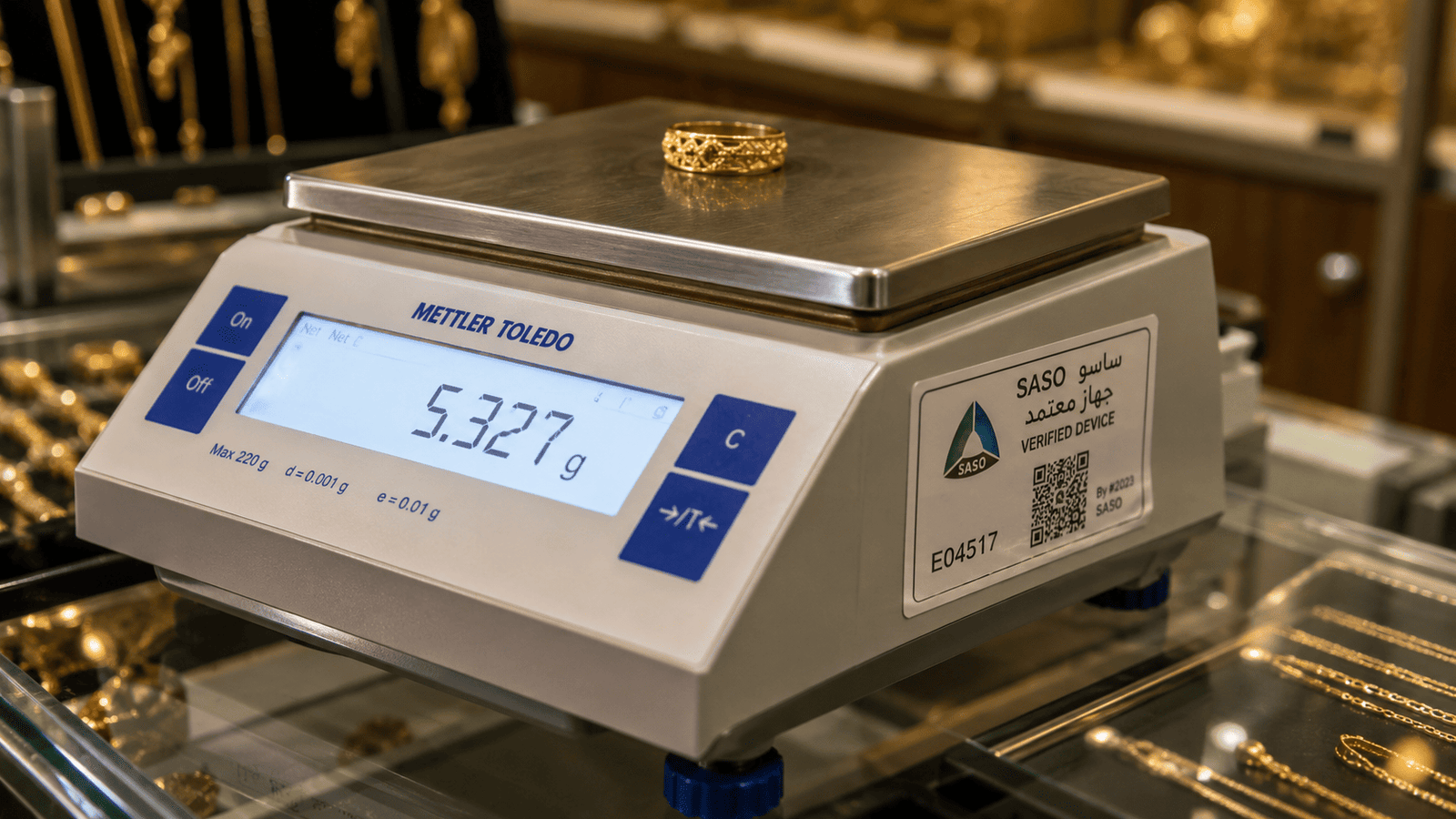
A SASO verification seal is the physical confirmation that your scale is legally fit for gold trade. Without it, you're exposed — regardless of what the display reads.
“ A scale can read correctly today and drift out of tolerance tomorrow. Compliance means documented verification; not just a number on a screen. — Section 02
Not all precision scales are created equal. OIML Recommendation R 76; the international standard for non-automatic weighing instruments — defines four accuracy classes, each suited to different applications:
For gold weighing in a commercial context in Saudi Arabia, Class II is the minimum acceptable standard. A Class III scale; the kind you'd find behind a supermarket deli counter, is not appropriate for precious metal transactions regardless of its stated readability. The division value, verification intervals, and maximum permissible errors are fundamentally different, and a Class III instrument will not pass SASO's legal metrology inspection for gold trade use.
This matters when purchasing equipment. A scale marketed as "digital" or "accurate to 0.01g" may not actually carry a Class II OIML type approval. Those are different things. Type approval documents the instrument's design, construction, and performance across a range of conditions, not just a single snapshot reading. Insist on seeing the OIML type approval certificate and the accuracy class marking on the instrument itself before any purchase decision.
Common mistake
Many jewellers buy a scale based on its gram readability (e.g. "0.01g") without checking the OIML accuracy class. A scale can display to 0.01g and still be Class III; completely unfit for legal gold trade in KSA. Always ask for the OIML type approval certificate and confirm it shows Class I or Class II before purchasing.
In our experience working with traders and jewellers across the Kingdom, these are the seven points where compliance breaks down. Most problems aren't from ignorance of the law. They're from operational gaps that accumulate quietly over time.
There's an overwhelming number of scales on the market, and frankly not all of them belong anywhere near a jewellery counter. Here's what to filter for, beyond the Class II requirement already covered above.
For gold trade, you want a verification scale interval of 0.01g or finer. A scale reading to 0.1g will systematically round transactions in ways that add up to meaningful money over hundreds of daily sales. For high-value investment gold (bars, coins), some operators opt for 0.001g Class I balances, worth considering if your transaction volumes or unit values justify it.
Saudi jewellery environments vary widely from climate-controlled mall boutiques in Riyadh's Kingdom Centre to open-air souks in Dammam or Taif with significant dust, humidity fluctuation, and temperature swings. A scale with at least IP54 protection is far more field-stable than a bare-chassis instrument. For outdoor or semi-outdoor souk environments, push for IP65 or higher.
Dual-display models: showing the same reading to both operator and customer simultaneously are increasingly common in KSA shops and significantly reduce the dispute potential in transactions. Some GCC regulatory discussions are moving toward making customer-facing displays a requirement for precious metal sales. Getting ahead of that now isn't just about compliance; it's about transaction confidence.
Higher-end gold scales connect to POS systems, print weight-documented receipts, and log transaction data by timestamp. For larger operations: trading companies, wholesale dealers, refineries, this isn't a nice-to-have. It's an audit trail. And in a regulatory environment where SASO is actively engaging the jewellery sector on compliance, having documented records of every weighing transaction is exactly the kind of evidence that protects you.
| Feature | What It Actually Means for Your Business |
|---|---|
| OIML Class II type approval | You're operating a legally recognised instrument — SASO inspectors cannot challenge the instrument's fitness for purpose if approval documentation is current |
| 0.01g verification scale interval | At SAR 300+/gram, a 0.1g error per transaction costs SAR 30 per sale. Class II precision eliminates systematic drift that compounds across daily volumes |
| IP65 environmental protection | Operates reliably in open-air souks, dusty mall environments, and coastal humidity without sensor seal degradation affecting accuracy over time |
| Dual customer display | Reduces customer disputes, builds transaction trust, and positions you ahead of emerging GCC transparency requirements for precious metal sales |
| Auto-tare with memory function | Speeds up multi-piece weighing without re-zeroing between items — material in high-volume souk trading environments |
| Rechargeable battery operation | Continues operating through power interruptions common in souk locations; battery health does not affect the calibration state of the sensor |
| SASO-accepted type certificate | Required documentation for legal metrology verification — without it, SASO cannot stamp the scale as fit for trade regardless of how well it performs in testing |
“ A scale marketed as "accurate to 0.01g" may not carry OIML Class II approval. Readability and type approval are different things and only one of them keeps you compliant. — Section 05
Gold weighing scales in Saudi Arabia span a wide price range depending on specification, capacity, and whether calibration services are bundled at purchase. The table below gives realistic budget guidance but treat it as a starting point for conversations with suppliers, not as fixed pricing.
| Scale Type | Typical Use Case | Est. Range (SAR) | Est. Range (USD) |
|---|---|---|---|
| Entry-level OIML Class II (0.01g, basic display) | Small jewellery shop, low transaction volume | SAR 800 – 2,500 | $213 – $667 |
| Mid-range Class II with dual display | Jewellery retail, customer-facing counter | SAR 2,500 – 6,000 | $667 – $1,600 |
| Professional trade scale (IP65, data logging) | Gold souk traders, wholesale dealers | SAR 6,000 – 14,000 | $1,600 – $3,730 |
| High-capacity analytical (Class I/II, 0.001g) | Refineries, investment gold verification | SAR 15,000 – 40,000+ | $4,000 – $10,670+ |
All figures are indicative market estimates based on available supplier data and general market conditions as of 2026. They are provided as budget guidance only and do not represent formal quotations. Exchange rate used: 1 USD = 3.75 SAR (approximate fixed rate).
Pro tip
When comparing quotes for gold weighing scales in Saudi Arabia, ask whether calibration and SASO verification coordination is included in the price. Some suppliers bundle this; others don't. A scale that arrives without a calibration certificate isn't ready to use in trade and the cost of post-purchase verification can add SAR 300 to SAR 1,000 depending on the instrument class and your location in KSA.
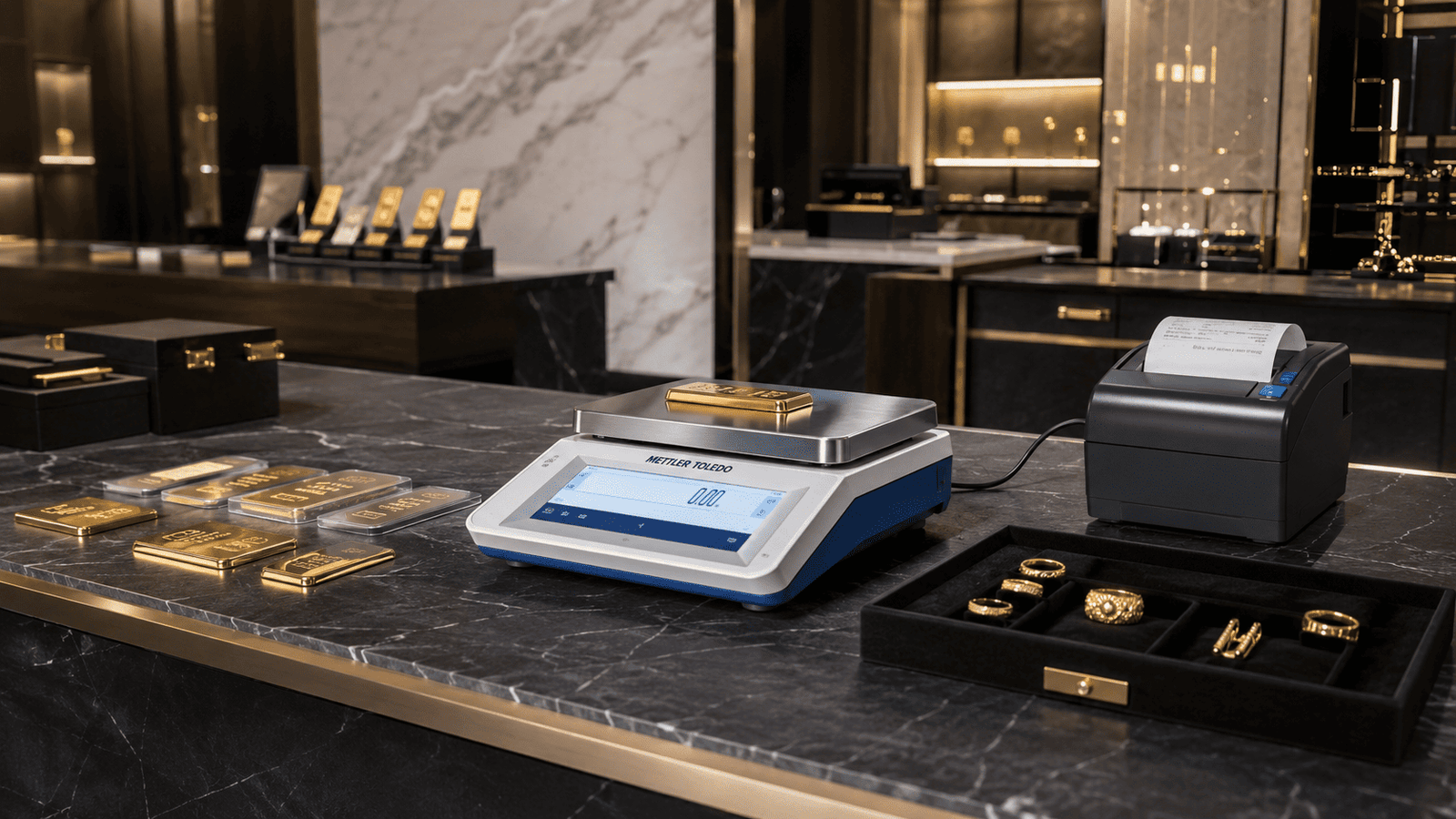
Professional-grade gold scales with data logging and receipt printing are increasingly the norm for wholesale dealers and multi-counter jewellery operations in KSA.
There's a distinction worth understanding clearly: calibration and verification are not the same thing; even though they're used interchangeably in most conversations.
Calibration is a technical process of comparing a scale's readings against a traceable reference standard and documenting the deviation. It tells you how accurate the scale is. Verification is the legal act conducted or authorised by SASO, that confirms the scale meets the requirements of its accuracy class and stamps it as fit for trade use. You can have a calibrated scale that isn't verified. For legal gold trade in Saudi Arabia, you need both.
Calibration should be performed by an accredited laboratory using certified reference weights at minimum OIML F2-class weights for a Class II trade scale, though F1-class is preferred for higher confidence margins. If the organisation doing your calibration can't tell you what class of reference weights they're using, that's a problem worth investigating before you accept their certificate.
What do SASO inspectors check during a Taqyees inspection? Based on the programme's framework and standard legal metrology practice, expect scrutiny across these areas:
We keep seeing the same gap at inspections: operators have certificates somewhere; in an email, in a folder at head office, in the manager's phone, but not physically present and matched to the specific instrument. Keep a laminated copy filed with each scale. It sounds trivial. It stops avoidable violations.
The scale of the sector makes this worth taking seriously. According to World Gold Council data cited in industry research, Saudi Arabia consumed 35 tonnes of gold jewellery in 2024 alone. With gold prices above SAR 10,700 per troy ounce in early 2025, the financial stakes at every point of sale are significant. A scale that's drifted 0.05g out of tolerance across a high-volume trading day isn't a small rounding error — it's a systematic discrepancy touching every transaction that day.
Gold and precious metal trade scales in KSA must meet at minimum OIML Class II (high precision) standards. The scale must be of an approved type, carry the relevant certification documentation, and be verified by SASO's legal metrology programme before being used in commercial transactions. Class III scales; standard retail shop scales, are not appropriate for gold trade use and will not pass a Taqyees inspection.
SASO's Taqyees programme sets the re-verification intervals. Annual verification is a standard expectation for legal metrology instruments used in trade, though specific cycle periods are subject to SASO's regulatory updates. Work with an accredited calibration provider in KSA or contact SASO directly to confirm current cycle requirements for your instrument type and region.
The scale must be immediately removed from trade use until it is repaired, re-calibrated, and re-verified by an authorised body. Continuing to use a scale that has failed inspection or operating an unverified instrument is a violation of KSA's Law of Precious Metals and Gemstones and can result in fines or trading licence suspension.
Yes, provided it carries an OIML type approval certificate from a recognised authority. That certificate establishes that the scale's design and construction meets the international standard. But the certificate alone is not sufficient; the instrument still must go through SASO's in-country verification process before entering trade use. Buying an uncertified scale "because it reads accurately" is not compliant, regardless of how good the readings appear.
Calibration is a technical measurement process: comparing the scale's readings against traceable reference weights and documenting any deviation. Verification is the legal approval from SASO confirming the scale meets the requirements for trade use and affixing the verification seal. For compliant gold trade in KSA, you need both. A calibrated but unverified scale is not legally fit for trade.
Calibration fees vary depending on the scale type, maximum capacity, number of test points, and whether the provider also coordinates SASO verification. For a typical Class II jewellery trade scale in the 200g to 1,000g range, calibration costs in KSA generally start from SAR 200 to SAR 800 for the calibration service alone. SASO verification fees are separate. Contact Global Scales & Systems for current rates and to confirm service availability in your region.
Global Scales & Systems Co. Ltd provides calibration and weighing solutions across Saudi Arabia. Our calibration services cover Class II precision instruments for jewellery and trade applications, with full traceability to SASO-recognised reference standards. We serve traders and businesses in Riyadh, Jeddah, Dammam, and across the GCC. Contact our team for a calibration assessment tailored to your operation.


 Click to start chat