
Milligram Accuracy in Jewellery Scales: 5 Critical Tolerance Numbers Every KSA Gold Trader Must Know
At SAR 589/gram for 24K gold, a 0.1 g scale error costs real money. Learn what tolerance numbers on jewellery scales actually mean for KSA compliance.

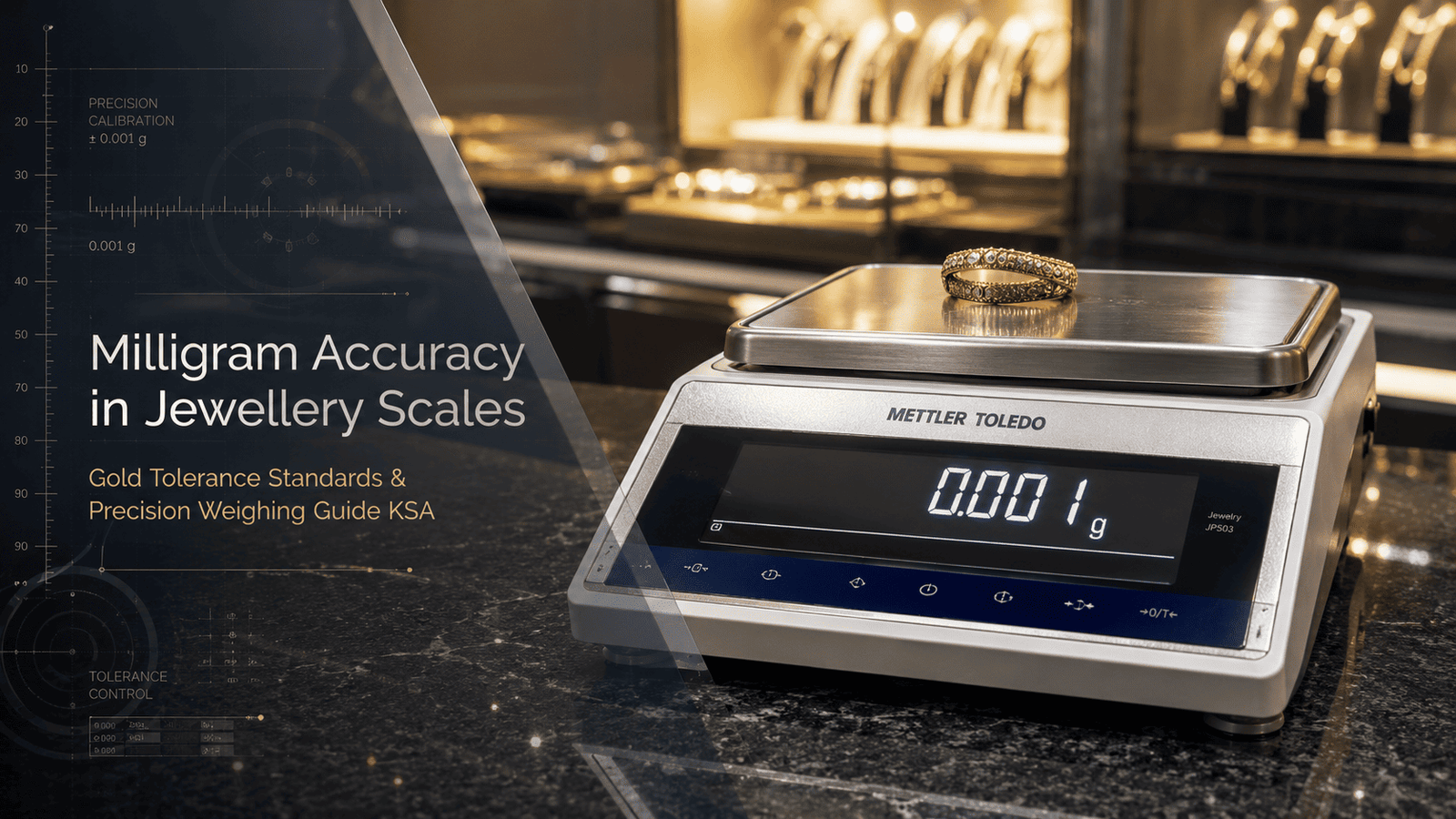
At SAR 589 per gram for 24-karat gold, the approximate retail rate in Saudi Arabia as of May 2026, a milligram-level weighing error is not a rounding inconvenience. It's a financial transaction with a defined SAR value. Run fifty buy-side transactions a day on a scale that's 0.1 gram out of tolerance and you're handing over the equivalent of nearly SAR 2,950 in silent, unaccounted losses before you've closed the shutters for evening prayer. The problem isn't always a dishonest scale. It's a misunderstood one. And the confusion almost always starts in the same place: the tolerance numbers.
Milligram accuracy in jewellery scales is a topic that gets thrown around constantly in the gold trade, but rarely explained well. Terms like readability, verification interval, and maximum permissible error get used interchangeably and they shouldn't. They mean different things, they carry different regulatory weight, and they affect your business in different ways. This article breaks down every number that matters, walks through real instrument specifications, and explains exactly what SASO and OIML compliance requires from any scale operating commercially in Saudi Arabia.
01 The Difference Between Readability and Accuracy (And Why It Costs People Money)
Here is the thing that trips up almost every jewellery retailer who hasn't specifically studied metrology: a scale that displays 0.001 g on screen is not necessarily accurate to 0.001 g.
The display readability represented by the symbol d in the instrument specification is the smallest increment the scale will show you. Think of it as the resolution of the screen. A scale with d = 0.001 g will display values like 12.345 g, moving up and down in steps of one milligram. It looks precise. And in many cases, it is precise. But "precise" and "accurate" are not synonyms in metrology.
Accuracy in a legal sense is governed by a different number: the verification scale interval, written as e. This is the value used by calibration bodies, SASO inspectors, and OIML authorities to assess whether an instrument is performing within its certified tolerance. On some instruments d and e are the same. On others, e is ten times larger than d, meaning the scale might display a result to 0.001 g but only be certified to maintain accuracy within ±0.005 g or more under verification conditions.
And there is a third number that ties everything together: the Maximum Permissible Error, or MPE. The MPE defines the outermost boundary of allowable deviation from true mass that an instrument can exhibit and still be considered compliant. Per the International Organisation of Legal Metrology's recommendation OIML R76, the global standard for non-automatic weighing instruments that SASO adopts as its reference framework — the MPE is expressed as a multiple of e and increases in steps across the weighing range. At low loads, the MPE is a tight fraction of e. As you move toward the instrument's maximum capacity, it relaxes.
So when a vendor tells you a scale is "accurate to a milligram," ask which of those three numbers they're quoting. The answer changes everything.
“ A scale that displays 0.001 g on screen is not necessarily accurate to 0.001 g. Precise and accurate are not synonyms in metrology. — Section 01
02 OIML R76 and Accuracy Classes: Where Jewellery Scales Sit
OIML R76 defines four accuracy classes for non-automatic weighing instruments, designated by Roman numerals: Class I, Class II, Class III, and Class IIII. A jewellery or gold balance operates in Class II, the second-highest classification and that distinction carries specific technical requirements.
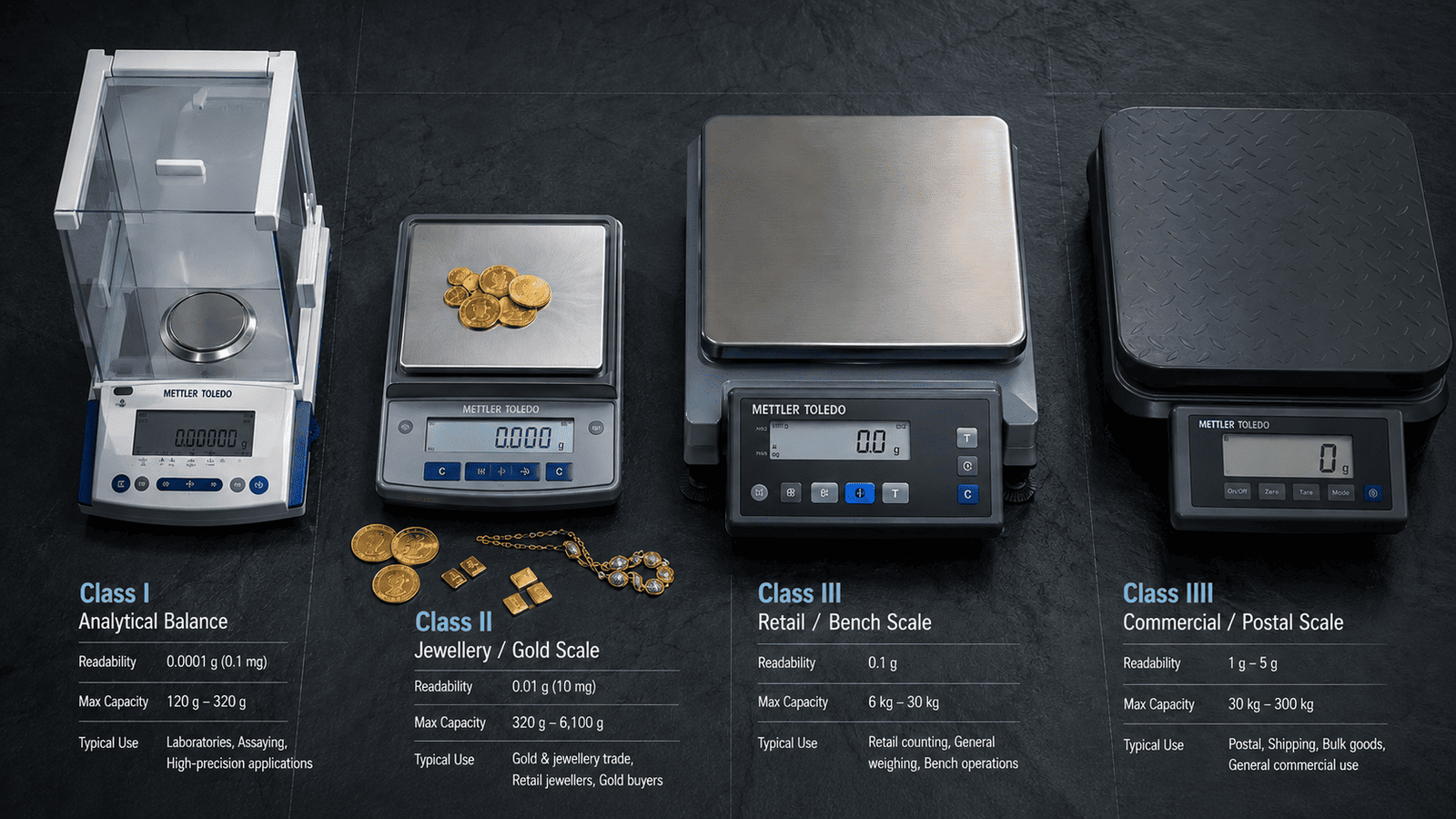
Class I is reserved for analytical and scientific instruments: the kind of equipment you find in ISO 17025-accredited calibration laboratories and pharmaceutical assay environments. These instruments can carry verification scale intervals as fine as 0.001 mg. The infrastructure around them; vibration isolation tables, temperature-controlled rooms, certified reference weights, reflects that extreme precision.
Class II is where commercial jewellery scales live. The verification scale interval e for Class II instruments ranges from 0.001 g down to lower values for specialist carat balances. These are the instruments that appear on counters in gold souqs across Riyadh, Jeddah, and Dammam; in assay offices; in gold trading companies managing physical inventory. For any commercial transaction involving gold or precious metals in Saudi Arabia, a Class II instrument is the appropriate classification.
Class III and Class IIII cover progressively less precise instruments, the kind used in grocery retail, logistics, and bulk commodities, where a gram here or there has far less financial consequence.
The important point for any retailer operating in KSA: SASO, as a full member of OIML, recognises and enforces this classification framework. A scale used for commercial gold transactions needs to be Class II, Legal for Trade, and verified by an accredited body within the calibration cycle mandated for instruments in active commercial use.
03 The 5 Numbers You Need to Understand on Any Jewellery Scale Certificate
When a calibration certificate lands on your desk, it should never go straight into a filing cabinet. It contains five numbers that directly govern your compliance exposure and your margin protection. In working with jewellery retailers and gold traders across the GCC, these certificates are habitually filed unread and that is where problems quietly accumulate.
Number 1: d (actual scale division / readability)
The smallest weight increment the display resolves. This is what you see on screen. It tells you about the instrument's display resolution, not its legal accuracy.
Number 2: e (verification scale interval)
The interval used for determining compliance under OIML R76. This is the number the calibration inspector works to. If d and e differ on your instrument, e is the one that governs your legal position.
Number 3: Max (maximum capacity)
The heaviest load the instrument is certified to weigh accurately. Consistently loading above Max voids the instrument's verification and your compliance standing. Bullion traders loading 500 g gold bars on a scale with a 320 g capacity are operating outside the certified range, regardless of what the screen shows.
Number 4: Min (minimum capacity)
The lightest load at which the instrument can be used for legal-for-trade purposes. Under OIML R76, Min is defined in relation to e, typically 20e for Class II instruments. On a scale with e = 0.001 g, the minimum capacity for legal trade purposes is 0.02 g. Weighing a diamond below that threshold and using the reading for a commercial transaction puts you outside the certified operating range.
Number 5: MPE at each test point
A properly issued calibration certificate will show test loads applied at multiple points across the range, the actual error recorded at each point, and whether that error falls within the MPE for the instrument's accuracy class. Each recorded error should be comfortably inside the MPE limit. Errors that are close to the boundary at the time of calibration signal a scale that is nearing the end of its reliable service life between calibration visits.
Pro tip
When comparing jewellery scale models, always request the full specification sheet showing both d and e values, not just the headline readability figure. On some instruments these numbers differ by a factor of ten, which means the advertised display resolution is not the value that governs legal compliance. The e value is what a SASO inspector will reference during verification.
04 Mettler Toledo JP and JE Series: Spec Walkthrough
The Mettler Toledo JP and JE series are among the most widely specified precision gold and carat balances used by jewellery businesses, assay offices, and gold trading companies across the GCC. Here is what the verified published specifications actually tell you and what those numbers mean operationally.
The JE203G carries a maximum capacity of 220 g and a readability of 0.001 g (1 milligram). That sub-milligram resolution makes it appropriate for detailed gemstone weighing, small fabricated pieces, and transactions involving high-value items where every tenth of a gram carries significant SAR value. Internal adjustment and passcode protection come as standard.
The JE1002G steps the capacity up to 1,200 g with a readability of 0.01 g, and the JE5002G extends to 5,200 g at the same 0.01 g readability, covering the mid-range inventory control and bulk gold weighing that characterises a trading desk managing mixed lots.
For high-capacity work: bullion, large gold bars, inventory batches, the JP32001G offers a maximum capacity of 32,200 g at 0.1 g readability. This is the scale you'd see at a gold refinery taking in raw material, or at a trading house managing kilogram-scale transactions. It uses Mettler Toledo's MonoBloc weighing technology (the entire force measurement system machined from a single piece of material, which eliminates the mechanical tolerances that accumulate when multiple components are assembled). It also carries FACT; Fully Automatic Calibration Technology, which means the scale uses its built-in reference weight to self-adjust whenever ambient temperature drift is detected, without operator intervention.
All JP and JE balances rated as Legal for Trade carry OIML Class II certification and are available in configurations appropriate for commercial use in most OIML member countries, which includes Saudi Arabia under the SASO metrology framework.
| Specification | What It Actually Means for Your Operation |
|---|---|
| FACT internal auto-adjustment | No manual calibration between shift changes — the scale adapts automatically to temperature drift in your showroom |
| OIML Class II Legal for Trade | Compliant for commercial gold transactions under SASO's metrology framework |
| d = 0.001 g (JE203G) | Resolve weight differences of one milligram — relevant at SAR 589/gram, where 10 mg = SAR 5.89 |
| MonoBloc weighing technology (JP series) | Single-piece force sensor eliminates accumulated mechanical tolerances over the instrument's service life |
| Overload protection | Survives accidental overloading — common when handling heavy bullion on a high-resolution balance |
| Stainless steel pan | Withstands cleaning agents, resists corrosion from handling polished metal pieces repeatedly |
| Battery operation | Weigh anywhere in the showroom without hunting for a socket — useful during Hajj season stock-taking |
| Passcode protection | Lock access to calibration settings and unit conversions — prevents accidental or deliberate tampering |
05 The SAR Maths: What Tolerance Really Costs at Current Gold Prices
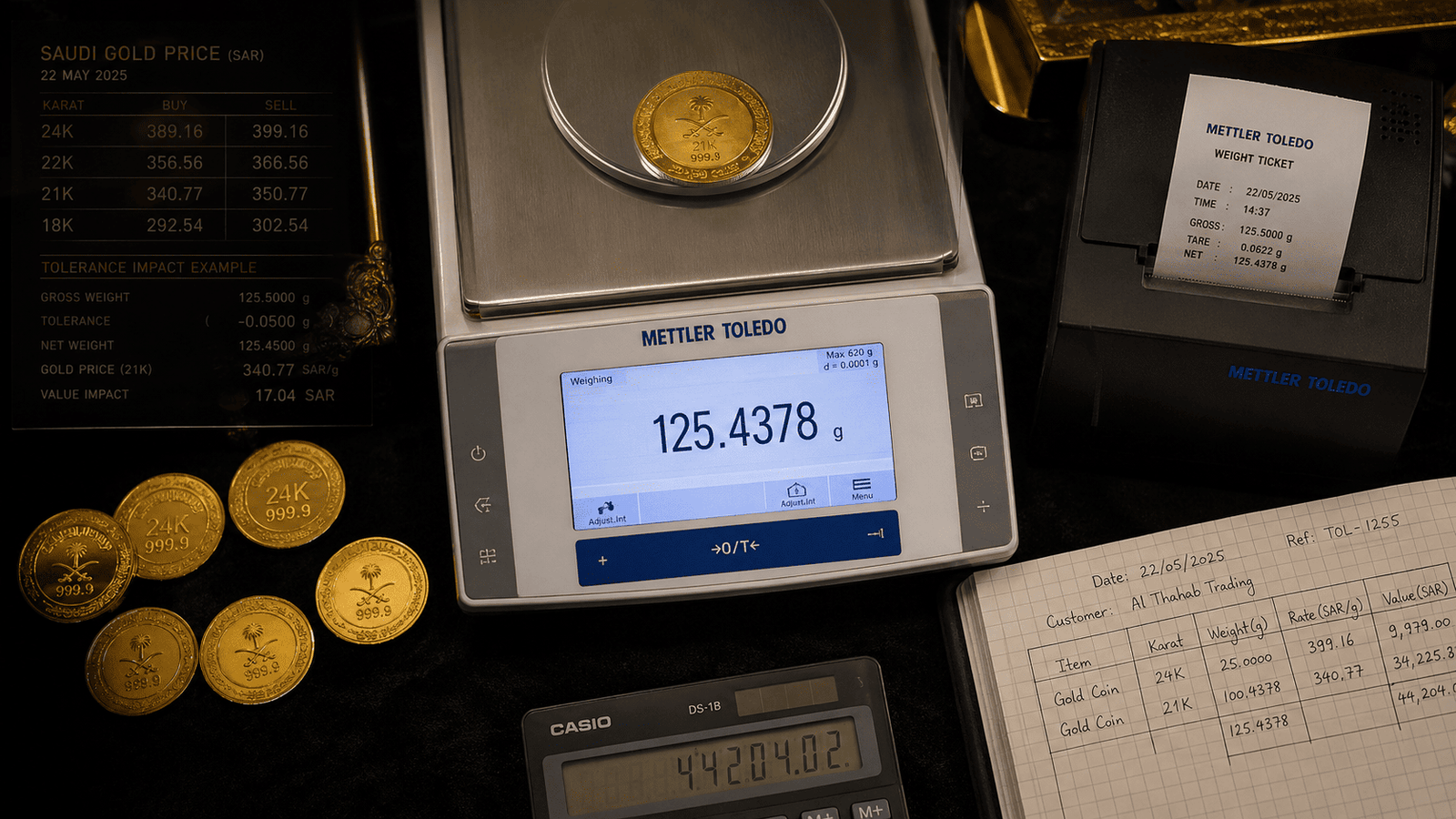
Let's be direct about this: the number people need to understand is not e. It's (e × gold price per gram × daily transaction volume).
With 24K gold currently trading at approximately SAR 589 per gram as at March 2026, in the Saudi retail market, the financial value of one milligram of gold is approximately SAR 0.59. That sounds small. It stops sounding small when you apply it to scale tolerance across a trading day.
The table below shows indicative error values at the current gold price, assuming a scale operating at its maximum permissible error boundary, meaning the scale is just barely compliant but drifting toward the edge of its tolerance.
| Scale readability (d) | Typical e value | MPE at low load | Value of MPE at SAR 589/g | Transactions/day | Max daily exposure |
|---|---|---|---|---|---|
| 0.001 g (1 mg) | 0.001 g | ±0.0005 g | SAR 0.29 per transaction | 100 | SAR 29 |
| 0.01 g | 0.01 g | ±0.005 g | SAR 2.95 per transaction | 100 | SAR 295 |
| 0.1 g | 0.1 g | ±0.05 g | SAR 29.45 per transaction | 100 | SAR 2,945 |
These figures are illustrative calculations based on current market gold prices and OIML R76 Class II MPE principles. They assume a scale operating at its maximum permissible error limit consistently in one direction — which real instruments typically do not do. Actual error distribution is random across transactions. Use these figures to understand exposure risk, not to predict exact losses.
The third row is the scenario that keeps compliance officers at responsible gold trading companies awake. A scale with 0.1 g readability, perfectly acceptable for bulk commodity weighing, does not belong on a counter processing high-value per-gram transactions. At SAR 589 per gram, the instrument's tolerance is operating at a cost scale that is simply not appropriate for the trade being conducted.
This is not a theoretical concern. According to Research and Markets, the Saudi Arabia gold and diamond jewellery market was valued at USD 4.56 billion in 2024 and is projected to reach USD 8.34 billion by 2030 at a CAGR of 10.59%. The market is large enough that instrument compliance matters commercially. And per the World Gold Council, Saudi Arabia consumed 228.1 tonnes of gold over the last five years: 167.1 tonnes of it as jewellery. That is a very large number of individual transactions where scale accuracy has a direct SAR impact.
“ The number people need to understand is not e. It's (e × gold price per gram × daily transaction volume). — Section 05
06 SASO, NMI, and OIML: What Compliance Requires in Saudi Arabia
Saudi Arabia's national standards body SASO , is a member of the International Organisation of Legal Metrology (OIML) which means the OIML R76 framework is the operative reference for non-automatic weighing instruments used commercially in the Kingdom. SASO's metrology division; the National Metrology Institute, or NMI, oversees the traceability chain from primary national standards down through accredited calibration laboratories to the instruments operating on commercial premises.
Any scale used for commercial gold transactions; meaning a transaction where price is determined in whole or in part by a weighing result, needs to be a Legal for Trade instrument certified under OIML R76 Class II or higher. The instrument must carry an OIML certificate (or a national type approval that references OIML R76), must be verified initially before commercial use, and must be re-verified periodically thereafter by an accredited body. The calibration certificate you receive after each verification visit is the documentation that demonstrates this compliance.
Using a non-verified scale or a scale operating outside its certified tolerance for commercial gold transactions creates legal exposure, in terms of regulatory risk in the abstract sense and a concrete problem if a transaction is disputed. In Saudi Arabia, where the Ministry of Commerce and Investment actively enforces consumer protection legislation, a jewellery business found using non-compliant measuring instruments faces administrative action and potential suspension of trading rights.
The practical compliance checklist is short:
- Instrument type approval under OIML R76 Class II (check the marking plate on your scale)
- Current calibration certificate from an accredited laboratory, traceable to national or international standards
- Calibration within the required interval for commercial instruments in active daily use
- Instrument levelled and stabilised in its operating position (moving a calibrated scale and not re-levelling it can immediately affect its accuracy)
Global Scales & Systems provides SASO-compatible calibration and verification services for precision weighing instruments across the KSA and GCC region. If you're unsure whether your instruments' current documentation satisfies the requirements above, that conversation starts with a calibration audit — not a new scale purchase.
Common mistake
Moving a calibrated jewellery scale to a new counter position; even within the same showroom and not re-levelling it immediately compromises its calibration accuracy. Gold balances are sensitive to tilt. The bubble level on the instrument's base is there for a reason: verify it every time the scale changes position, and run a zero check before the first transaction of each shift.
07 How to Read a Jewellery Scale Calibration Certificate Without a Metrology Degree
The calibration certificate that comes with your scale verification is less intimidating than it looks. Here is what to look for:
The header section identifies the instrument: model, serial number, and manufacturer. Cross-reference the serial number on the certificate against the serial number plate on the physical instrument. They must match. Mismatch here is a red flag that the certificate doesn't belong to the instrument being used.
The technical specifications section will state accuracy class (you want Class II for jewellery trade use), d (actual scale division), e (verification scale interval), Max, and Min. These should correspond to the instrument's nameplate. If they don't match, the instrument has either been modified or the wrong certificate has been issued.
The test results section is the most important part. It will show the test loads applied typically at multiple points across the range, including zero, mid-range, and near maximum capacity and the error recorded at each test point. Each error is then compared against the MPE for that load level under OIML R76 Class II. The certificate should show explicitly whether the instrument passed or failed at each point.
A clean certificate shows all test-point errors inside the MPE limits, often with clear numerical margins. A certificate where recorded errors are sitting very close to the MPE limits at the time of calibration suggests the instrument may need attention before the next scheduled calibration interval, particularly if it is used heavily.
The certificate should also state the calibration date, the next recommended calibration date, the accreditation body under which the calibrating laboratory operates, and the reference standards used during calibration (which confirm traceability to national or international mass standards).
Keep a physical copy at the instrument's location. Many SASO-related compliance visits will ask to see this documentation on-site.
08 Frequently Asked Questions
The questions below come up repeatedly when gold traders and jewellery retailers begin to engage seriously with scale compliance for the first time.
What is the difference between readability and accuracy on a jewellery scale?
Readability (d) is the smallest increment the scale displays on screen. Accuracy in a legal sense is governed by the verification scale interval (e) and the Maximum Permissible Error defined under OIML R76. An instrument can show results to 0.001 g on its display but be certified to a coarser e value. Always check the calibration certificate for e and MPE values rather than relying on the display readability alone.
Does SASO require jewellery scales in Saudi Arabia to be calibrated?
Yes. Any weighing instrument used for commercial transactions where price is determined by weight, including gold and jewellery sales, must be a Legal for Trade instrument verified under OIML R76 Class II or higher. SASO, as an OIML member, enforces this framework. Calibration must be performed by an accredited laboratory with traceability to national mass standards, and re-verification is required at intervals appropriate to the instrument's use.
What accuracy class should a gold scale be?
For commercial gold transactions, OIML R76 Class II is the appropriate accuracy class. Class I instruments, used in analytical laboratories, exceed commercial requirements and carry significantly higher cost. Class III instruments are not appropriate for precious metal trade at the per-gram price levels that characterise the Saudi gold market.
How often should a jewellery scale be calibrated in Saudi Arabia?
Calibration frequency depends on usage intensity and the applicable regulatory requirements in your jurisdiction, but most commercial jewellery instruments operating in daily active trade should be verified at least annually. High-volume operations; daily transactions in the hundreds, or instruments handling a wide range of weights, should consider semi-annual calibration. Between calibrations, a daily zero check and a routine test with a certified reference weight helps identify drift before it becomes a compliance or financial problem.
What is FACT on a Mettler Toledo gold balance?
FACT stands for Fully Automatic Calibration Technology. It refers to Mettler Toledo's system whereby the balance uses an internal reference weight to self-check and adjust whenever ambient temperature change is detected, without requiring operator input. In a showroom environment where temperature may vary between morning and afternoon or between an air-conditioned interior and the front counter near an entrance, FACT removes a significant source of drift error that would otherwise require a manual re-calibration step at each shift.
Can I use a scale I bought online for commercial gold weighing in Saudi Arabia?
Only if it carries a valid OIML type approval under Class II, is verified by an accredited calibration body traceable to national standards, and the calibration certificate is current. The physical instrument and its documentation must match. Scales purchased without type approval, or with calibration certificates that cannot be traced to an accredited laboratory, do not satisfy KSA commercial weighing requirements regardless of the display resolution they advertise.
What is the minimum weight I can legally weigh on a jewellery scale for commercial trade?
Under OIML R76, the minimum capacity (Min) is the lowest load at which a scale can be used for legal-for-trade purposes. For Class II instruments, Min is typically 20 times the verification scale interval (e). On a scale with e = 0.001 g, Min = 0.02 g. Weighing items below this threshold for commercial transaction purposes puts you outside the instrument's certified operating range. As your industrial weighing scale, gold scales, and calibration compliance partenr in Saudi Arabia and all of GCC, we are just a call away. What are you waiting for, reach out today for all your weighing needs and stay compliant.

 Click to start chat