
What Readability Really Means on a Gold Scale (And Why 0.001g Changes Everything)
What every gold and jewellery business in Saudi Arabia needs to know about scale readability, 0.001g precision, SASO compliance, and OIML R76 certification to avoid disputed transactions.

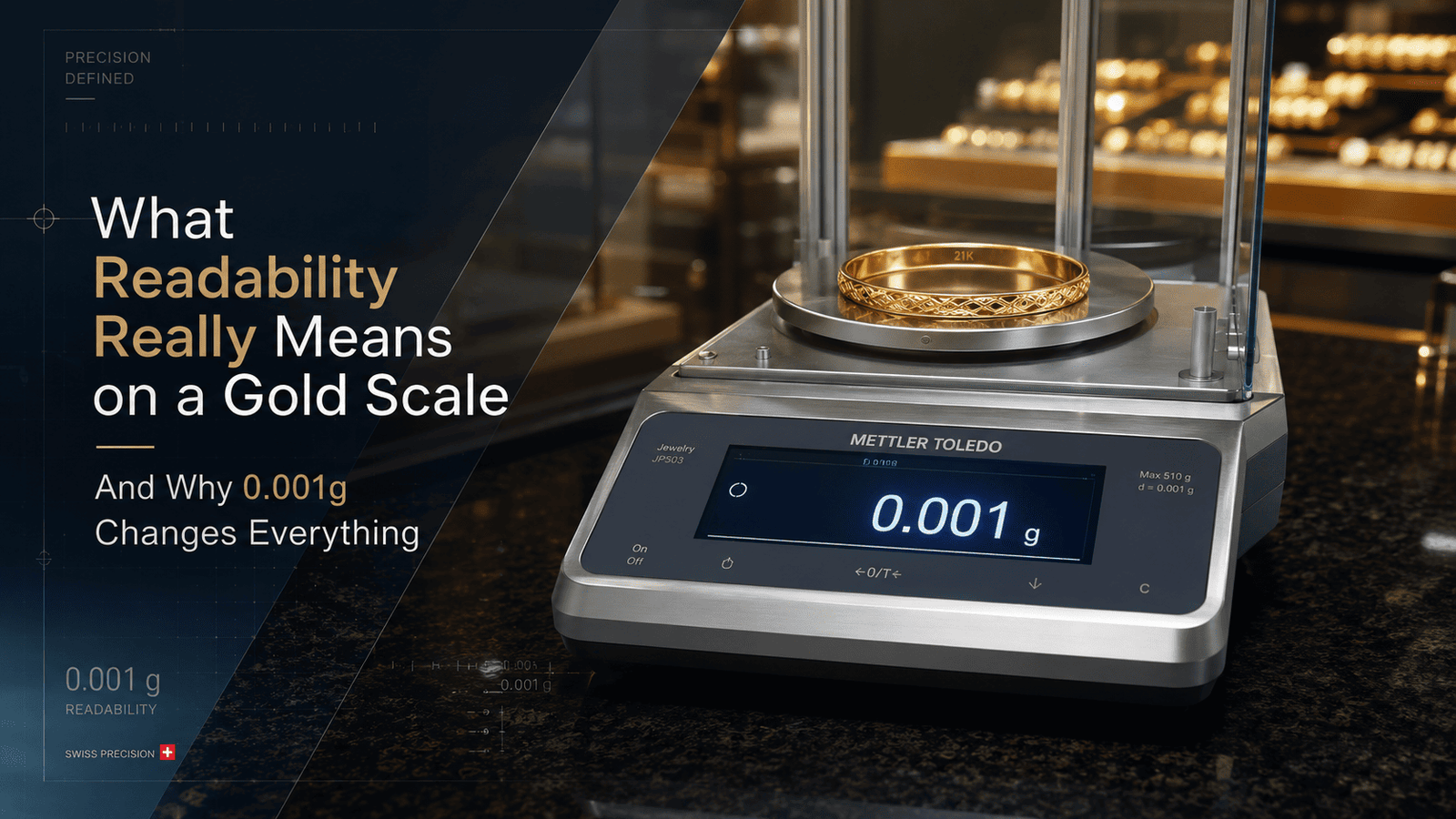
A jeweller in Riyadh runs a busy counter. On a given morning, he weighs forty-seven pieces before noon. His scale reads to 0.1g accuracy. He thinks it's fine; atleast calibration sticker is current, the number comes up fast. What he doesn't know is that on 21K gold priced at around SAR 530 per gram, each 0.1g rounding error is worth roughly SAR 53 per transaction. Over forty-seven transactions, that silent drift could swing several thousand riyals in either direction before lunch. Understanding what readability really means on a gold scale is not an abstract technical exercise. It is the difference between a profitable trade counter and one that bleeds margin quietly, transaction by transaction.
01 Readability Is Not the Same as Accuracy and the Difference Costs Money
Most buyers use the words "readability," "accuracy," and "precision" interchangeably. They are not the same thing, and conflating them is one of the most common and expensive mistakes in jewellery weighing.
Readability is the smallest increment a scale can display. A scale with 0.1g readability shows weight in steps of one-tenth of a gram. A 0.01g scale shows one hundredth. A 0.001g scale also called a milligram balance shows steps of one thousandth. The display is finer. But displaying a small number is not the same as getting that number right.
Accuracy refers to how close the displayed reading is to the true mass. A scale can have 0.001g readability and still be off by 0.01g if it isn't calibrated correctly, if it's placed on a vibrating surface, or if the ambient temperature has drifted. Readability is the resolution of the instrument; accuracy is how well it lives up to that resolution under real-world conditions.
Repeatability, sometimes called precision, means that if you weigh the same piece ten times in a row, you get the same number every time. A repeatable scale isn't necessarily accurate, but it is consistent. In a trade setting, consistency is what builds trust. Inaccuracy you can correct with calibration. Inconsistency is much harder to manage.
Here's why this matters practically: when you buy a scale marketed as "0.001g readability," you're being told the finest step the display can show. You are not automatically being told that it can actually distinguish between 5.000g and 5.001g under your shop conditions. That question whether the instrument can back up its readability with real-world accuracy is where OIML R76 and SASO compliance enter the picture, and it's where the gap between cheap scales and certified instruments becomes financially significant.
02 The SAR/Gram Maths That Make 0.001g Matter
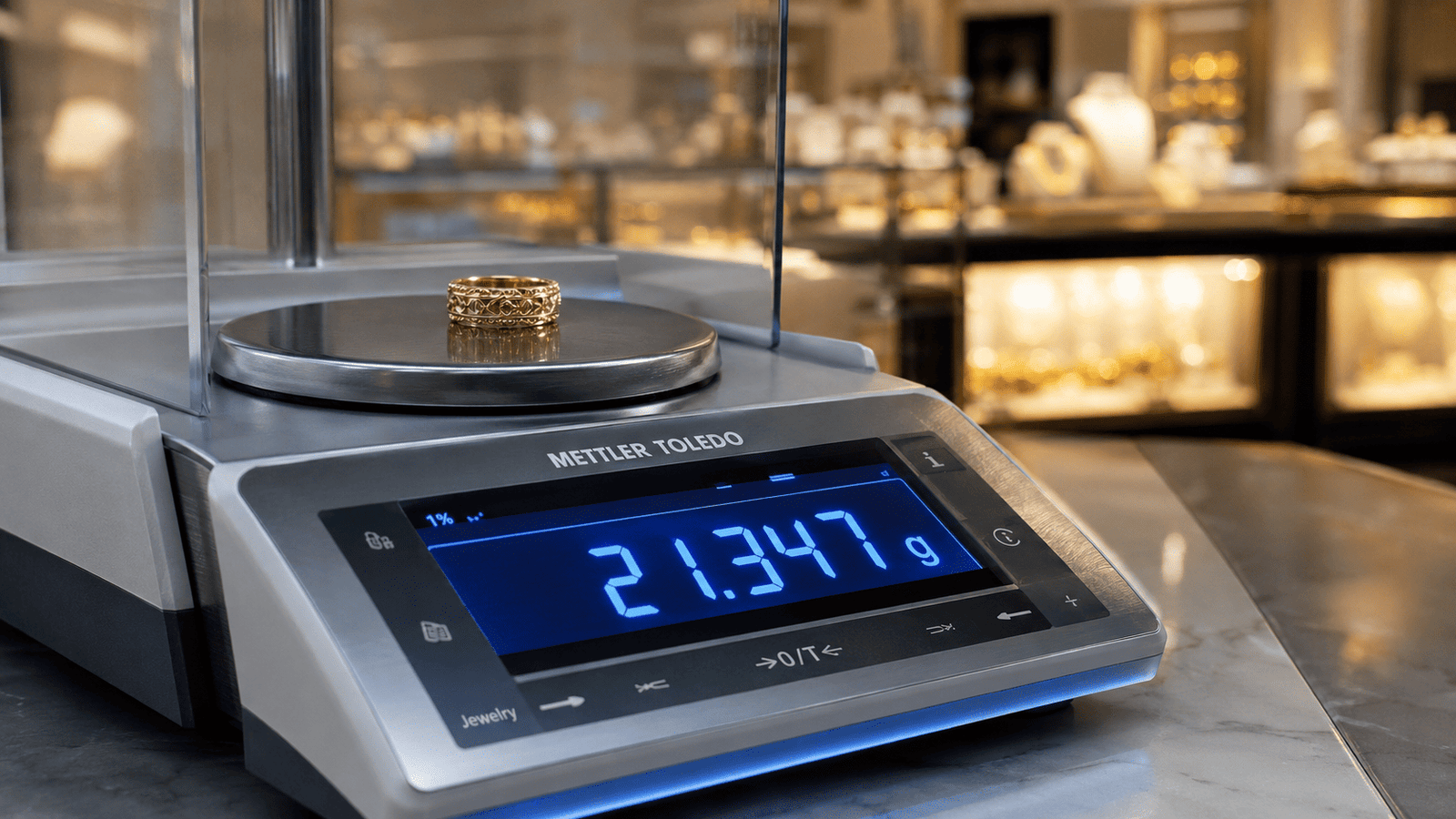
Let's put some real numbers on this. As of May 2026, the spot price for 24K gold in Saudi Arabia is running at approximately SAR 560–589 per gram, according to market data. For 21K gold, the grade most commonly traded at retail in KSA, the rate sits around SAR 520–540 per gram.
At SAR 530 per gram, here is what each increment of imprecision is actually worth:
| Readability Step | Value per Increment (21K at SAR 530/g) | Daily Impact (50 transactions) |
|---|---|---|
| 0.1g | SAR 53.00 | Up to SAR 2,650 of daily pricing ambiguity |
| 0.01g | SAR 5.30 | Up to SAR 265 of daily pricing ambiguity |
| 0.001g | SAR 0.53 | Under SAR 27 — essentially negligible |
That table is not theoretical. Every time a 0.1g-readability scale rounds a weight up or down to the nearest tenth, it introduces up to SAR 53 of ambiguity into that transaction. Scale in favour of the buyer consistently, and the jeweller loses. Scale in favour of the house consistently, and customers don't come back.
A 0.001g scale reduces that ambiguity to 53 halalas per transaction, essentially negligible at the human scale of a single piece. Multiply that improvement across a busy counter doing 50 to 100 transactions a day, and you're removing hundreds of riyals of daily pricing noise. And as Research and Markets notes, the Saudi gold and diamond jewellery market was valued at USD 4.56 billion in 2024 and is projected to reach USD 8.34 billion by 2030 at a 10.5% CAGR. That growth means more volume, more transactions, and more instances where this precision gap compounds.
“ A 0.1g scale introduces up to SAR 53 of pricing ambiguity per gold transaction. Over fifty trades in a day, that is a swing of SAR 2,650 you cannot account for. — Section 02
03 SASO, NMI, and OIML R76: What Calibration Compliance Actually Requires
This is where a lot of jewellery businesses in KSA are unknowingly operating on the wrong side of the regulations. In Saudi Arabia, weighing instruments used in commercial trade, including gold and jewellery scales at retail counters, are subject to oversight by the Saudi Standards, Metrology and Quality Organization (SASO) and the National Metrology Institute (NMI). The international technical benchmark underpinning both is OIML R76, the global recommendation for non-automatic weighing instruments published by the International Organization of Legal Metrology.
Under OIML R76, scales are categorised into accuracy classes from Class I (the most precise, sometimes called "special accuracy") through Class II, III, and IIII. For jewellery weighing in commercial trade, the relevant class is almost always Class I or Class II, depending on the capacity and scale interval being used.
Crucially, OIML R76 doesn't just set a readability requirement, it sets a maximum permissible error (MPE) at each load point. A scale claiming Class I performance at 0.001g readability must demonstrate that its reading error, under test conditions, stays within defined tolerances across the entire weighing range. This is different from a scale that merely displays four decimal places. Display resolution and legal-for-trade certification are two entirely different things.
In practice, this means that for any gold counter operating under a trade licence in Saudi Arabia, the scale used for pricing must be a certified instrument that has been type-approved under SASO/NMI guidelines and periodically verified by an accredited calibration body. A scale bought online for SAR 150, even if it shows "0.001g" on the display, almost certainly doesn't meet this standard, and operating with it at a trade counter is a compliance risk.
Common mistake
A scale that displays "0.001g" on its screen is not automatically SASO-certified or OIML R76 compliant. Type approval, NMI verification, and a current calibration certificate are all separate requirements and all required for legal commercial gold trade in KSA. If you cannot produce those documents at an inspection, the instrument's display resolution is irrelevant.
This issue comes up constantly when working with new jewellery clients across Riyadh and Jeddah. The scale looks professional. The display shows milligrams. But there's no SASO mark, no NMI verification record, no calibration traceability. That's not a compliance technicality, what you have is a liability in the event of a commercial dispute.
04 The Three Scale Tiers: Choosing the Right Readability for Your Operation
Not every jewellery operation needs the same instrument. Here's how to think about it clearly.
0.1g Readability — The Wrong Tool for Gold Trade
A 0.1g scale (Class III or IV in most configurations) is fine for things like fruit, deli counters, or postal weighing. For gold jewellery priced by the gram? At SAR 530/gram, you're pricing in SAR 53 steps. The only time a 0.1g scale belongs in a jewellery environment is for rough weight estimation of large bulk quantities and even then, it should never be the transaction instrument.
0.01g Readability — The Minimum Acceptable Threshold
A 0.01g precision balance is the floor for any commercial gold trade counter. At SAR 530/g, each step is SAR 5.30, manageable for mid-weight items like bracelets and necklaces, but still introducing meaningful ambiguity for small pieces like earring components or gold chains sold by gram weight. Suitable for most retail trade counters under OIML Class II certification, and widely used across the Kingdom. If you're running a busy counter on a tight equipment budget, this is the minimum you should accept, but it's not the target though.
0.001g Readability — The Professional Standard
For fine jewellery, diamond-set pieces, gem trading, or any operation where per-piece accuracy matters, 0.001g is the professional standard. At this level, your pricing step in SAR is under 1 riyal. It's also the standard required by most certified assay labs and gem evaluation centres operating under NMI guidelines in KSA. At this tier, pricing disputes at the counter essentially stop and that alone justifies the instrument cost many times over.
“ Moving a gold counter to 0.001g readability is the single change that most reliably stops customer pricing disputes at the point of sale. — Section 04
05 Why Saudi Arabia's Climate Makes Readability Even More Critical
Here's something the spec sheet won't tell you: a 0.001g scale that performs perfectly in a temperature-controlled European lab does not automatically perform the same way inside a Jeddah shopping mall or a Riyadh souk in July. Precision balances are sensitive to temperature changes, drafts, vibration, and humidity; all of which are present in KSA retail environments. A poorly designed or improperly installed instrument can drift meaningfully between morning calibration and afternoon transactions when ambient temperatures shift. This is not speculation; it's the physics of load cell electronics.
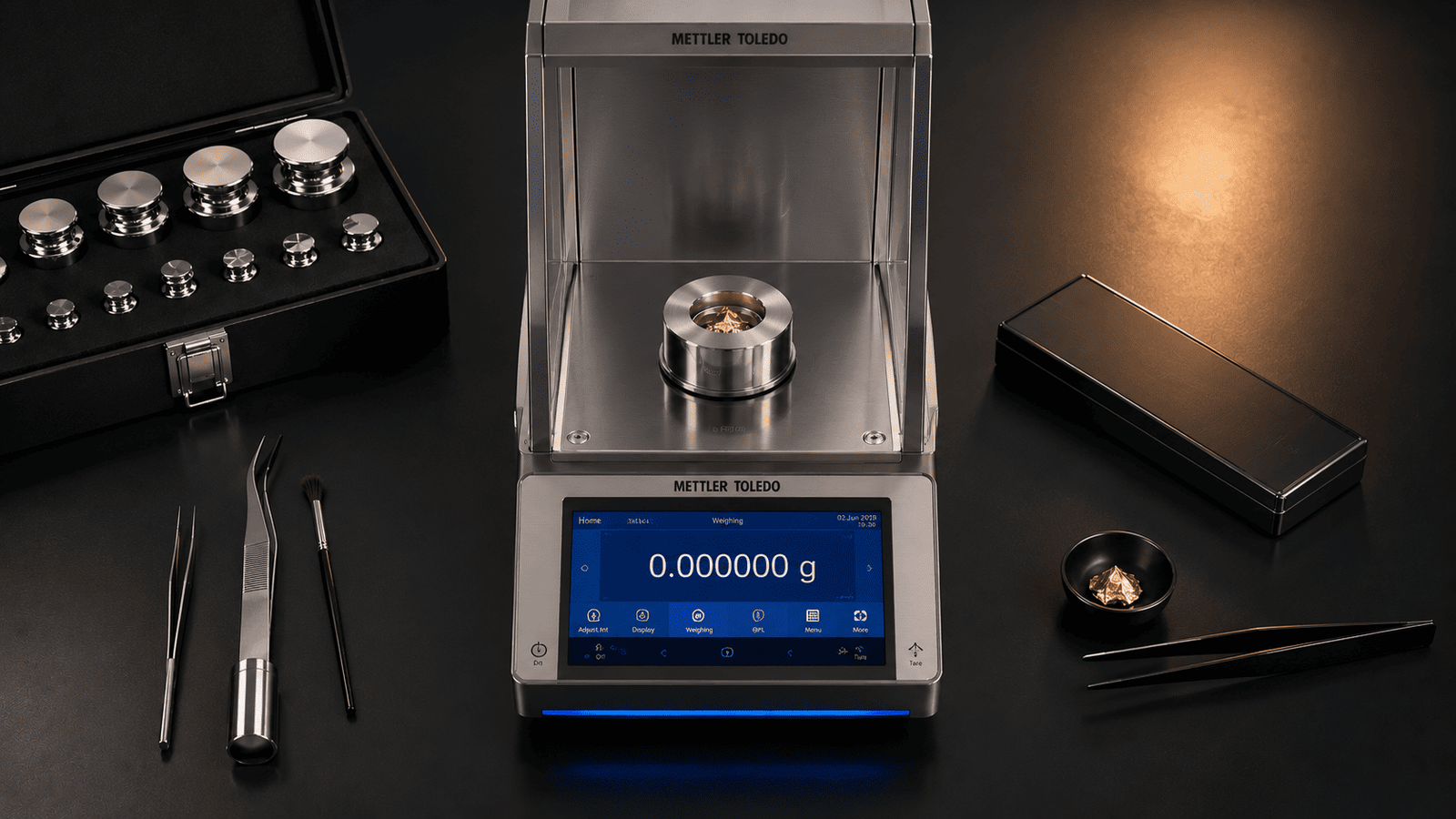
What this means practically is that readability and accuracy performance should be evaluated under your actual operating conditions, not just from a datasheet. Look for instruments with internal auto-calibration, sometimes called ProFACT or FACT (Fully Automatic Calibration Technology), which adjusts the instrument automatically when temperature shifts are detected. In KSA, this feature isn't a luxury option. It's a reliability essential.
The installation environment matters just as much as the instrument. A vibrating surface from a nearby HVAC unit, or a counter positioned next to a frequently opening door, will degrade real-world readability performance. We've seen 0.001g instruments effectively performing at 0.005g consistency when sited incorrectly. The instrument matters. The installation matters equally.
Pro tip
When commissioning a new jewellery balance in KSA, always request a site acceptance test, not just a factory calibration certificate. A calibration performed at your location, under your ambient temperature and surface conditions, is the only reliable baseline for ongoing performance monitoring. A certified supplier should be able to provide this as part of the commissioning process.
06 Feature → Benefit: What to Look for in a Compliant Gold Scale
Not all scales marketed for jewellery are built equally. Here is what each key specification actually means for your trade counter operations.
| Feature | What It Actually Means for Your Counter |
|---|---|
| OIML R76 Class I or II certified | Legally valid for commercial gold trade in KSA; protects you in any pricing dispute or SASO inspection |
| Internal auto-calibration (FACT/ProFACT) | Scale self-corrects when ambient temperature shifts — critical given KSA climate variability between morning and afternoon |
| Draft shield enclosure | Eliminates air current interference; essential for milligram-level repeatability in retail environments with foot traffic and air conditioning |
| Stainless steel weighing pan | Resists corrosion and residue transfer; easy to clean between different gemstone types without affecting the next measurement |
| RS-232 / USB data interface | Connects directly to your POS or inventory system — eliminates manual data entry errors that defeat the purpose of precision weighing |
| GLP/GMP timestamped print output | Generates a dated, auditable record of each weighing — essential documentation for commercial dispute resolution and compliance records |
| 0.001g readability, 200–500g capacity | Covers 99% of jewellery pieces without repeated taring; capacity headroom for heavier necklaces and bangles without switching instruments |
| NMI/SASO verification mark | The only proof the instrument has been validated for legal-for-trade use in the Kingdom of Saudi Arabia |
07 Indicative Price Ranges: Gold Scale Tiers for KSA Jewellers
Scale pricing in Saudi Arabia varies significantly by readability tier, certification level, and whether the instrument includes commissioning and calibration. The following table gives realistic budget guidance.
| Scale Tier | Readability | Typical Use Case | Est. Price (SAR) | Est. Price (USD) |
|---|---|---|---|---|
| Basic precision balance | 0.01g, Class II | Mid-volume retail counter | SAR 1,200–3,500 | $320–$935 |
| Professional jewellery balance | 0.001g, Class I | High-volume trade counter, gem lab | SAR 3,500–9,000 | $935–$2,400 |
| Analytical balance (lab-grade) | 0.0001g (0.1mg) | Assay labs, fine gem grading, R&D | SAR 9,000–22,000 | $2,400–$5,870 |
| Certified verification balance | 0.001g with NMI cert | Regulated trade, SASO-registered counters | SAR 5,500–14,000 | $1,470–$3,735 |
Exchange rate basis: 1 USD ≈ SAR 3.75. All figures are indicative market estimates only and do not constitute a formal quotation.
08 A Growing Market Demands Tighter Tolerances
The commercial argument for 0.001g goes well beyond compliance. According to Bonafide Research's 2026 report on Saudi Arabia's gold jewellery sector, the market is forecast to grow at more than 10.39% CAGR from 2026 to 2031, driven by weddings, gifting culture, and rising luxury spending across the Kingdom. That growth means more competition, more sophisticated buyers, and tighter scrutiny of trade practices.
Saudi consumers, particularly the younger demographic that Vision 2030 is actively cultivating, arrive at the counter knowing the spot price. They've checked it on their phones before they walked in. When your scale and their phone agree to within a fraction of a gram, the transaction is smooth. When there's a rounding discrepancy that costs them SAR 50 on a SAR 2,000 purchase, the trust that took years to build disappears in seconds.
This is the reputational argument for precision, alongside the compliance one. It's not just about being legally correct. It's about being commercially credible in a market growing faster than almost any other in the region.
09 Frequently Asked Questions
These are the questions we hear most often from jewellery businesses evaluating precision scales in KSA.
What does readability mean on a gold scale?
Readability is the smallest weight increment a scale can display, for example, 0.001g means the display updates in steps of one thousandth of a gram. It is not the same as accuracy (how correct the reading is) or repeatability (how consistent it is across multiple weighings). All three properties matter for commercial gold trade, and all three are governed by OIML R76 certification standards.
Why does 0.001g readability matter for gold jewellery in Saudi Arabia?
With 21K gold priced at approximately SAR 520–540 per gram in 2026, each 0.001g step is worth around 0.53 SAR. For comparison, a 0.1g scale introduces up to SAR 53 of rounding ambiguity per transaction, which compounds across dozens of daily transactions into meaningful margin loss or customer trust erosion. Milligram readability eliminates that ambiguity at the counter level.
Is a SASO-certified scale required for gold trade counters in KSA?
Yes. Weighing instruments used in commercial trade in Saudi Arabia are subject to SASO and NMI oversight, and must comply with the technical requirements of OIML R76 for their accuracy class. Using an uncertified instrument at a trade counter is a compliance risk and can invalidate pricing in the event of a customer dispute or regulatory inspection.
What is OIML R76 and does it apply to jewellery scales?
OIML R76 is the International Organization of Legal Metrology's recommendation for non-automatic weighing instruments. It defines accuracy classes (I through IIII), maximum permissible errors, and testing requirements. For jewellery and gold trade, Class I (special accuracy) or Class II (high accuracy) instruments are required. Saudi Arabia's SASO and NMI framework aligns with OIML R76 standards.
How often does a jewellery scale need calibration in Saudi Arabia?
The standard recommendation for precision balances in commercial trade use is at least once per year, conducted by an NMI-accredited calibration body and documented with a traceable calibration certificate. High-volume or high-temperature environments, which describes most KSA retail settings, may warrant more frequent verification. Internal auto-calibration features are not a substitute for periodic third-party verification.
What happens if my gold scale drifts in Saudi Arabia's heat?
Electronic load cells are sensitive to temperature changes. In KSA's climate, a scale without internal auto-calibration can drift measurably between morning and afternoon. This means a scale that reads accurately at 9 AM may be 0.005g–0.02g off by 2 PM without the operator realising it. Internal motorised calibration systems detect temperature shifts and self-correct. In KSA, this feature should be considered mandatory, not optional.
Can I use a basic kitchen or postal scale for gold weighing at my counter?
No. Kitchen and postal scales are typically Class III or IV instruments with 0.1g or 1g readability, far outside the tolerance required for gold trade. They are not type-approved for commercial precious metal transactions, carry no SASO certification, and their use at a trade counter creates legal and financial exposure. The price difference between a basic scale and a certified jewellery balance is marginal compared to the regulatory and pricing risk it eliminates.
Global Scales & Systems Co. Ltd. is the official Mettler Toledo partner for Saudi Arabia and the GCC, supplying, installing, calibrating, and servicing the full range of precision jewellery and gold scales across the Kingdom, with coverage in Riyadh, Jeddah, the Eastern Province, and beyond. Reach out today for a project-specific consultation.

 Click to start chat