
Portable Gold Scales vs. Bench Scales: 5 Proven Use Cases Every KSA Field Trader Must Know Before Buying
They're not competing products, they're purpose-built for different workflows. A real-world guide for field traders and goldsmiths in Saudi Arabia, with SASO compliance context.

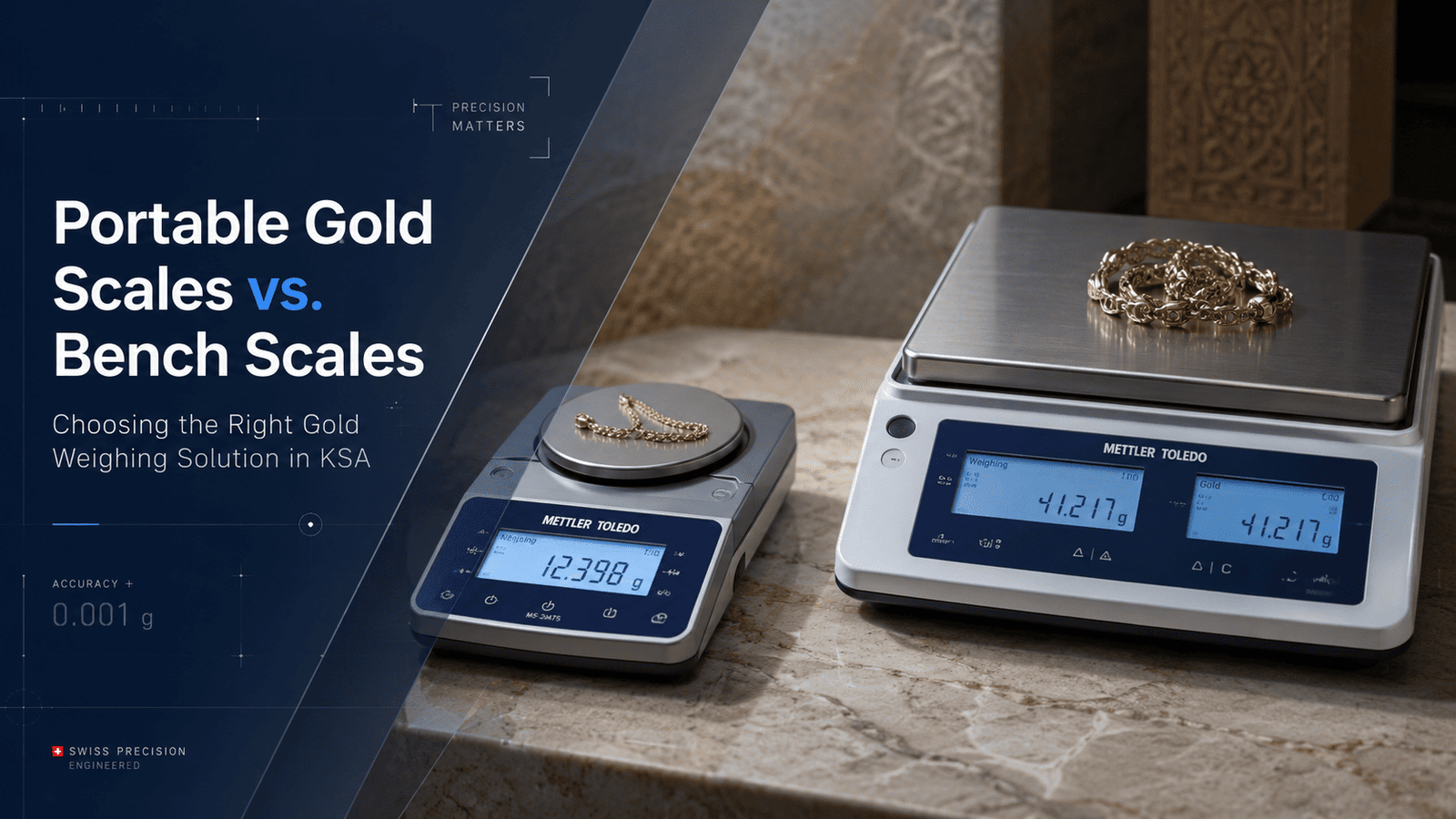
A goldsmith in Jeddah's Al-Balad souk is in the middle of negotiating a 21K necklace purchase. He reaches under the counter, pulls out a compact battery-operated balance, drops the piece onto the pan, and the reading stabilises at 0.01g precision within a second. Transaction done. No fumbling for a power cable. No second display facing the buyer at an awkward angle.
Thirty kilometres away, a jewellery showroom on Prince Sultan Road is running end-of-month inventory on 200 pieces. The shopkeeper needs both hands free, a large weighing pan to handle tangled chains and multi-piece sets, an internal calibration weight he can trigger with one keypress, and a secondary display so customers can see the reading without leaning over the counter. That's a completely different job, and it needs a completely different tool.
The debate between portable gold scales vs. bench scales comes down to this: they're not competing products. They're purpose-built for different workflows. Getting that wrong is expensive, either in operational friction, or in compliance exposure you didn't plan for.
01 What "Fit for Trade" Actually Means for Gold Sellers in Saudi Arabia
Before we compare features, let's be clear about one thing: in Saudi Arabia, any scale used in a gold transaction that affects pricing must meet legal metrological standards. This isn't optional, and it's not theoretical.
SASO, through its Taqyees legal metrology programme, specifically addressed the challenges facing the gold and jewellery sector in calibrating weighing instruments. The initiative brought together SASO leadership and the National Committee for Jewellery and Gemstones to resolve calibration gaps in the sector, which tells you how seriously the Kingdom takes the accuracy of gold weighing equipment.
Saudi Arabia's Law of Precious Metals and Gemstones goes further. It sets penalties for anyone who "deceives or cheats in the type, weight, or purity of precious metals." The word weight is right there in the law. Using an uncalibrated or non-approved instrument isn't just bad practice, it's a liability.
Both portable and bench scales can be "legal for trade" if they carry the right certification. OIML (International Organisation of Legal Metrology) approval is the most widely accepted standard in KSA and across the GCC. What matters is that the instrument is approved, calibrated, and used correctly in its intended environment. A portable scale running on batteries at a souk exhibition is perfectly legal for trade, if it's certified and in calibration. A high-end bench scale that hasn't been recalibrated since it was installed twelve months ago? Not so much.
Common mistake
Buyers invest in the right hardware, then treat calibration as someone else's problem. In a legal-for-trade context, the instrument's certification is only as good as its last calibration. An expensive bench scale that's twelve months overdue on calibration is non-compliant regardless of its OIML marking. Build the calibration schedule into your purchase decision from day one.
02 Where Portable Gold Scales Win
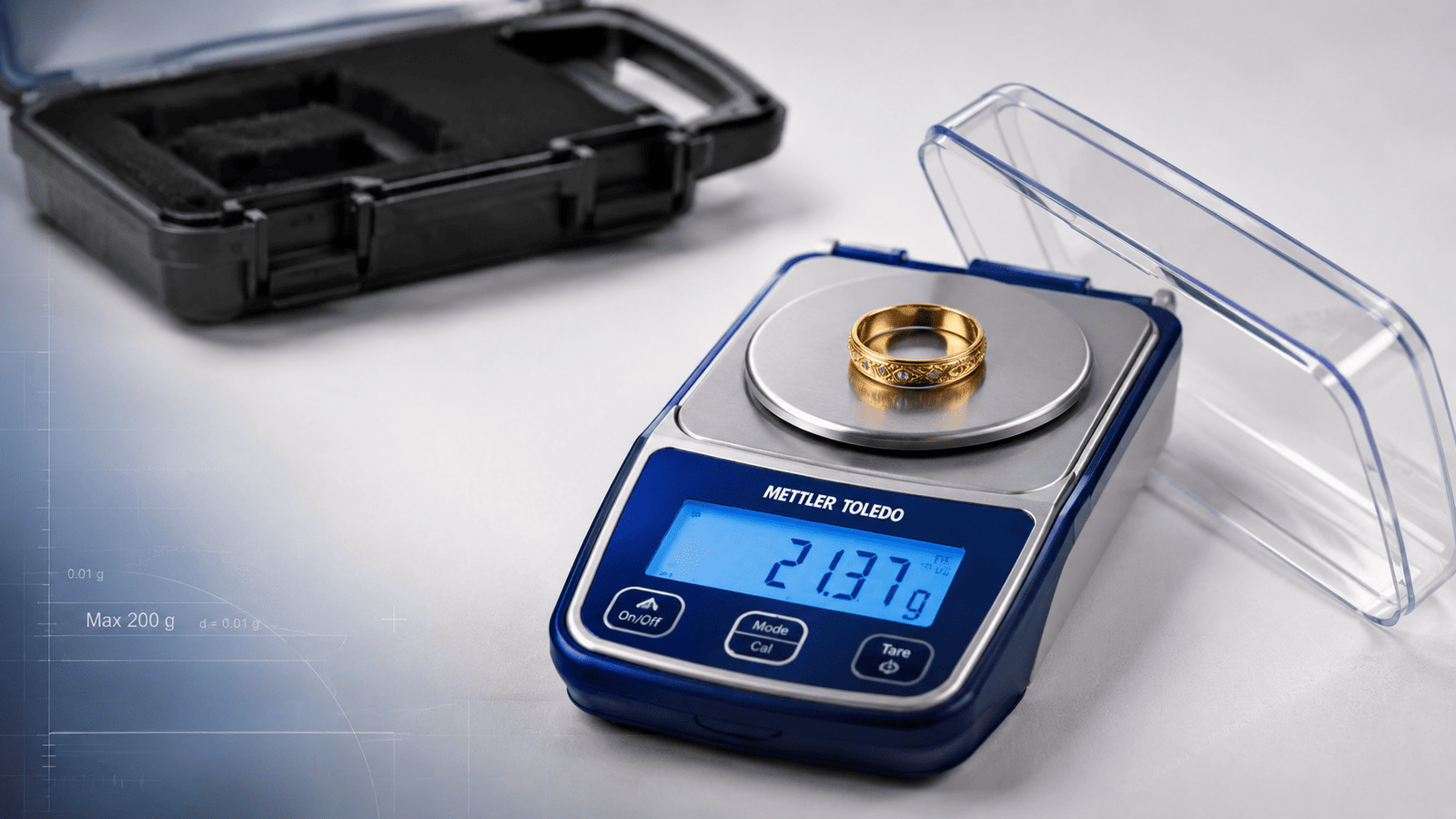
Portable scales exist because gold trading doesn't only happen at fixed counters. Here are the scenarios where they're genuinely the right tool.
Field Buying and Souk Visits
A field buyer travelling between multiple souk locations in a single day can't lug a mains-powered bench unit from stall to stall. Portable battery-operated balances like the Mettler Toledo JL series were built for exactly this. The JL602GE weighs up to 620g at 0.01g readability and runs on batteries. The JL1502GE extends that to 1,520g. Both fit in a padded carry case, stack for storage, and are available as legal-for-trade versions in most countries, including OIML-approved variants.
That 1,520g ceiling covers the vast majority of gold jewellery trade transactions. A complete set of bangles, a heavy necklace, a mix of rings, you'd rarely hit that limit in a buying trip. And at 0.01g readability, you're well within the precision required for commercial gold weighing.
Pop-Up Exhibitions and Jewellery Trade Shows
Saudi Arabia hosts major jewellery events throughout the year. Saudi Luxury Week runs in Riyadh and Jeddah. Regional trade shows attract exhibitors from across the GCC. At these venues, power sockets are unreliable, counter space is minimal, and you need a scale that travels in your luggage without drama.
A portable balance with a dust cover that doubles as a stacking tray, a footprint smaller than an A4 sheet, and a built-in density determination application, which lets you check gold purity by measuring displacement weight, is serious kit for exhibition use. The buyer across the table sees a professional, credible transaction.
Travelling Goldsmiths and Home Service Calls
There's a growing segment of travelling goldsmiths in KSA who visit clients at home or in private offices for repair assessments, piece valuations, or custom commission consultations. For this context, portable is non-negotiable. Battery operation means no dependency on the client's power outlet. A small form factor means the scale doesn't intimidate a domestic setting.
The JL series supports 16 different weighing units including mesghal and tola, which are still used in parts of the traditional Saudi gold trade. That's not a minor detail for a travelling goldsmith working with clients who quote gold weight in regional units.
“ A portable balance that supports mesghal and tola isn't a luxury feature, for a travelling goldsmith in KSA, it's the difference between a credible transaction and an awkward conversion. — Section 02
03 Where Bench Scales Are the Smarter Call
A bench scale is designed for a fixed location where volume, repeatability, and customer-facing transparency matter more than portability.
High-Volume Retail Showrooms
A jewellery showroom processing dozens of purchases a day needs a scale that performs consistently without manual intervention. The Mettler Toledo JE series bench balances feature internal motorised calibration, meaning the instrument adjusts itself using a built-in reference weight, without any external calibration weights to track, lose, or incorrectly apply. The JE1002G handles up to 1,200g at 0.01g readability. The JE3002GE extends capacity to 3,200g.
That larger pan matters. A retail counter sees multi-piece weighings, long necklaces that won't sit flat on a small circular pan, and sets being weighed together for bundle pricing. The JE series has a wider rectangular pan, 180mm x 180mm on the JE3002GE, designed for exactly this.
Goldsmith Workshops and Manufacturing Units
A bench scale in a workshop context has a different demand profile. The goldsmith needs to weigh raw gold alloy before casting, measure finished weight against spec, and track metal loss through the fabrication process. These are precision tasks performed at a fixed station, often with power available and no particular need for mobility.
Internal calibration is especially valuable in a workshop where the bench vibrates, the ambient temperature fluctuates from the furnace heat, and the person operating the scale doesn't have time to run a manual calibration routine before every use. The scale self-corrects. The JE series also connects to printers, secondary displays, and wireless Bluetooth adapters, meaning weight records can be logged directly to a PC or printed for the workshop's job tracking records.
Inventory Counting and Assay Verification
End-of-day inventory is a fixed-location task. So is gemstone density measurement for purity verification. Bench scales with a stable AC power supply and a large base area for totalization weighing, where you place multiple pieces on the pan and accumulate a running total, are simply more ergonomic for sustained use over 30 to 90 minutes of counting.
04 The Comparison: What Each Format Gets Right
Here's a direct breakdown for decision-making. The readability is identical across both formats, 0.01g precision at equivalent price points. The difference is operational context, not accuracy.
| Factor | Portable Scale (e.g. JL series) | Bench Scale (e.g. JE series) |
|---|---|---|
| Power source | Battery (4×AA) or mains | Mains (AC) |
| Calibration method | External (manual weight required) | Internal (motorised, one-touch) |
| Weighing pan size | Small circular pan | Large rectangular pan (up to 180×180mm) |
| Connectivity | RS232 | RS232, printer, secondary display, wireless |
| Best use | Field buying, souk, exhibitions, travel | Showroom counter, workshop, inventory |
| Portability | Carry case included, stackable | Fixed installation |
| Typical capacity | 620g to 1,520g | 1,200g to 3,200g |
| Readability | 0.01g | 0.01g |
| Legal for trade | Available (OIML/NTEP in most countries) | OIML Legal for Trade (all JE models) |
05 The SASO Taqyees Angle: Calibration Is the Part Most People Skip
This is where the most risk sits. Buying a certified scale is step one. Keeping it calibrated and registered is the step many traders don't think about until an inspector visits.
SASO's Taqyees programme exists precisely because the gold and jewellery sector faces specific challenges in the calibration of weighing instruments. The initiative isn't theoretical, it reflects real gaps in how the sector manages ongoing instrument compliance.
For portable scales with external calibration, calibration must be performed using certified reference weights. If you're using a JL series portable at a souk, that external calibration weight needs to travel with you, and you need to run a calibration check before use. For bench scales with internal calibration like the JE series, the instrument handles this automatically, which reduces the risk of the human skipping the step under pressure.
Both formats are fully valid under SASO and OIML frameworks. The practical difference is that bench scales make ongoing compliance easier to maintain in a high-transaction environment.
“ Calibration isn't a setup step. In a legal-for-trade context, it's an ongoing operational requirement, and in KSA, SASO is actively looking at this sector. — Section 05
06 Compact Mettler Toledo Models Worth Knowing
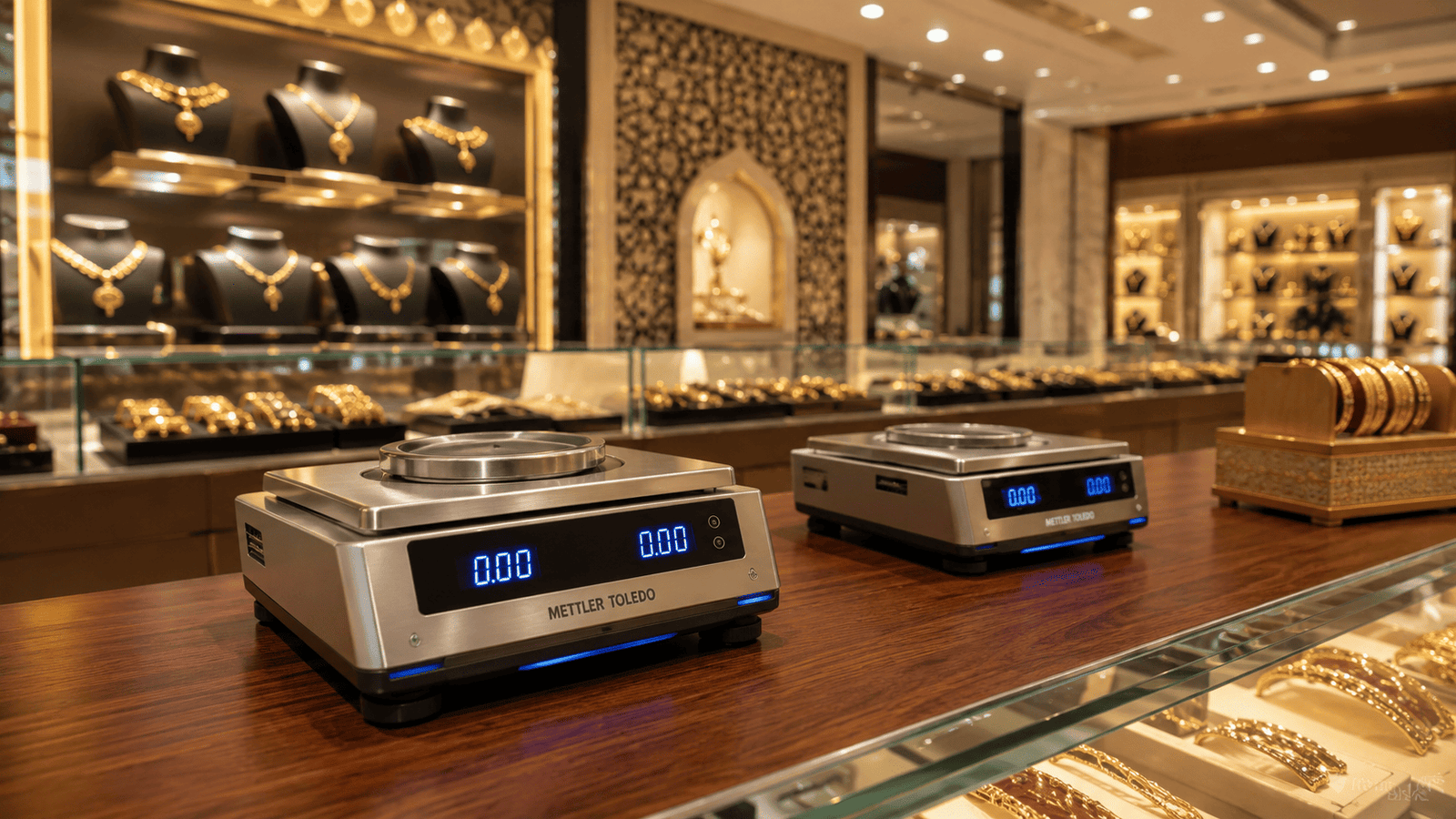
Global Scales & Systems works with clients across Saudi Arabia and the wider GCC who need precision weighing instruments that comply with SASO and OIML standards. Here are the compact MT models most commonly used in the jewellery trade, with verified specifications.
JL602GE, Portable
Capacity 620g / 0.01g readability. Battery-operated. External calibration. Legal for trade in most countries. 16 weighing units including mesghal and tola. Built-in dust cover. RS232. Circular pan. Compact footprint. Carry case available.
JL1502GE, Portable
Capacity 1,520g / 0.01g readability. Same platform as the JL602GE but higher capacity, covers heavier sets and bulk-buying scenarios. The bestseller in the portable category.
JE1002G, Bench
Capacity 1,200g / 0.01g readability. Internal calibration. OIML Legal for Trade. Connects to printer, secondary display, wireless adapter. Die-cast aluminium housing. Built-in applications for density determination (gold purity check) and totalization.
JE3002GE, Bench
Capacity 3,200g / 0.01g readability. Wider pan (180mm × 180mm). External calibration. OIML Legal for Trade. Same connectivity as JE1002G. The preferred model for showrooms with large-piece inventory.
All four models include density determination for gold purity measurement and totalization for set weighing, these are standard built-in applications, not add-ons.
Pro tip
If you operate in both field and showroom contexts, consider running both a JL portable and a JE bench unit rather than trying to make one do both jobs. At these price points, the combined cost of a JL602GE and a JE1002G is less than the productivity and compliance cost of using the wrong tool in either setting.
07 What to Budget: Indicative Price Ranges
These are indicative market estimates only. Actual pricing varies by supplier, volume, and regional configuration. Contact Global Scales & Systems for a formal quote.
| Model / Configuration | Use Case | Est. Price (SAR) | Est. Price (USD) |
|---|---|---|---|
| Portable compact (e.g. JL602GE) | Field buyer, souk, exhibitions | SAR 900 – 1,400 | $240 – $375 |
| Portable high-capacity (e.g. JL1502GE) | Field buyer, travelling goldsmith | SAR 1,200 – 1,800 | $320 – $480 |
| Bench scale mid-range (e.g. JE1002G) | Showroom counter, workshop | SAR 1,800 – 2,800 | $480 – $745 |
| Bench scale high-capacity (e.g. JE3002GE) | High-volume showroom, assay | SAR 2,500 – 3,800 | $665 – $1,010 |
Prices are indicative market estimates for budget planning only, not formal quotations. Pricing varies by configuration, accessories, and applicable SASO certification requirements. Contact us for a formal proposal.
08 Frequently Asked Questions
The most common questions we receive from gold traders and goldsmiths across KSA before making a buying decision.
Can I use a portable battery-operated gold scale for legal transactions in Saudi Arabia?
Yes, provided the scale carries the appropriate legal-for-trade certification, OIML approval is the relevant standard for KSA and the wider GCC. The instrument must also be calibrated correctly before use. SASO's Taqyees programme specifically governs the calibration of gold weighing instruments, so make sure your instrument is on a regular calibration schedule with a certified provider.
What readability should a gold scale have for jewellery trade use in KSA?
0.01g is the accepted commercial standard for gold jewellery transactions. This resolution is sufficient for OIML Class II trade approval and meets the precision needed for pricing by gram in the Saudi gold market. Some assay and hallmarking labs require higher precision (0.001g), but for retail and field trade, 0.01g is the appropriate readability.
What is the difference between internal and external calibration on a gold scale?
External calibration uses a physical reference weight you place on the pan to run the calibration routine. The weight must itself be certified and should travel with a portable scale. Internal calibration uses a motorised weight built into the instrument itself, triggered by pressing a button (or automatically, on some models) without any external accessory. Internal calibration is generally more convenient in a fixed-counter showroom context; external calibration is workable in the field with proper discipline.
Is the Mettler Toledo JL series available in mesghal and tola units?
Yes. The JL series supports 16 weighing units including mesghal, tola, baht, momme, Hong Kong tael, and Singapore tael alongside standard grams, carats, troy ounces, and pennyweights. This makes it genuinely practical for the Saudi and broader regional gold trade where traditional units are still in active use.
How often should a gold weighing scale be calibrated in Saudi Arabia?
SASO and the Taqyees programme require periodic calibration of commercial weighing instruments. As a working rule, a fixed showroom bench scale should be calibrated at minimum annually by a certified calibration provider. A portable field scale should be checked with its external calibration weight before each trading day. Global Scales & Systems provides SASO-aligned calibration services across the Kingdom.
Which scale is better for determining gold purity?
Both portable and bench Mettler Toledo gold scales include a built-in density determination application that uses Archimedes' principle to estimate metal purity based on measured displacement weight. This doesn't replace formal hallmarking or acid testing, but it gives a fast directional read in the field. For formal assay work, a dedicated laboratory balance with higher readability is typically required.

 Click to start chat