
Analytical vs Precision Gold Balance for Shops: The Critical Choice Most KSA Dealers Get Wrong
Which balance does your gold shop actually need and which one could leave you exposed at the next SASO inspection? The answer depends on where in the shop you're weighing.

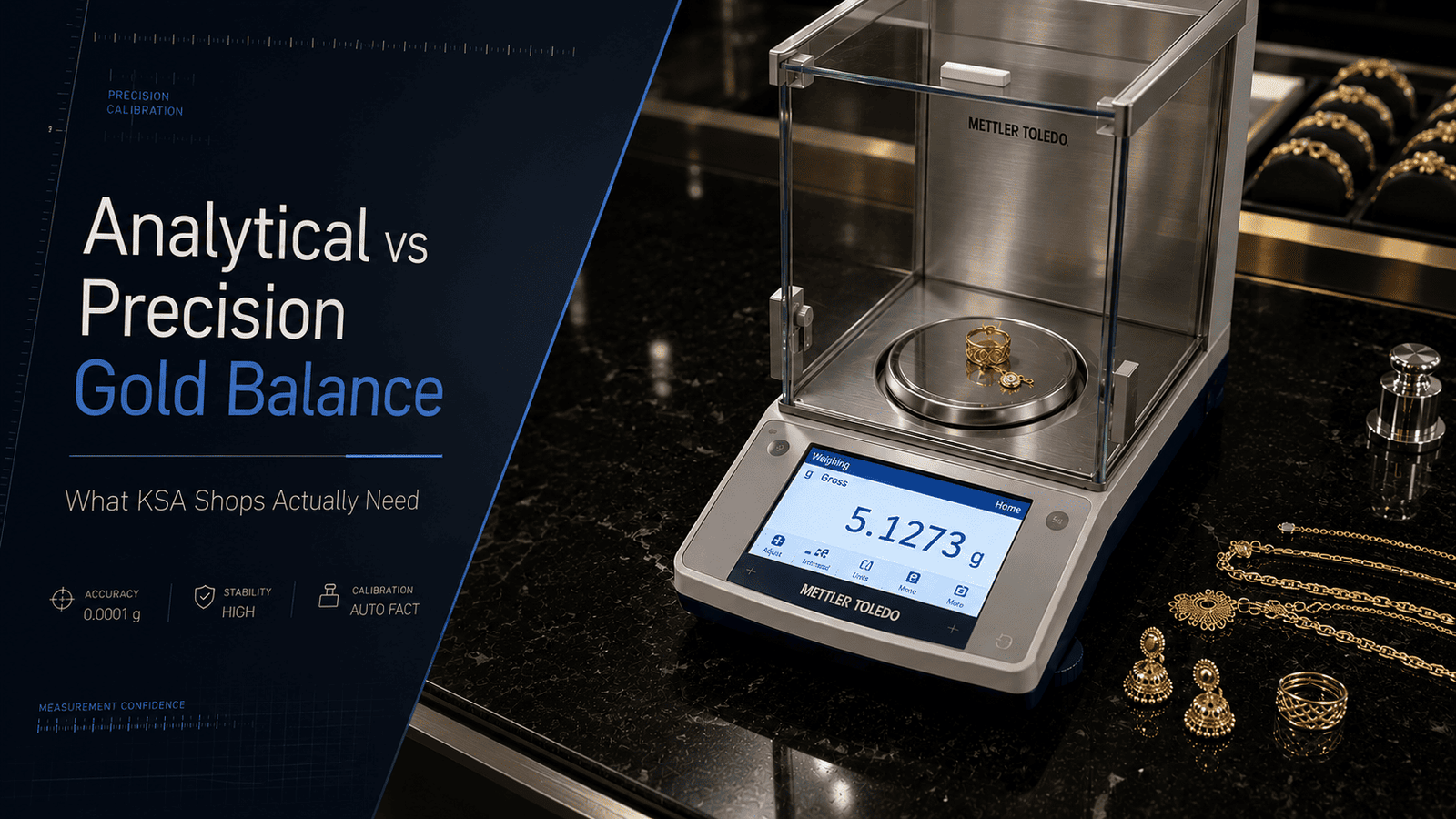
A customer drops a 22K bangle on your counter. The price per gram is live on the screen behind you. You weigh it, you name a number, and the deal is done in thirty seconds. It's a transaction that happens thousands of times a day across Saudi Arabia's gold souks, from Al-Zal market in Riyadh to the Al-Balad corridors in Jeddah. And the instrument you're doing it on, whether you know it or not, may be the wrong one.
The question of analytical vs precision gold balance is one we get asked constantly by gold shop owners across KSA. Not because the answer is complicated, but because the industry is full of conflicting advice: salespeople pushing analytical balances to shops that don't need them, and shops running uncertified instruments that leave them exposed to SASO inspection. After working with gold retailers, refiners, and jewellery workshops across the Kingdom, we've seen both mistakes cost real money. Here's the definitive answer.
01 What Each Balance Actually Does: Specs Without the Lab Jargon
Before the workshop-versus-counter argument, it helps to pin down what these two instruments actually are, because they're genuinely different tools.
A precision balance measures mass to a readability of 1 mg (0.001 g) at the finest end, and can handle capacities ranging from a few hundred grams up to several kilograms depending on the model. They're built for daily production environments. They handle vibration reasonably well. You can use them on a busy counter without waiting thirty seconds for the reading to stabilise. In the OIML R 76 framework, the international standard for non-automatic weighing instruments that SASO adopts as its metrology reference, a precision balance at 0.001 g readability typically falls into Class II, which is the "high precision" category reserved for fine trade including precious metals.
An analytical balance goes a step further: readability of 0.1 mg (0.0001 g), which is ten times more sensitive than a precision balance. Capacity is limited, usually between 60 g and 520 g. Crucially, analytical balances come with a built-in draft shield, and they need it. The sensor is so sensitive it will react to the air current from a passing customer, a sneeze across the room, or the faint vibration of a delivery truck outside. Under OIML, these sit in Class I (Special Precision) territory, typically used in laboratory and high-specification assay environments.
Put simply: analytical balances are more sensitive but harder to live with. Precision balances are slightly less sensitive but practical and robust.
“ An analytical balance is not automatically better for counter use just because it reads to 0.0001 g. If it's not OIML-approved as a trade instrument, you're operating outside legal requirements. — Section 02
02 The Workshop vs Counter Split: Where Each Instrument Belongs
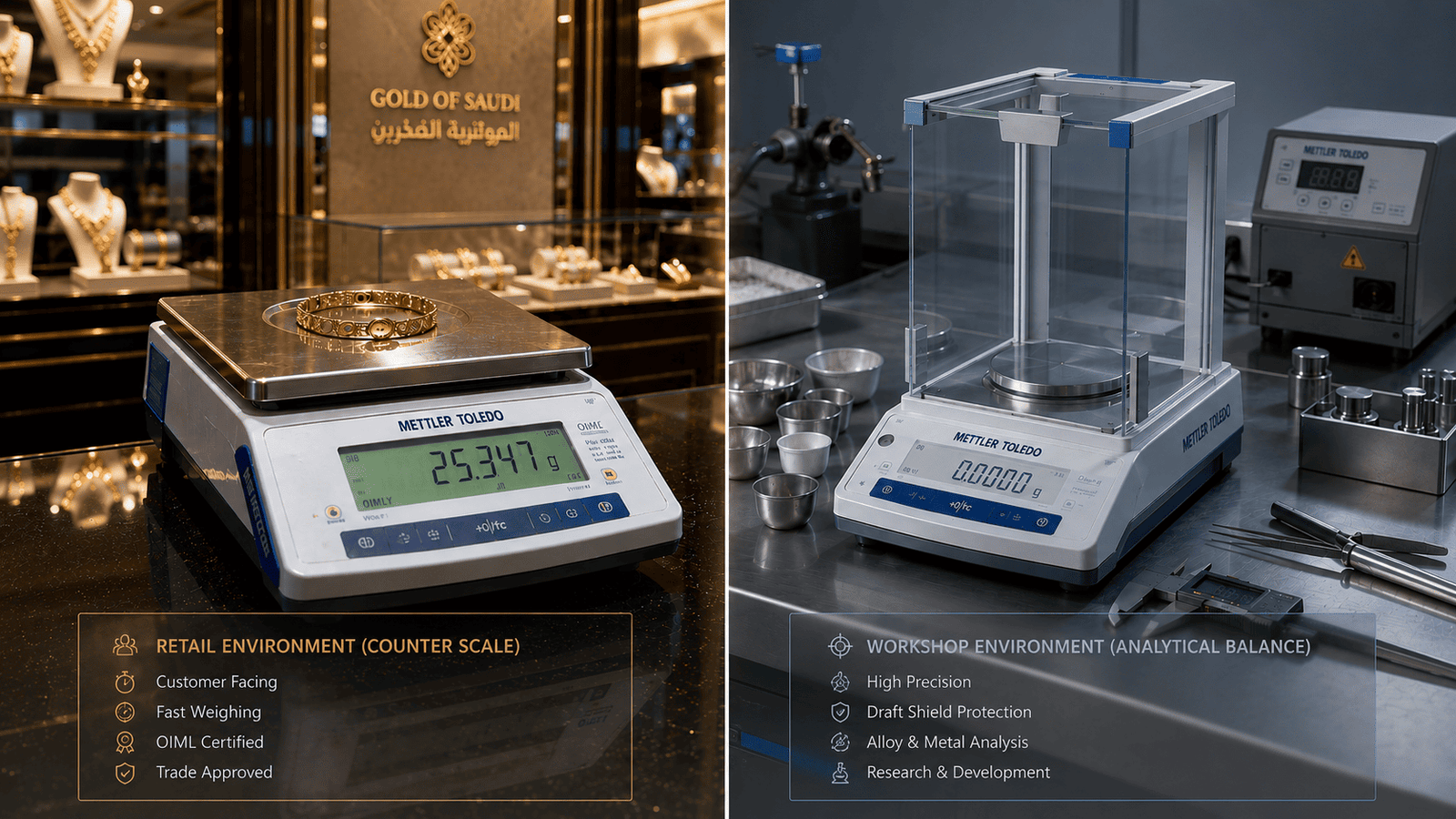
This is where the real answer lives, and it's not a question of quality; it's a question of function.
The Counter
Your retail counter is a trade environment. Every gram you quote to a customer is the basis of a financial transaction. In that context, what matters is not whether you can read to the fourth decimal place. It's whether your instrument is legal for trade.
Under OIML R 76, scales used in commercial transactions must carry a valid conformity mark from a recognised body, and they must meet the accuracy class specified for the goods being traded. For gold and precious metals, that means Class II at minimum, with a verification scale interval (the "e" value) of no worse than 1 mg. A calibration sticker from last year's inspection is not enough on its own; the instrument needs to have been approved as a trade instrument in the first place.
What you need on your counter is a Class II, OIML-certified jewellery precision balance with internal calibration capability, a clear digital display visible to the customer (or a remote display), and a calibration history you can produce on request. That's the compliant setup.
Pro tip
When selecting a counter balance, look for OIML-certified gold scales in Saudi Arabia with internal automatic calibration (isoCAL or ProFACT). These self-correct for temperature drift throughout the day, meaning your morning calibration remains valid at 3pm in a 35°C shop, a practical necessity in KSA's climate.
The Workshop
The back of the shop is a completely different operating environment. If your team does fabrication, alloy blending, stone-setting quality checks, or karat verification, the question changes.
Say you're mixing a 21K gold alloy and need to calculate the exact gold content of a batch. Or you're checking whether an incoming consignment of scrap gold is within stated fineness tolerance. At that level of verification, 1 mg readability may not cut it. A 10-gram sample of 21K gold has approximately 8.75 g of pure gold content. A 1 mg error at that weight is small. But if you're working with half-gram filigree components and the workshop's rejection threshold is ±0.5 mg, an analytical balance is the right call.
Workshops doing fine fabrication, assay verification, or gemstone apportionment are the legitimate use case for analytical balances. The draft shield that looks like an inconvenience on a counter is, in the workshop, doing real work: keeping air currents off a pan that can detect 0.1 mg of additional dust.
The error we keep seeing is shops buying analytical balances for their counters because a salesperson told them "higher precision is always better." It isn't. Higher sensitivity in the wrong environment just means more instability, more re-readings, and a slower service queue.
03 SASO and OIML: What the Law Actually Requires
Saudi Arabia's metrology framework is administered by SASO, which aligns with OIML recommendations. According to SASO Standard 1357:2020, all gold jewellery sold commercially must carry an official hallmark indicating purity, weight, manufacturer code, and year of assay. That hallmark is only credible if the weighing instrument producing those figures is traceable to a certified reference.
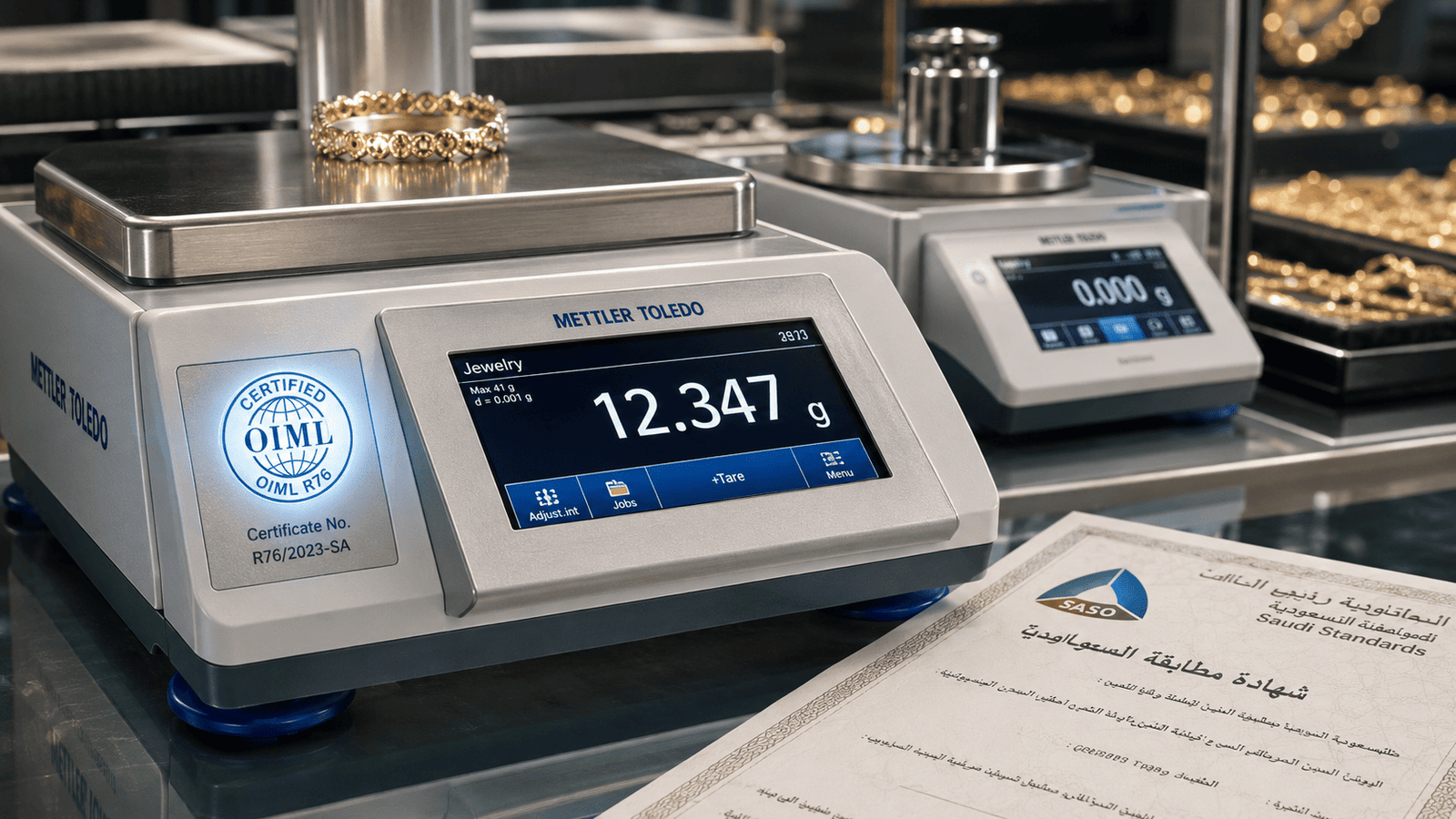
For trade purposes, OIML R 76 defines four accuracy classes. Class I (special precision, minimum 50,000 scale intervals) and Class II (high precision, minimum 100 scale intervals) are the relevant ones for gold retail. Most jewellery counters in KSA should be operating Class II OIML-certified instruments. Class I analytical balances are appropriate for reference-level verification rather than routine trade.
SASO conducts periodic market surveillance inspections, and the gold and jewellery sector is one of its active focus areas. Operating a non-certified scale at your point of sale is not a grey area: it's a violation, and the practical consequence ranges from a notice to temporary suspension of trading until the instrument is replaced and certified.
Common mistake
Even if your balance was OIML-certified when you bought it, periodic recalibration by an accredited service provider is mandatory. A certified instrument that hasn't been recalibrated in two years is not a compliant instrument. The certificate has an expiry, and a SASO inspector will check it. Ensure your jewellery scale calibration services are booked on a scheduled basis, not just when the instrument starts behaving strangely.
04 The Hidden Cost of Getting This Wrong
Let's talk money, because that's ultimately what this decision comes down to.
Scenario A: A shop owner buys an analytical balance for the counter because it was recommended as "the most accurate." Price paid: roughly SAR 8,000–12,000. The problem: the unit is not OIML-certified for trade. Every transaction on it, technically, has no legal standing. The balance is also slow in a retail environment, the draft shield gets opened and closed fifty times a day, and within eighteen months the air-current sensitivity has degraded from constant exposure. Recalibration cost is higher. The shop eventually replaces it with a proper trade balance anyway.
Scenario B: A workshop buys a budget precision balance at SAR 900 because "it's just for the back." No draft shield, 0.01 g readability. They use it to verify incoming 18K scrap against a stated weight. The readability is too coarse for the verification task; small discrepancies get missed. Over twelve months, the cumulative gold yield variance from undetected short-weights represents a real financial loss, and none of it shows up on any report until a sharp-eyed accountant notices the metal reconciliation doesn't close.
The right answer in both cases is the same: match the instrument to the task. You probably need two instruments, not one that tries to do both.
“ A certified instrument that hasn't been recalibrated in two years is not a compliant instrument. The certificate has an expiry, and a SASO inspector will check it. — Section 03
05 Indicative Price Ranges: What to Budget
These are indicative market estimates, not quotes. Actual prices depend on brand, model, included accessories, and whether OIML certification and local calibration are included. Always request a total cost of ownership, not just a unit price.
Disclaimer: All price ranges below are indicative market estimates for budget planning only. Contact Global Scales & Systems for a current, itemised quotation specific to your application.
| Balance Type | Readability | Primary Use | Indicative Range (SAR) | Indicative Range (USD) |
|---|---|---|---|---|
| Entry precision (non-trade) | 0.01 g | Rough intake / stock check | SAR 400–1,200 | $105–320 |
| Class II OIML precision (trade-certified) | 0.001 g | Counter retail, gold trade | SAR 1,500–6,000 | $400–1,600 |
| High-spec Class II with internal calibration | 0.001 g | Premium counter + compliance | SAR 5,500–12,000 | $1,465–3,200 |
| Analytical Class I (0.1 mg) | 0.0001 g | Workshop assay, alloy verification | SAR 5,000–18,000 | $1,330–4,800 |
| Semi-micro analytical (0.01 mg) | 0.00001 g | Reference lab, refinery | SAR 14,000–40,000 | $3,730–10,665 |
Add installation, a calibration service contract, and OIML recertification costs to the total for counter instruments. These recurring costs are not optional; they're part of the compliance cost of operating a legal gold trade business.
06 Feature to Benefit: What the Specs Mean in Practice
Spec sheets are full of numbers that don't translate easily into daily shop reality. Here's what each key specification actually means for your operation.
| Spec | What It Means for Your Shop |
|---|---|
| OIML Class II trade certification | Every transaction on your counter has legal standing; you're protected during SASO inspection |
| Internal automatic calibration (isoCAL / ProFACT) | The balance self-corrects for temperature drift throughout the day; your morning calibration stays valid at 3pm in a 35°C shop |
| 0.001 g readability (precision) | 1 mg accuracy on a 20 g piece means your price quote is accurate to within 0.005% of true weight |
| Draft shield (analytical) | Eliminates the 0.5–2 mg error introduced by air movement across an open pan; essential for workshop assay work |
| Remote display / dual display | Customer can see the live weight; eliminates dispute at point of sale |
| GLP/GMP data output | Printable, timestamped weighing records that satisfy SASO traceability requirements and support internal quality audits |
07 What the KSA Gold Market Context Actually Demands
The Saudi gold and diamond jewellery market was valued at approximately USD 4.56 billion in 2024 and is forecast to grow to USD 8.34 billion by 2030 at a compounded annual growth rate of 10.59%. According to World Gold Council data cited by UnivDatos, Saudi Arabia consumed 228.1 tonnes of gold over the last five years, with jewellery demand peaking at 38.1 tonnes in 2023. That's a market where the volume and value of individual transactions justifies investing in the right instrument.
Riyadh's gold souk alone handles hundreds of transactions per hour at peak. The commercial and regulatory pressure is real. Consumers are more informed than they were five years ago; many now verify weight on their own pocket scales before completing a purchase. And SASO's market surveillance activity has intensified across retail sectors under Vision 2030's consumer protection mandate. In that environment, operating a non-certified or poorly maintained balance is not just a compliance risk; it's a reputational one.
We keep seeing a specific failure pattern across KSA shops we service: the owner invested in a quality balance two or three years ago, but the calibration certificate lapsed, and nobody noticed. The balance is still accurate. But it's no longer certified. Those are two different things, and only one of them protects you.
08 FAQ: Analytical vs Precision Gold Balances in Saudi Arabia
These are the questions we field most often from KSA gold shop owners, answered directly.
Does a gold shop in Saudi Arabia legally need an OIML-certified balance?
Yes. Any scale used in a commercial transaction, including weighing gold for sale, must be a legal-for-trade instrument carrying a valid OIML conformity mark. Under SASO's metrology framework (which aligns with OIML R 76), non-certified scales used for trade are non-compliant regardless of their actual accuracy. If you're selling gold by the gram, the instrument needs to be OIML Class I or Class II approved for trade. For more on what this means in practice, see our guide on SASO-compliant weighing for gold shops.
What's the difference between readability and accuracy on a jewellery balance?
Readability is the smallest unit the display shows (e.g., 0.001 g). Accuracy is how close that reading is to the true mass. A balance can display four decimal places and still be inaccurate if it's uncalibrated or temperature-drifting. That's why OIML certification and periodic calibration matter: they verify that what the display shows actually reflects the true weight within defined error limits.
Can I use one balance for both the counter and the workshop?
In theory, yes, but in practice it's a compromise. A Class II precision balance with 0.001 g readability can handle both trade transactions and most workshop verification tasks. But if your workshop needs sub-milligram alloy verification, a dedicated analytical balance makes more sense in the back. Running an analytical balance on a busy retail counter is inefficient and increases the risk of drift and damage.
How often does a jewellery balance need calibration in KSA?
At minimum, annually, and more frequently for instruments in high-usage environments. SASO-aligned practice follows OIML guidelines recommending recalibration after any repair, after relocation, and on a scheduled basis determined by the instrument's usage intensity. For a busy gold counter doing 80 to 100 transactions a day, quarterly or bi-annual calibration checks are reasonable. Your calibration service provider should issue a traceable certificate tied to national mass standards.
What is SASO Standard 1357:2020 and does it affect my balance choice?
SASO Standard 1357:2020 governs the commercial sale of gold jewellery in the Kingdom, requiring that all items sold carry an official hallmark recording purity, weight, manufacturer code, and year of assay. The weight figure on that hallmark is only credible if the instrument that produced it is traceable and certified. So while the standard doesn't name a specific balance model, it effectively makes a properly calibrated, OIML-certified balance a prerequisite for any compliant gold retail operation.
Is an analytical balance overkill for a standard retail gold shop?
For most shops, yes. A Class II OIML precision balance with 0.001 g readability is what the law requires and what the trade environment demands. Analytical balances add cost, fragility, and operational complexity without delivering any legal or practical advantage at the point of sale. Save the analytical balance for the workshop if your operation involves alloy verification, stone weight apportionment, or fine fabrication quality checks.
“ You probably need two instruments, not one that tries to do both. Match the instrument to the task, every time. — Section 04
09 The Simple Decision Framework
If you walk away with one thing from this article, make it this.
Ask yourself two questions. First: is this instrument going to be used in a transaction where a customer pays based on the weight shown? If yes, you need an OIML-certified trade balance, Class II precision, 0.001 g minimum. No exceptions. Second: does your operation include alloy verification, fine fabrication QC, or reference-level assay work in a controlled environment? If yes, add an analytical balance to the workshop. Not to the counter.
At Global Scales & Systems, we supply, calibrate, and certify both instrument types across KSA, from single-counter gold shops in the Eastern Province to multi-site jewellery chains in Riyadh. If you're unsure which configuration is right for your operation, request a consultation. The conversation takes twenty minutes. Getting the wrong instrument, and then replacing it, takes a lot longer and costs significantly more.

 Click to start chat