
5 Dangerous Mistakes KSA Procurement Teams Make When Specifying Explosion-Proof (ATEX) Industrial Weighing Scales
From ATEX vs IECEx confusion at the Aramco site gate to zone classification errors that void your insurance, here is every costly specification mistake to avoid when sourcing explosion-proof weighing scales in Saudi Arabia.

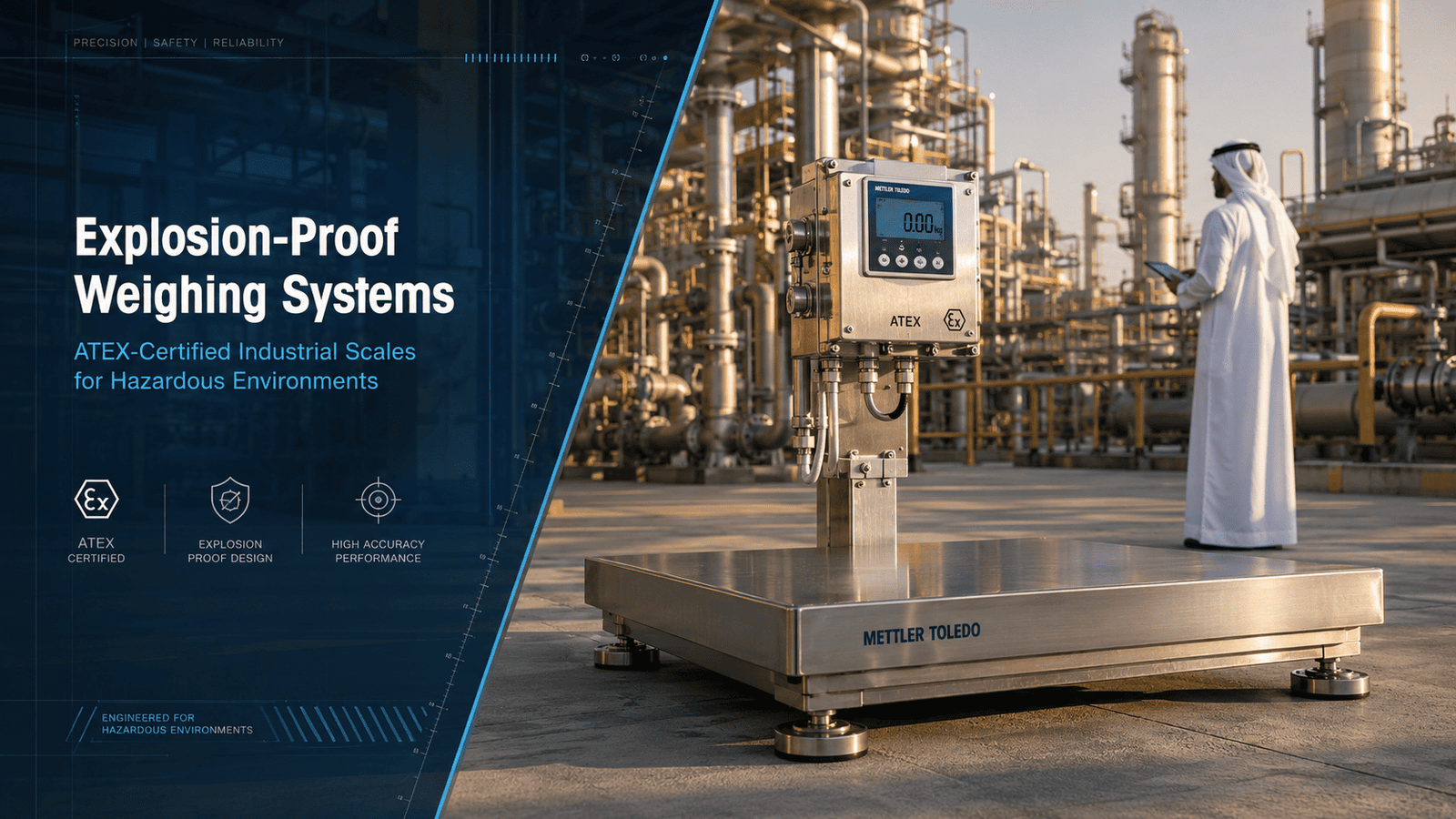
Let me share a not-so-uncommon scenario; a procurement team at a Jubail refinery places an order for explosion-proof (ATEX) industrial weighing scales, good price, fast delivery, proper ATEX markings on the datasheet. The scales arrive. And then the site gate rejects them. The supplier sent equipment with an EU ATEX certificate only. No IECEx Certificate of Conformity. Saudi Aramco's engineering procedure references IECEx explicitly. The SASO SALEEM SABER system does not recognise the ATEX-only documentation. The equipment sits in a bonded warehouse for six weeks while the purchase order gets revised, the project timeline slips, and someone has to explain to the finance director why they are paying storage fees.
This happens more often than anyone admits. The hazardous area weighing category looks deceptively simple from the outside, it is a scale with extra certifications, right? Wrong. There are at least five genuinely costly ways to get this wrong, and this article covers every one of them.
01 Why the KSA Regulatory Environment Makes Hazardous Area Weighing Harder Than It Looks
Saudi Arabia's oil and gas sector is one of the most concentrated accumulations of explosive-atmosphere risk anywhere on earth. With Aramco targeting a more than 60% increase in gas production by 2030 compared to 2021 levels, and the Kingdom already ranking as the world's fourth-largest petrochemicals producer with installed capacity exceeding 120 million tonnes per annum, the industrial footprint is only growing. More capacity means more classified hazardous zones. And more classified zones means more equipment that has to meet the right standards.
Here is where the first dangerous mistake lives: assuming that "ATEX certified" is enough. ATEX is a European Union directive. It governs how equipment is designed, tested, and marked for use in potentially explosive atmospheres. Saudi Arabia's regulatory framework, managed by SASO (Saudi Standards, Metrology and Quality Organization), recognises IECEx certificates and has implemented the SALEEM SABER system as the mandatory electronic certification and conformity assessment platform for all imported goods. For equipment going into explosive atmospheres, the relevant document you need at customs clearance is the SASO IECEx Recognition Certificate.
IECEx, administered by the International Electrotechnical Commission, is recognised in over 30 countries. ATEX is a regional EU directive. Both reference similar IEC 60079 technical standards, but they are not interchangeable at the Saudi site gate.
And at major operator sites, it is stricter still. IECEx certification has become mandatory for contractors and equipment across Saudi Arabia's oil, gas, and petrochemical sectors, with Aramco's SAEP documents specifying exact requirements. Arriving with ATEX-only certificates when the project standard demands IECEx results in immediate rejection. This issue appears repeatedly on new site projects across the Eastern Province, and it always costs more to fix than it would have cost to specify correctly.
The practical takeaway: for any KSA oil, gas, or petrochemical application, insist on equipment carrying both ATEX and IECEx approval. Not one or the other. Both.
“ Arriving with ATEX-only certificates when the project standard demands IECEx results in immediate rejection, and it always costs more to fix than it would have cost to specify correctly. — Section 01
02 The Zone Classification Error That Voids Your Insurance
Mistake number two is zone classification, and this one has safety, not just administrative, consequences. The IECEx and ATEX frameworks classify hazardous areas based on how frequently and for how long a flammable atmosphere is present.
Gas and vapour zones are classified as follows:
- Zone 0: Flammable gas or vapour present continuously or for long periods
- Zone 1: Likely to occur occasionally in normal operation
- Zone 2: Not likely in normal operation, but possible for short durations
Dust zones follow the same logic at Zone 20, 21, and 22. Every piece of equipment installed in a classified zone must be certified for that zone, or a more demanding one. A Zone 2-rated scale cannot be installed in a Zone 1 area. Full stop. Installing under-rated equipment in a higher-risk zone is a safety violation, voids your insurance, and exposes site management to personal liability under Saudi Arabia's occupational safety regulations.
In practice, the most common zone error is not installing the wrong equipment on purpose, it is purchasing before the hazardous area classification study has been finalised. A procurement manager gets the budget approved and places the order. The HSE team completes the area classification six weeks later. The zones come out more demanding than assumed. The scales that were ordered do not qualify.
A peer-reviewed analysis published in the Canadian Journal of Chemical Engineering examining industrial accidents in Saudi Arabia's chemical sector over 46 years found that 20.6% of all recorded incidents were explosions, with fires accounting for a further 54%. These are not hypothetical risks. They are the consequences of exactly the kind of failures that proper hazardous area equipment classification is designed to prevent. Spend time on the area classification study before writing the purchase order. It is the only logical sequence.
Common mistake
Never raise a purchase order for hazardous area weighing equipment before the site's area classification study is signed off. If the study later upgrades your zones from Zone 2 to Zone 1, the equipment you ordered is non-compliant, and changing it after delivery costs significantly more than getting it right in the first place. The HSE team and the procurement team must be in the same room before the PO is raised.
03 Intrinsic Safety vs. Flameproof: Why the Protection Concept Matters
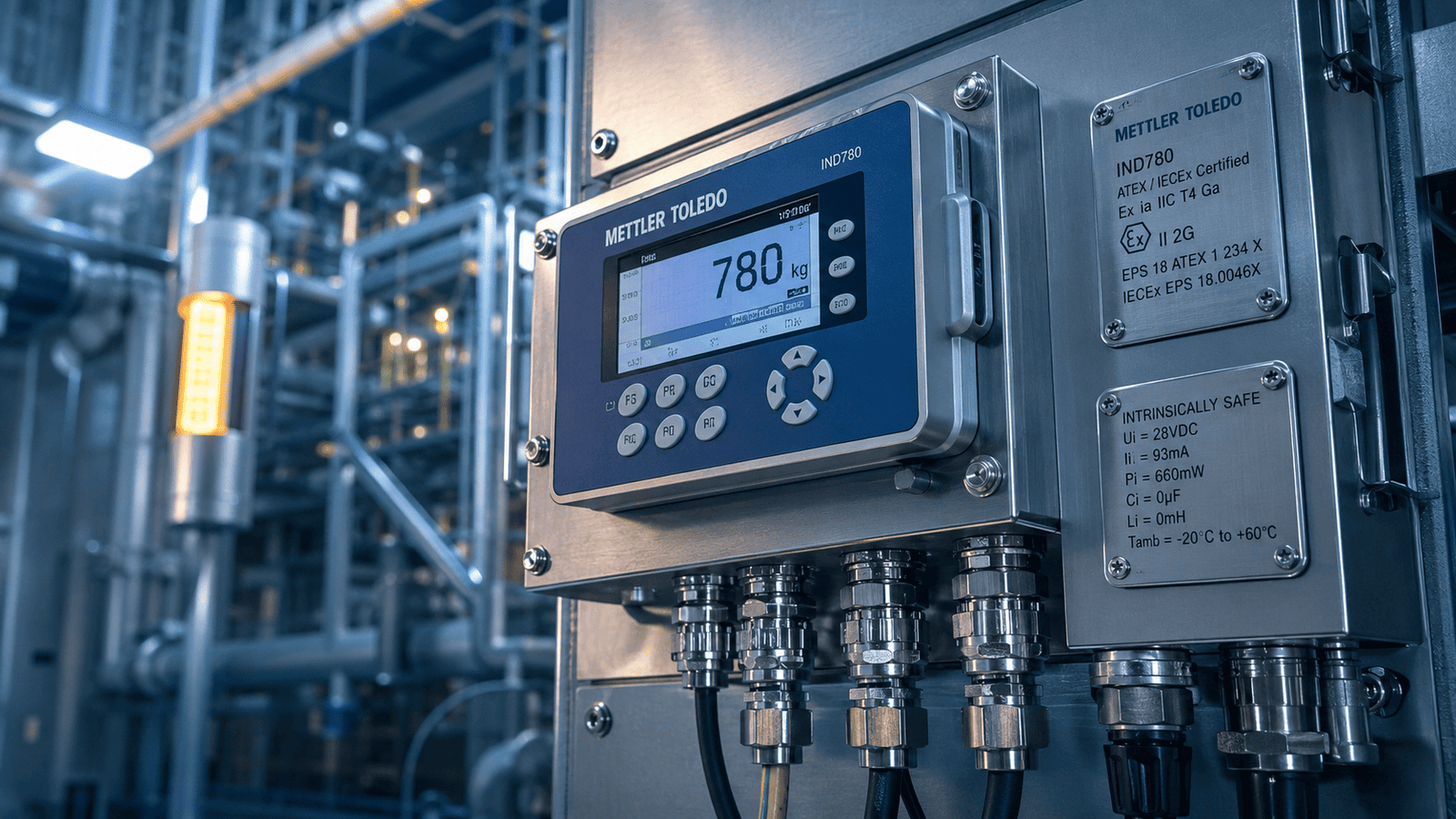
Once you have the zone right, you need to pick the correct method of ignition protection, and this is mistake number three: treating all "explosion-proof" or "ATEX" equipment as equivalent. There are several protection concepts used in hazardous area equipment. For industrial weighing scales, the two most relevant are intrinsic safety and flameproof.
Intrinsic Safety (Ex i)
The electrical energy in the circuit is limited below the level that could cause ignition. Even under fault conditions, no spark or heat is produced that can ignite the surrounding atmosphere. This is the highest-confidence protection method for weighing, because it works at the circuit level, you do not need an explosion-containment enclosure, which makes maintenance and calibration far simpler.
Intrinsic safety comes in three sub-levels: Ex ia (suitable for Zone 0), Ex ib (Zone 1), and Ex ic (Zone 2). For most oil and gas weighing applications in Saudi Arabia, drum filling, batch weighing, tanker loading, Ex ib in Zone 1 is the practical standard.
Flameproof (Ex d)
The enclosure is built to contain any internal explosion and prevent it from propagating to the surrounding atmosphere. These units are heavier, maintenance is more involved (opening a flameproof enclosure in a live classified zone requires a hot work permit in many facilities), and the enclosures corrode aggressively in KSA's coastal and humid industrial environments.
For static platform weighing and bench applications in O&G and petrochemical, intrinsically safe systems consistently outperform flameproof equivalents on total cost of ownership. Lower installation complexity, no conduit sealing requirements, and significantly easier recalibration. The additional upfront cost of certified explosion-proof equipment, typically three to five times the equivalent standard unit, is a real budget conversation to have. But it closes quickly when you consider what a shutdown incident or a failed third-party audit costs.
04 Reading the ATEX Marking: What Those Codes Actually Tell You
Here is where technical mistakes get very specific, mistake number four is not being able to interpret the equipment marking, or worse, delegating that to a supplier who hands you a compliant-looking datasheet and moves on. An ATEX/IECEx marking on a weighing scale looks something like this:
II 2 G Ex ib IIC T4 Gb
Here is what each element means:
- II, Equipment Group II (surface industries, as opposed to mining)
- 2, Category 2, suitable for Zone 1
- G, Gas atmosphere (D would indicate dust)
- Ex ib, Intrinsic safety, protection level b (two fault tolerant)
- IIC, Gas group, covers hydrogen and acetylene (the most demanding; IIB covers ethylene, IIA covers propane)
- T4, Temperature class, maximum surface temperature 135°C, suitable for substances with auto-ignition temperature above 135°C
- Gb, Equipment protection level for Zone 1
Why does the gas group matter in KSA? Because Jubail and Yanbu facilities handle hydrogen streams, LPG, ethylene, and other high-risk substances. An IIB-rated scale is not sufficient in a hydrogen atmosphere. You need IIC. And the temperature class? If you are weighing near process lines running at temperatures above what your T-class allows as an ambient environment, the scale's surface temperature under fault conditions may become an ignition source. Your process engineer and your HSE team need to sign off on this, not just your procurement team.
For dust-sensitive applications, fertiliser plants, petrochemical powder handling, the equivalent marking includes Zone 21 and Ex ib IIIC (for all dusts including metal dust). Do not buy a gas-only certified scale for a dust application. They are different certifications.
“ An IIB-rated scale is not sufficient in a hydrogen atmosphere. You need IIC, and the difference is written on the certificate, not the datasheet headline. — Section 04
05 What the Technical Specifications Need to Include for KSA Conditions
Environmental specs are the fifth failure point, and KSA's operating conditions make this more demanding than any European or North American reference standard assumes.
IP Rating
IP66 is the industry minimum for outdoor industrial use. For sites that get hosed down regularly, many refinery decks, LPG handling areas, IP67 (temporary immersion) is the practical standard. Specify stainless steel housing with hermetic sealing, not painted carbon steel.
Platform Material
Specify AISI 316 stainless steel, not AISI 304. In the presence of hydrogen sulphide (H2S), chloride-containing cleaning agents, or coastal humidity (think Ras Tanura, Jubail), 304 stainless pits and corrodes. 316 contains molybdenum, which resists these. This is a spec line that gets quietly downgraded by suppliers competing on price.
Operating Temperature Range
Standard industrial equipment is rated to 55°C or 60°C ambient. KSA outdoor summer temperatures in the Eastern Province regularly hit 47–50°C. Factor in radiative heat from metal decks and process equipment, and ambient temperatures at the weighing point can comfortably exceed 60°C. Confirm that both the platform and the indicator are rated for your actual site conditions, not standard datasheet conditions.
Calibration Interval
In harsh chemical environments, expect calibration every 3–6 months. Build this into your total cost of ownership model. An uncalibrated ATEX scale is a compliance issue under SASO and OIML R60 requirements, and an operational accuracy issue. Accuracy class for industrial-grade applications is typically ±0.05% to ±0.1% of full scale.
Pro tip
When reviewing a supplier's datasheet, check the platform material designation before anything else. AISI 304 and AISI 316 look identical in photos and sound similar in spec sheets, but in KSA's coastal refinery environments they perform very differently over a 3–5 year asset life. Always ask for material certification documentation, not just the marketing spec sheet.
06 Hazardous Area Weighing Solutions: What a Complete KSA Setup Looks Like
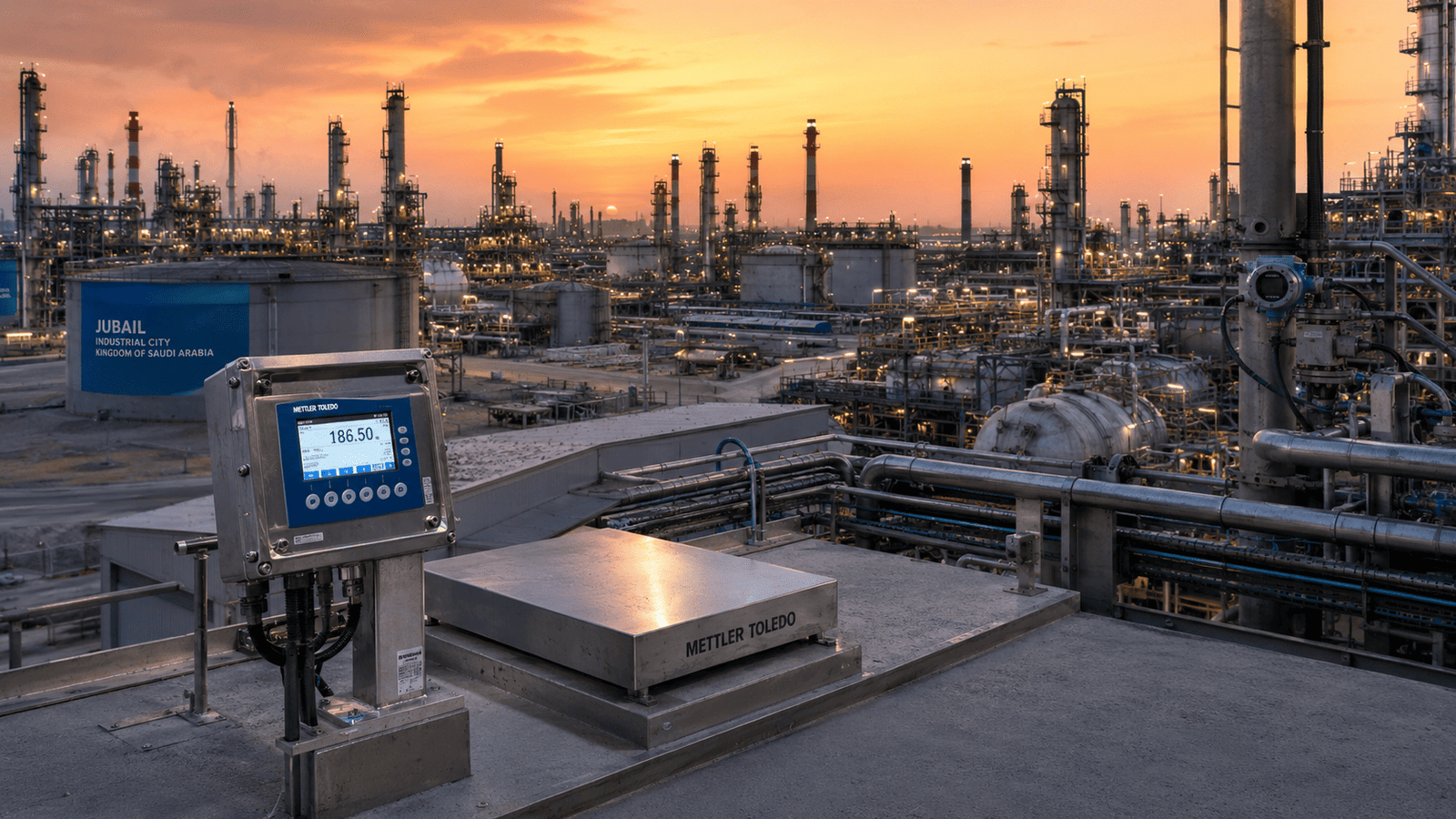
Global Scales & Systems works with facilities across the Kingdom on hazardous area weighing projects, from simple drum and IBC weighing in Zone 2 chemical stores to fully integrated tank and vessel weighing systems in Zone 1 process areas. The product range for these applications covers four main configurations.
Bench and portable scales. For sampling, laboratory batching, and small-drum applications. Capacities typically from 3 kg to 60 kg. These are the most frequently specified and the most frequently under-specified in terms of zone rating.
Floor and platform scales. The core workhorse of O&G hazardous area weighing. Capacities from 150 kg to 600 kg. Suitable for drum filling, IBC weighing, and loading bay check-weighing.
Weigh modules and load cells. For integrating weighing into tanks, vessels, silos, and hoppers. The platform sits inside the process; the indicator and cabling are routed to a safe area via certified barriers. ATEX and IECEx certified load cells with appropriate gas group and temperature class ratings are critical here.
Weighing indicators and terminals for hazardous areas. Intrinsically safe indicators with certified barriers, designed for Zone 1 and Zone 2 installation. These connect to safe-area systems including SAP, Historian, and DCS.
As Mettler Toledo's official partner in Saudi Arabia, Global Scales & Systems supplies, installs, and services the full Mettler Toledo hazardous area weighing range. All equipment carries ATEX, IECEx, and FM approvals. All installations are supported by local calibration services accredited in line with SASO and NMI requirements.
Honestly, the equipment is only half the conversation. The other half is who commissions it, who calibrates it, and who signs the calibration certificate when your HSE manager hands it to the Aramco permit-to-work office. That is where local in-Kingdom support matters and where some importers fall short.
“ The equipment is only half the conversation. The other half is who commissions it, who calibrates it, and who signs the certificate when your HSE manager hands it to the permit-to-work office. — Section 06
07 Indicative Pricing for ATEX Industrial Weighing Scales in Saudi Arabia
The table below gives indicative budget ranges for hazardous area weighing scale configurations in the KSA market. These are market estimate guides only and reflect supply, certification, and installation complexity. Final pricing depends on specification, quantity, and site conditions. Always request formal quotes before committing budget.
| Configuration | Typical Application | Est. Range (SAR) | Est. Range (USD) |
|---|---|---|---|
| Bench/portable ATEX scale (Zone 2, Ex ic) | Drum sampling, small batch, lab use | SAR 6,000 – 15,000 | $1,600 – $4,000 |
| Floor/platform scale (Zone 1/21, Ex ib, up to 300 kg) | Drum & IBC filling, check-weighing | SAR 18,000 – 52,000 | $4,800 – $13,800 |
| Heavy-duty floor scale (Zone 1, Ex ib, 300–600 kg) | Tanker loading bay, bulk process | SAR 52,000 – 120,000 | $13,800 – $32,000 |
| Weigh module system (tank/vessel, full integration) | Process tanks, silos, reactor vessels | SAR 112,000+ | $30,000+ |
Disclaimer: All figures are indicative market estimates for budget planning purposes only. They do not constitute a quotation. Contact Global Scales & Systems for a formal project-specific proposal.
08 Feature to Benefit: What ATEX Scale Specs Mean for Your Operation
Specifications on a datasheet are only meaningful when you understand what they translate to in daily site operations. The table below maps the key spec lines to the real-world operational outcomes they deliver for KSA oil, gas, and petrochemical facilities.
| Specification | What It Actually Means on Your Site |
|---|---|
| ATEX + IECEx dual certification | Clears SASO SALEEM SABER customs; accepted at Aramco and SABIC site gates without variance requests |
| Ex ib IIC T4 protection marking | Rated for Zone 1 hydrogen-group atmospheres, covers your most demanding gas-risk areas |
| IP67 hermetic sealing | Survives aggressive hosing during turnaround cleaning; handles Jubail coastal humidity without corrosion |
| AISI 316 stainless steel platform | Resists H2S, caustic cleaning agents, and chloride-driven pitting, material that lasts in KSA refinery conditions |
| OIML R60 accuracy class | Calibration certificate will pass SASO and NMI audit without dispute |
| Certified safe-area barrier + IECEx indicator | Full system certification from sensor to display, no grey area on which component is responsible for zone compliance |
09 How to Evaluate an ATEX Scale Supplier in Saudi Arabia
A certification mark on a datasheet is the beginning of due diligence, not the end of it. Ask any supplier these three questions before raising a purchase order.
1. Can you provide the full IECEx Certificate of Conformity, including the approved drawings? Not just the summary page. The full certificate includes specific conditions of use, approved cable entry methods, and maximum values for barrier parameters. You need to confirm your planned installation matches the approved design.
2. Who performs calibration in-Kingdom, and to what accreditation? An ATEX scale that is miscalibrated is both a safety issue and a SASO compliance issue. Calibration in hazardous areas requires certified equipment and trained technicians. If the supplier's answer is "we will arrange a visit from the European factory team," that is a resourcing risk for ongoing operations.
3. What is your track record at Aramco and SABIC contractor sites? Not in general, specifically at classified hazardous area projects in KSA. A supplier who has not navigated SAEP documentation requirements and Aramco permit-to-work procedures before will learn on your project timeline.
Global Scales & Systems has been supporting industrial weighing installations across Saudi Arabia's oil, gas, and petrochemical sectors for years. Our calibration services are aligned with SASO, NMI, and OIML requirements, and our team has direct experience commissioning hazardous area weighing systems at facilities in Jubail, Yanbu, and the Eastern Province.
10 FAQ: Explosion-Proof (ATEX) Industrial Weighing Scales in Saudi Arabia
The following questions represent the most common points of confusion we encounter when working with KSA procurement teams on hazardous area weighing projects.
What is the difference between ATEX and IECEx, and which does Saudi Arabia require?
ATEX is a European Union directive; IECEx is an international certification scheme administered by the IEC. Saudi Arabia's SASO recognises IECEx certificates through its SALEEM SABER platform, and major operators including Aramco and SABIC require IECEx documentation for equipment used in classified hazardous areas. For KSA projects, always specify equipment carrying both certifications where possible, but IECEx is the non-negotiable one for local compliance.
What ATEX zone classification do most Saudi oil and gas applications fall into?
The majority of static weighing applications in KSA oil, gas, and petrochemical facilities fall into Zone 1 (occasional gas/vapour presence during normal operation) or Zone 2 (possible but not likely in normal operation). Process area platforms, drum-filling stations, and LPG loading bays are typically Zone 1. Warehouse storage areas for flammable liquids may be Zone 2. Your facility's hazardous area classification study is the authoritative reference.
How often do ATEX weighing scales need calibration in KSA conditions?
In harsh KSA industrial environments, calibration every three to six months is the typical operational standard. Frequency depends on the criticality of the weighing application, the severity of the environment, and the requirements of your quality management system. SASO and OIML R60 standards govern permissible tolerances. All calibration in classified hazardous areas must be performed by trained technicians using intrinsically safe certified test equipment.
Can a standard industrial scale with an IP66 rating be used in a hazardous area?
No. IP rating governs ingress protection against dust and water, not ignition protection in explosive atmospheres. A standard industrial scale with an IP66 rating has no ATEX or IECEx approval. Installing it in a classified hazardous zone is a safety violation, regardless of its physical robustness. Hazardous area approval and IP rating are entirely separate and complementary requirements.
What gas group rating do I need for a hydrogen processing environment?
Hydrogen falls into Gas Group IIC, which is the most demanding gas group classification. Equipment rated for IIB (which covers ethylene and similar gases) is not sufficient in a hydrogen atmosphere. Any scale, indicator, or load cell installed near hydrogen streams, electrolysers, or hydrogen-rich process areas must carry an IIC gas group rating. Confirm this on the equipment's IECEx Certificate of Conformity, not just the datasheet headline.
How long does it take to commission ATEX weighing systems at a KSA industrial site?
Simple installations, a Zone 2 floor scale with a certified barrier and indicator, can be commissioned in one to two days once equipment is on site and a permit to work is in place. Integrated tank or vessel weighing systems requiring civil work, cable routing, and DCS integration are larger projects: typically two to four weeks for installation and commissioning, plus calibration and documentation handover. Plan for SASO documentation and internal site safety approvals to add further lead time on new greenfield projects.
Global Scales & Systems Co. Ltd. is Mettler Toledo's official partner in Saudi Arabia and the GCC, supplying, installing, calibrating, and servicing the full range of hazardous area weighing solutions across the Kingdom, with coverage in Jubail, Yanbu, Riyadh, and the Eastern Province. Contact us for a formal project-specific proposal.
 Click to start chat