
What Is a Weighing Terminal? 5 Essential Integration Methods Every KSA Plant Engineer Must Know
From load cell signal to PLC data tag, what a weighing terminal actually does, which protocol to specify, and what KSA plant engineers consistently get wrong when they rush the spec.

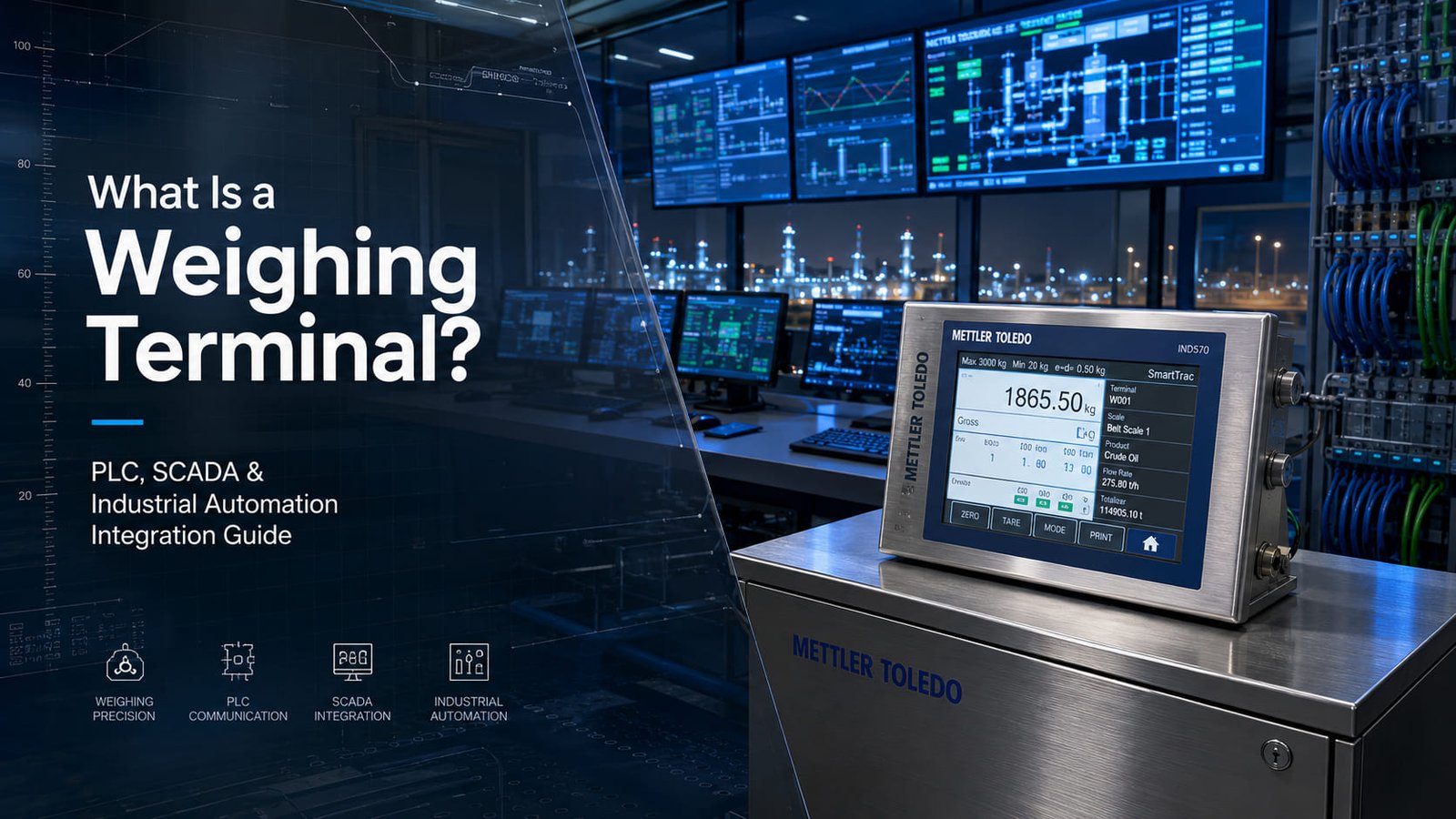
Picture a 50,000-tonne cement plant running two shifts in the Eastern Province. Raw material enters on conveyor belts, bulk product loads into tankers, and finished bags roll off a packaging line, all day, every night. Every one of those movements is tied to a weight reading. Now ask yourself: where does that weight reading actually go? Who is watching it? And what happens when the PLC controlling a dosing valve needs to respond to it in real time?
That is where the weighing terminal sits. It is the hardware bridge between your load cell signal and every automation system on your plant. And yet, in my experience working with clients across the Eastern Province and the Red Sea coast, it is one of the most under-specified pieces of equipment in a project bill of materials. Engineers price the load cells carefully. They agonise over the weighbridge slab. And then they spec the terminal as an afterthought. This guide fixes that.
01 What Is a Weighing Terminal, Exactly?
A weighing terminal, sometimes called a weight indicator, weight controller, or scale indicator, is an electronic instrument that receives the raw millivolt signal from one or more load cells, converts it into a calibrated weight reading, and presents that data to an operator, a control system, or both. Inside a modern industrial terminal you will find: an analogue-to-digital converter (ADC) that digitises the load cell signal, a microprocessor running calibration logic and filtering algorithms, a display for the local operator, and a set of communication interfaces for external systems. That last part is what this article is primarily about.
Here is something worth saying plainly: not all weighing terminals are the same, and the communication capability of the terminal determines how much value your entire weighing infrastructure can deliver. A terminal with only RS-232 serial output is a data island. A terminal with EtherNet/IP, PROFIBUS DP, and Modbus TCP is a first-class citizen of your plant automation network.
According to Market Research Future, the global weighing terminal market was valued at USD 5.1 billion in 2024 and is projected to grow at a 5.04% CAGR through 2035, driven largely by the integration of digital communication capabilities and the wider push toward Industry 4.0 automation. That growth is real, and it is happening because facilities like yours are demanding terminals that do more than display a number.
“ A terminal with only RS-232 serial output is a data island. A terminal with EtherNet/IP, PROFIBUS DP, and Modbus TCP is a first-class citizen of your plant automation network. — Section 01
02 Weighing Terminal vs. Scale Indicator vs. HMI: Getting the Terminology Right
Before we go any further, it is worth clearing up terminology confusion that appears repeatedly in procurement specs across the GCC.
Scale indicator is the older term, still common in calibration documents and SASO paperwork. It refers to the display and computation unit. Most people use it interchangeably with weighing terminal.
Weighing terminal, as used by Mettler Toledo and most modern vendors, implies a more capable device: one with programmable logic, automation I/O, and multiple fieldbus options. Think of it as a scale indicator that has grown up.
HMI (Human-Machine Interface) is a separate layer entirely. It is a touchscreen or panel PC running visualisation software (Ignition, WinCC, FactoryTalk) that pulls data from the PLC. The terminal feeds data to the PLC; the HMI shows you what is happening in the PLC. They are not the same thing and should not be substituted for each other.
Understanding this distinction matters enormously in KSA projects, where compliance documentation for SASO type approval is filed against the weighing terminal as the legal measuring instrument, not the HMI or the PLC. The Saudi Standards, Metrology and Quality Organization (SASO) maintains specific Technical Requirements for Non-Automatic Weighing Instruments under the Measurement and Calibration Law. Your terminal needs to meet those requirements. Your HMI does not.
03 The 5 Essential Methods: How a Weighing Terminal Interfaces with PLCs
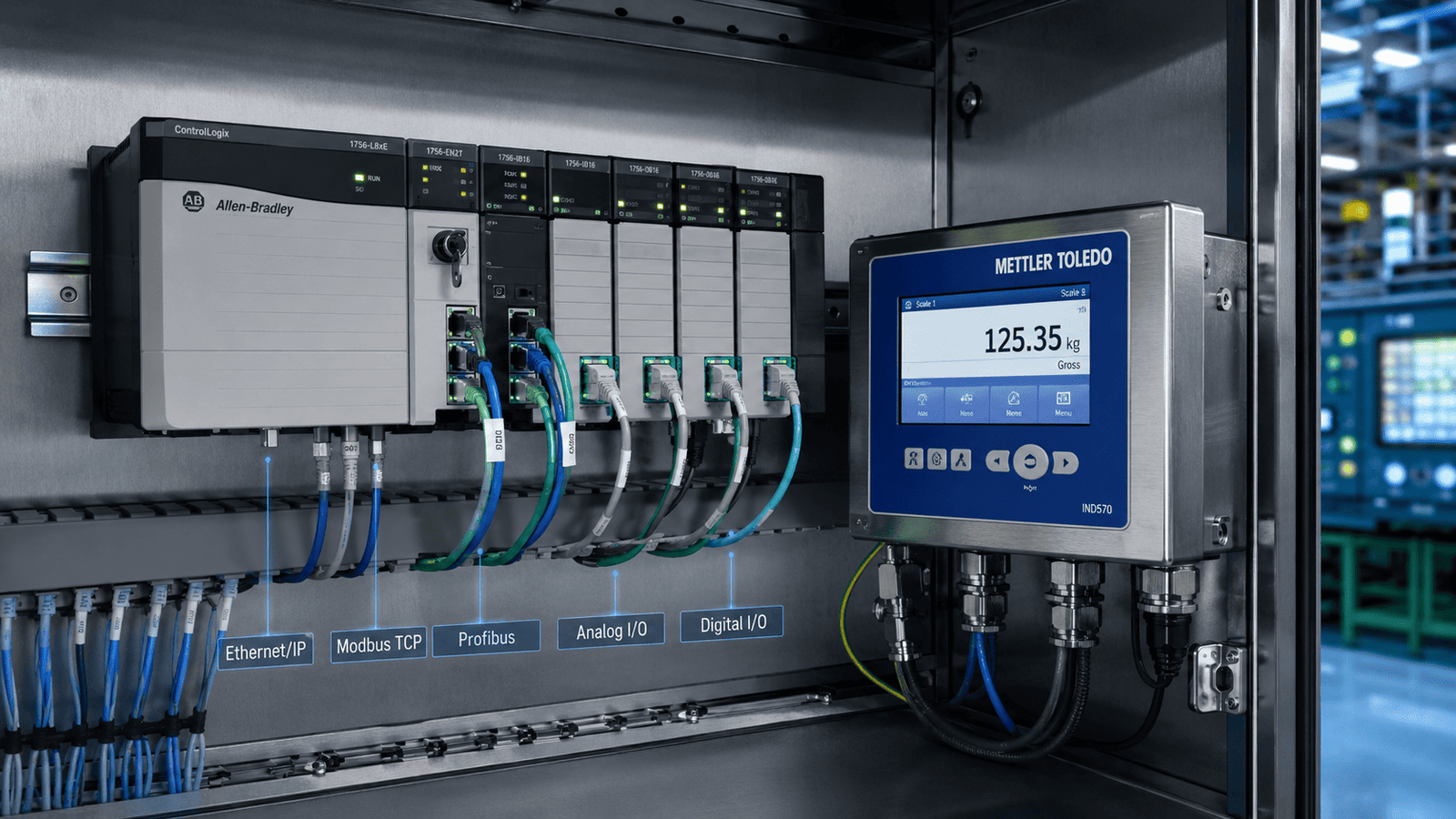
A weighing terminal communicates with a PLC through one of several industrial protocols, and which one you choose depends on your existing plant infrastructure, your PLC brand, and the update speed your application demands. Here is where it gets practical.
1. Modbus RTU / Modbus TCP
Modbus is the granddaddy of industrial communication protocols and, honestly, still the most common protocol we deal with in KSA plant retrofits. Modbus RTU runs over RS-485 serial cabling, cheap, robust, slow by modern standards, while Modbus TCP runs over standard Ethernet.
The weighing terminal publishes its weight data (and status bits) to a set of holding registers, and the PLC reads those registers on a timed scan cycle. For batch control or truck weighing, where you are reading a stable final weight rather than tracking a live process, Modbus TCP at a 100ms scan cycle is entirely adequate.
For new installations, Modbus TCP is the version to specify. It runs on your existing plant Ethernet infrastructure, it is supported by virtually every PLC brand (Siemens, Rockwell, Schneider, Mitsubishi), and configuration is well-documented. The Mettler Toledo IND570, for example, supports Modbus TCP as one of its primary fieldbus options, alongside EtherNet/IP, PROFIBUS DP, and PROFINET.
2. PROFIBUS DP
PROFIBUS DP (Decentralised Peripherals) is the dominant fieldbus in European-origin plants and in Saudi facilities that were engineered by German or Italian EPC contractors. If your plant runs Siemens S7 PLCs and SIMATIC systems, there is a good chance PROFIBUS is already your plant backbone.
The terminal publishes a GSD (General Station Description) file that the PROFIBUS master, typically the PLC CPU, uses to configure the data exchange. Weight, tare, setpoint status, and I/O bits are mapped to the process image of the PLC and updated cyclically, typically at 12 Mbit/s. Response times under 10ms are achievable, which makes PROFIBUS DP viable for fast dosing applications.
Common mistake
PROFIBUS is sensitive to cable termination. In a desert environment where cable trays run alongside high-voltage VFD conduits, noise-induced bus faults are a recurring headache on KSA sites. Get the cable topology reviewed by someone who has actually commissioned a PROFIBUS network in 50°C ambient, not someone who read the textbook. One missed termination resistor can bring the entire bus down.
3. EtherNet/IP
EtherNet/IP is the protocol of choice for Rockwell Automation (Allen-Bradley) environments and is growing fast in Saudi process plants, particularly in the oil and gas sector. It runs on standard TCP/IP infrastructure, which means it shares your plant Ethernet switches. The "IP" in EtherNet/IP stands for Industrial Protocol, not Internet Protocol, though both run on the same physical layer.
The Mettler Toledo IND780 supports EtherNet/IP alongside an Allen-Bradley Add-On Profile (AOP), which means you can drop the terminal's data structure directly into Studio 5000 (Logix Designer) as a pre-configured tag set. No manual register mapping. The weight value, status word, and command bits appear in the PLC project as named tags, which makes the integration genuinely fast and significantly reduces commissioning errors.
For new greenfield projects in KSA, if you have the flexibility to choose, EtherNet/IP with a modern terminal like the IND780 is the integration approach most worth specifying.
4. PROFINET
PROFINET is Siemens' Ethernet-based successor to PROFIBUS and is increasingly specified in new builds across the GCC. It combines the determinism of PROFIBUS with the physical layer of standard Ethernet, meaning you can run it on the same switches as your office network, though separation is still best practice for cybersecurity reasons.
The IND570 supports PROFINET natively. Configuration uses a GSDML file rather than a GSD file, and the terminal appears in TIA Portal as a standard IO device. For Vision 2030 megaprojects where Siemens is the automation vendor, PROFINET is becoming the default integration path for weighing terminals.
5. DeviceNet and ControlNet (Legacy Environments)
Both DeviceNet and ControlNet are Allen-Bradley protocols that predate EtherNet/IP. They are increasingly uncommon in new builds but are very much alive in existing plants, particularly in the petrochemical facilities around Jubail and Yanbu that were commissioned in the 1990s and 2000s.
The IND780 supports both, which is one of the reasons it remains a popular choice for brownfield integration projects in the KSA industrial sector. Retrofitting a new terminal into a plant running an existing Allen-Bradley PLC on ControlNet is significantly cheaper than replacing the PLC infrastructure, and the IND780's support for legacy protocols makes that retrofit viable.
04 How a Weighing Terminal Connects to a SCADA System
This question comes up constantly, and the short answer is: the terminal rarely connects directly to SCADA. The more typical architecture is:
Load cell → Weighing terminal → PLC → SCADA
The PLC acts as the data concentrator and control executor. SCADA reads the weight value (and status, alarms, totals) from the PLC's data tags via OPC-UA, Modbus TCP, or the SCADA's native driver. The SCADA system provides the historian, the alarm management, the trend displays, and the reporting. The PLC provides the real-time control logic. The terminal provides the certified weight measurement.
That said, some weighing terminals do support a direct connection path to SCADA via Ethernet TCP/IP with a shared data table, bypassing the PLC for read-only supervisory access. This is useful when you want weight visibility in the control room without routing the data through the PLC program. The IND780, for instance, supports Ethernet TCP/IP alongside its fieldbus options, allowing SCADA to pull weight data independently.
Industrial integration specialists confirm that modern weighing systems are engineered specifically to communicate with broader control infrastructure, following a hierarchical model where the terminal acts as a field device, the PLC handles local control logic, and SCADA manages supervisory monitoring and data archiving. That hierarchy is well-established and it works. The mistake I see in KSA projects is when someone tries to skip the PLC layer entirely and push weight data straight into SCADA for control decisions.
“ SCADA is not a real-time control system. It was not designed to close a control loop in 50ms. Use it for what it is good at: visibility, alarming, and reporting. — Section 04
05 Specifying a Weighing Terminal for KSA Industrial Environments
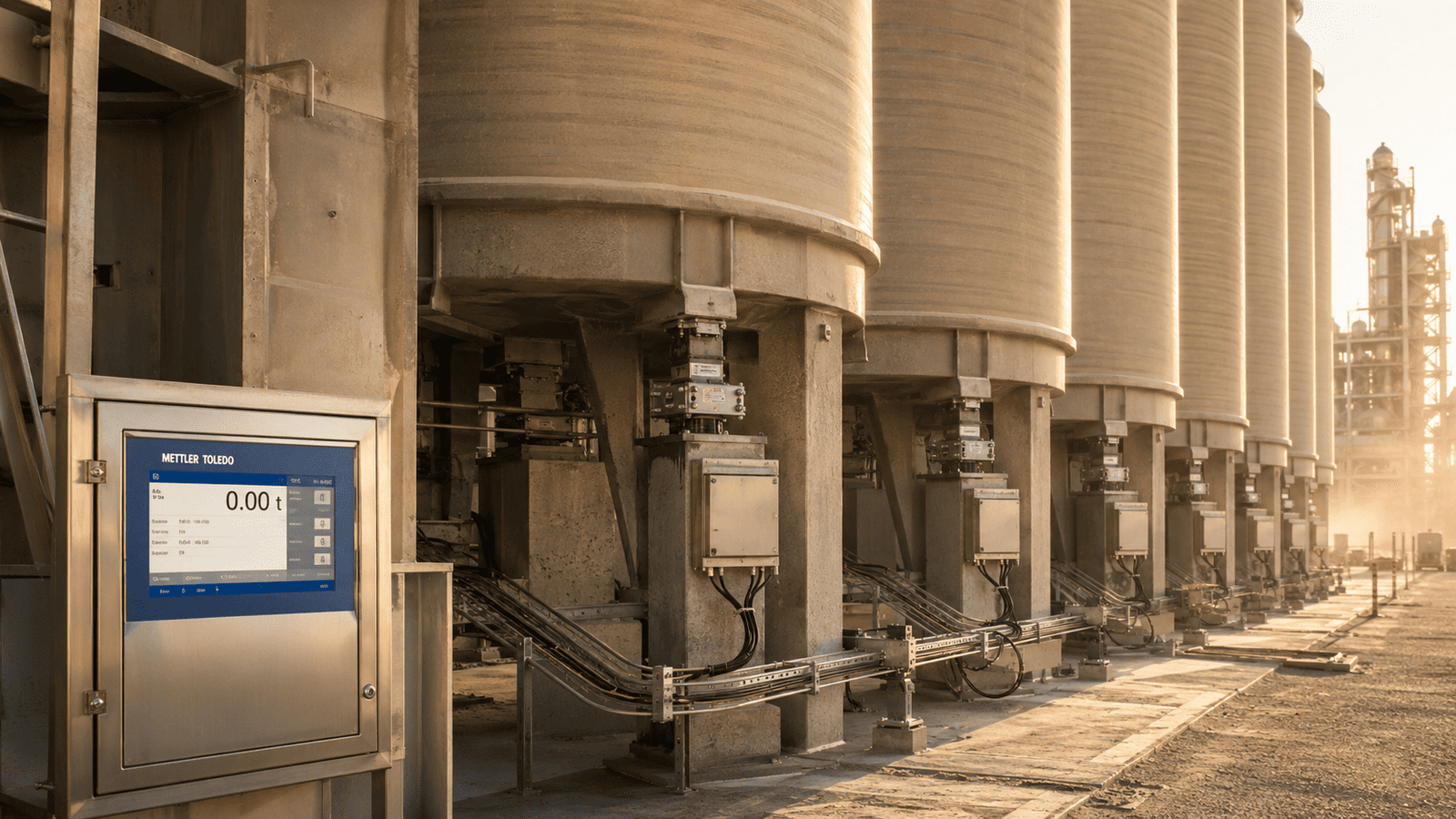
Saudi Arabia's industrial environments are demanding. The Eastern Province can see summer ambient temperatures of 50°C or higher. Humidity in coastal facilities near Jubail is punishing. Dust in cement, mining, and aggregate operations is constant. These are not edge cases, they are the baseline. When specifying a terminal for any KSA industrial site, these are the criteria that matter:
IP Rating: Minimum IP65 for panel-mount applications in clean environments. IP67 or IP69K for wash-down, outdoor, or heavy-dust locations. The IND780's harsh enclosure carries IP69K certification. Do not accept less than IP65 for any process environment.
Operating Temperature Range: Verify the terminal's rated operating range against your site conditions. Many standard industrial terminals are rated to 40°C ambient. In a roofed, ventilated enclosure in a Saudi plant, ambient inside the cabinet can easily exceed that. Budget for HVAC on the control cabinet or specify a terminal rated to 50°C or higher.
SASO and OIML Compliance: For any application that involves trade, custody transfer, or regulatory reporting, ZATCA invoice weights, port terminal throughput, pharma dispensing, the weighing terminal must carry an OIML certificate and be type-approved for the application. SASO, as a member of the International Organization of Legal Metrology (OIML), aligns its requirements with OIML R 76 for non-automatic weighing instruments. Make sure the terminal you specify carries the relevant approval, not just the load cells.
Calibration Traceability: Under SASO's Measurement and Calibration Law, calibration of legal-for-trade instruments must be traceable to national standards. Global Scales & Systems provides documented calibration services with full traceability chains, issued certificates, and scheduled recalibration programmes that satisfy audit requirements from SASO, SFDA, and site-level QA managers.
Lightning Protection: For outdoor weighbridge and silo applications in the Saudi desert, lightning protection is not optional. The POWERCELL PDX load cell from Mettler Toledo includes integrated StrikeShield technology specifically designed for this exposure. Pair it with a terminal that supports the POWERCELL digital interface and you have a diagnostics-capable, lightning-protected weighing chain.
Pro tip
When reviewing a terminal datasheet for a KSA project, check the operating temperature range before you check the protocol list. A terminal with all five fieldbus options that tops out at 40°C ambient is useless inside a cabinet in Jubail in July. Get the environmental spec right first, then confirm the communications.
06 Feature-to-Benefit Table: What the Specs Actually Mean for Your Plant
Terminal spec sheets are full of feature lists that do not translate themselves into operational language. Here is what each specification actually means when your team is running production.
| Terminal Feature | What It Means Operationally |
|---|---|
| EtherNet/IP with Allen-Bradley AOP | Drop-in Logix 5000 integration, no manual register mapping, commissioning in hours not days |
| PROFIBUS DP / PROFINET | Native Siemens TIA Portal integration, TÜV-tested cyclic data exchange at sub-10ms latency |
| Modbus TCP | Vendor-neutral, runs on existing Ethernet switches, lowest integration cost in brownfield retrofits |
| IP69K harsh enclosure (IND780) | Full wash-down resistance, deployable in food, pharma, cement without a protective housing |
| POWERCELL PDX load cell interface | Predictive load cell diagnostics delivered to the SCADA historian, catch failures before they cause downtime |
| CalFREE electronic calibration | Calibrate without physical test weights, critical for elevated silo vessels and fixed installation points |
| 4 discrete I/O (local) + 8 remote I/O modules | Direct setpoint control from the terminal itself, setfill, pre-act, and tolerance signals without a PLC for simple applications |
| Dual-channel analogue output (IND780) | Send weight as a 4–20mA signal directly to a legacy DCS or recorder with no protocol conversion |
07 Indicative Pricing: Weighing Terminal Configurations for KSA Industrial Projects
The ranges below are indicative market estimates for budgeting purposes only. Final pricing depends on specification, quantity, site conditions, integration complexity, and installation scope. Contact Global Scales & Systems for a site-specific quotation.
| Configuration | Typical Use Case | Est. Price Range (SAR) | Est. Price Range (USD) |
|---|---|---|---|
| Entry-level indicator (serial / Ethernet TCP/IP) | Bench, floor, or portable scale in warehouse or lab | SAR 3,000 – 8,000 | $800 – $2,100 |
| Mid-range with Modbus TCP or PROFIBUS DP | Dosing, batching, silo/hopper monitoring | SAR 12,000 – 28,000 | $3,200 – $7,500 |
| Industrial full-spec (EtherNet/IP or PROFINET, IP69K, hazardous area) | Oil & gas, chemical processing, truck weighing | SAR 32,000 – 65,000 | $8,500 – $17,300 |
| Enterprise / multi-channel (4 scale inputs, full fieldbus suite) | Port terminals, mega-projects, complex batching | SAR 70,000+ | $18,700+ |
08 Frequently Asked Questions
These are the questions our team fields most often from plant engineers, project managers, and procurement leads across KSA industrial sectors.
What is a weighing terminal and how does it differ from a regular scale?
A weighing terminal is the electronic instrument that processes the signal from load cells and converts it into a weight reading. A "scale" typically refers to the complete assembly, platform plus terminal. The terminal is the intelligent core: it handles calibration, filtering, display, and communication. In an industrial setting, the terminal is the part that talks to your PLC or SCADA. The platform itself does not.
Can a weighing terminal connect directly to a Siemens or Allen-Bradley PLC?
Yes. Modern industrial terminals like the Mettler Toledo IND570 and IND780 support the protocols used natively by both ecosystems. For Siemens, that means PROFIBUS DP or PROFINET, with configuration via TIA Portal. For Allen-Bradley, it means EtherNet/IP with an Add-On Profile that integrates directly into Studio 5000. Both connections are documented, supported, and used widely in KSA industrial plants.
How does a weighing terminal interface with a SCADA system?
In most architectures, the terminal connects to the PLC, and the PLC exposes weight data to SCADA via OPC-UA or the SCADA's native driver. Some terminals also support direct Ethernet TCP/IP connections for read-only supervisory access. SCADA should be used for visualisation, alarming, and historical logging, not for closing real-time control loops.
Does a weighing terminal need SASO approval for use in Saudi Arabia?
For legal-for-trade applications, including custody transfer, invoice weighing, port throughput, and SFDA-regulated pharmaceutical dispensing, the terminal must carry an OIML certificate and meet SASO's Technical Requirements for Non-Automatic Weighing Instruments. For internal process control with no legal-for-trade implications, type approval is not mandatory, but SASO-compliant calibration traceability is still best practice and is often required by client QA and audit programmes.
What is the best communication protocol for integrating a weighing terminal with a PLC?
It depends on your PLC platform. For Rockwell/Allen-Bradley environments, use EtherNet/IP. For Siemens environments, use PROFINET (new builds) or PROFIBUS DP (existing plants). For mixed or vendor-neutral environments, Modbus TCP is the lowest-risk option. For legacy brownfield plants with existing fieldbus infrastructure, the IND780's support for DeviceNet and ControlNet makes retrofit integration viable without replacing the PLC.
How often does a weighing terminal need calibration in KSA?
For legal-for-trade instruments, SASO's Measurement and Calibration Law requires periodic verification, typically annually. For internal process control, calibration frequency depends on application criticality, product value, and the client's quality management system. In our experience, most KSA clients in food, pharma, and petrochemical sectors run a 6-month calibration cycle to stay within their ISO 9001 and SASO audit requirements.
Can a weighing terminal work in a hazardous area (Zone 1 or Zone 2)?
Yes, though not all models. The IND780 offers a Division 2 (Zone 2) approved variant for use in explosive atmospheres, such as those found in petrochemical plants or solvent-handling facilities. Specification for hazardous area use requires careful review of the terminal's approval documentation and the site area classification. Always verify with your EPC engineer and the terminal supplier before specifying.

 Click to start chat