
7 Brutal Hidden Costs of Inaccurate Weighing Across Saudi Arabia's Key Industries
From oil & gas custody losses to pharma recalls; discover the real hidden costs of inaccurate weighing across Saudi Arabia's key industries and what KSA operations must do to stay compliant and profitable.

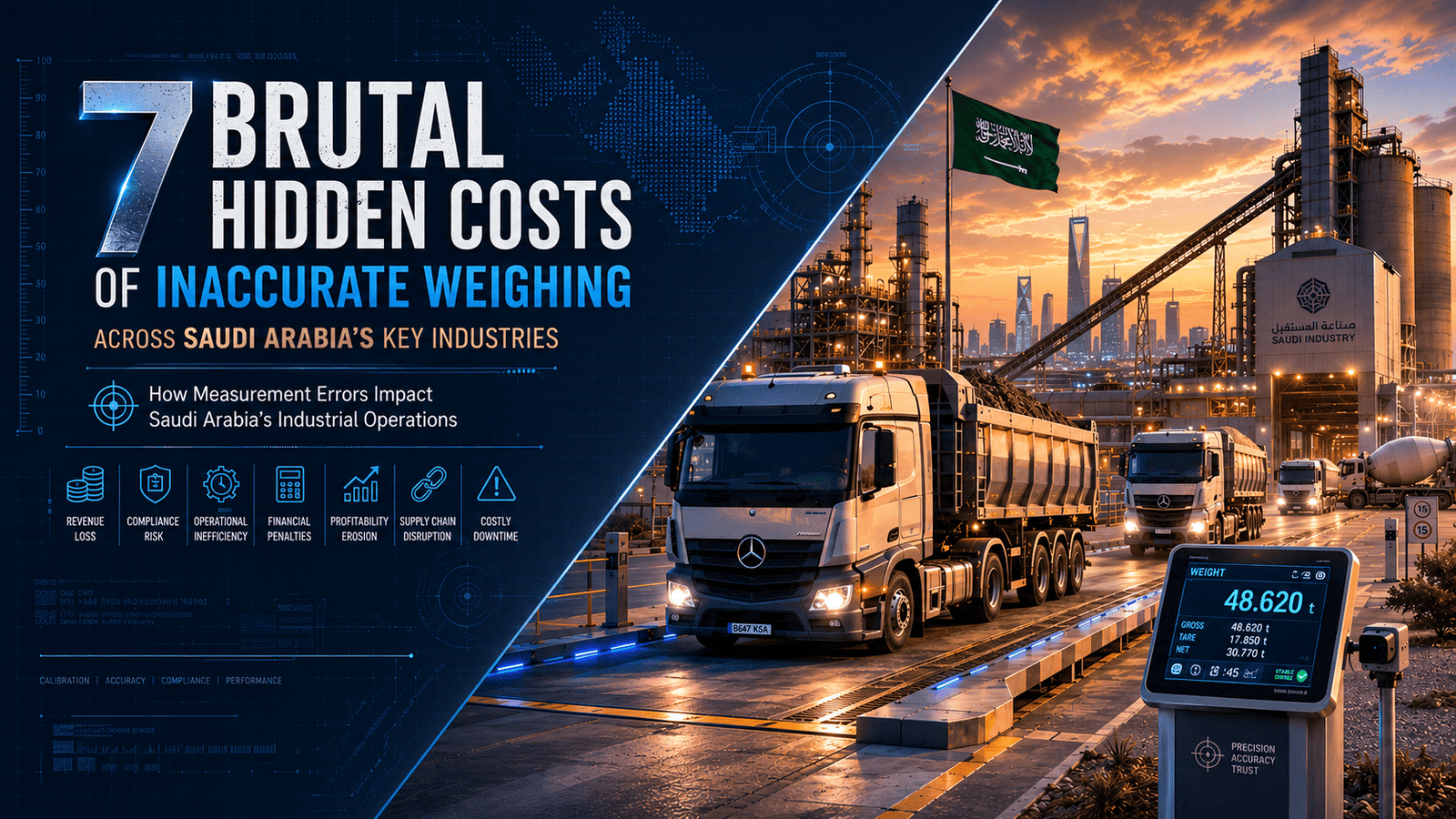
A cement plant in the Eastern Province was shipping trucks out 200 kg over ticket weight for eleven months. Not because of fraud, but because a single load cell had drifted out of calibration and nobody caught it. By the time a routine audit flagged it, the giveaway had quietly cost them over SAR 180,000 in cement they had never billed for. And that was just material loss. The hidden costs of inaccurate weighing, the regulatory fines, the wasted rework, the failed shipments, the compliance penalties, and piled on top.
This is the scenario playing out across Saudi Arabia's industrial base right now. In logistics, in oil and gas, in pharma, in ports, in manufacturing, in food production. The scales are technically "working," the trucks are moving, the production lines are running. But the numbers are wrong. And wrong numbers, at industrial volumes, are expensive in ways that don't show up on a standard P&L review until something breaks.
01 The Real Scale of the Problem
Let's set context before we get into industry specifics. According to Technavio's 2025 industrial weighing market analysis, the global industrial weighing machine market is forecast to grow at a CAGR of 4.6% through 2029; driven precisely by the increasing demand for accuracy, traceability, and automation in weighing processes. That demand is being pulled by operational pain: the cost of getting it wrong.
The hidden costs of inaccurate weighing don't follow a simple formula. Sometimes they're a slow haemorrhage, grams of product giveaway per unit across millions of units. Sometimes they're a cliff edge, a failed SASO inspection, a pharma batch recall, a port authority fine. The industries we serve across the GCC face all of these. And in most cases, the root cause is the same: poorly calibrated, poorly maintained, or simply under-specified weighing equipment.
We keep seeing this same issue across clients in Riyadh, the Eastern Province and Jeddah. The scale was bought five years ago. It's "still reading something." Nobody has called for a calibration. And nobody has done the maths on what "close enough" is actually costing them at 10,000 transactions a month.
02 Logistics: The Billion-Riyal Blind Spot
Logistics operations in Saudi Arabia are running at extraordinary scale under Vision 2030; new logistics zones, expanded road freight, and accelerated e-commerce fulfilment. Volume is up. And when volume is up, weighing error compounds fast.
The most visible cost is freight miscalculation. Trucks that leave a depot under-declared by even 50 kg per trip add up to a material billing deficit over weeks. The reverse and systematic overloading brings a different set of problems: axle damage liability, road authority fines, and increased vehicle wear. But the real blind spot in logistics is the hidden audit trail problem. When a shipment arrives at a destination and the received weight doesn't match the dispatch weight, somebody pays for the discrepancy. It might be a re-weighing charge. It might be a credit claim. It might be a dispute that consumes a week of operations management time. None of that appears on the scale's invoice.
What does appear, eventually, is the cost of failed compliance. Saudi Arabia's standards body SASO mandates calibration certification for commercial and legal-for-trade weighing instruments under OIML frameworks. A logistics depot operating a weighbridge or platform scale that hasn't been SASO-certified and periodically recalibrated is running on borrowed time. A single inspection failure doesn't just trigger a fine; it can ground a facility's weighing operations until rectification is complete.
And here's the thing nobody likes to admit: most logistics operators underinvest in weighing infrastructure because they think of it as a support function rather than a revenue function. It is a revenue function. Every kg miscalculated at dispatch is either a billing error or a liability. At scale, those errors don't average out, they accumulate.
03 Cement and Building Materials: Giveaway You'll Never Get Back
Cement is one of Saudi Arabia's most structurally important industries, with Vision 2030 infrastructure projects driving sustained high production volumes across companies like Saudi Cement, Yanbu Cement, and Arabian Cement.
The hidden cost in cement is product giveaway, and it's brutal in its simplicity. A bulk cement loading system running 200 kg over target on a 25-tonne truck results in 0.8% giveaway per load. Run that across 80 truck dispatches a day and it adds up to 64 extra tonnes of cement per day that you're loading and not billing. At current ex-factory cement prices, that can represent tens of thousands of riyals per month walking out the gate unrecorded.
Inaccurate weighing in cement also creates problems upstream, in batching. Concrete mix design depends on precise aggregate and cement ratios. A batching plant with a drifted load cell produces inconsistent mix designs that can affect compressive strength, which matters enormously for any project falling under SASO or municipal structural specifications. The downstream cost of a rejected concrete batch, or worse, a structural defect, dwarfs the cost of a calibration visit.
Then there's SASO compliance on weighbridges specifically. Truck scales used for commercial sale must carry valid SASO certificates and comply with OIML R76 or OIML R134 as applicable. Certifying bodies in KSA conduct periodic field verifications, and a failed weighbridge can force a production halt at a loading facility, an outcome that no cement plant manager wants when project timelines are already under pressure.
“ Inaccurate weighing in cement batching can affect compressive strength, and the downstream cost of a rejected concrete batch dwarfs the cost of a calibration visit. — Section 03
04 Maritime and Ports: Protecting Supply Chains from Weight Discrepancies
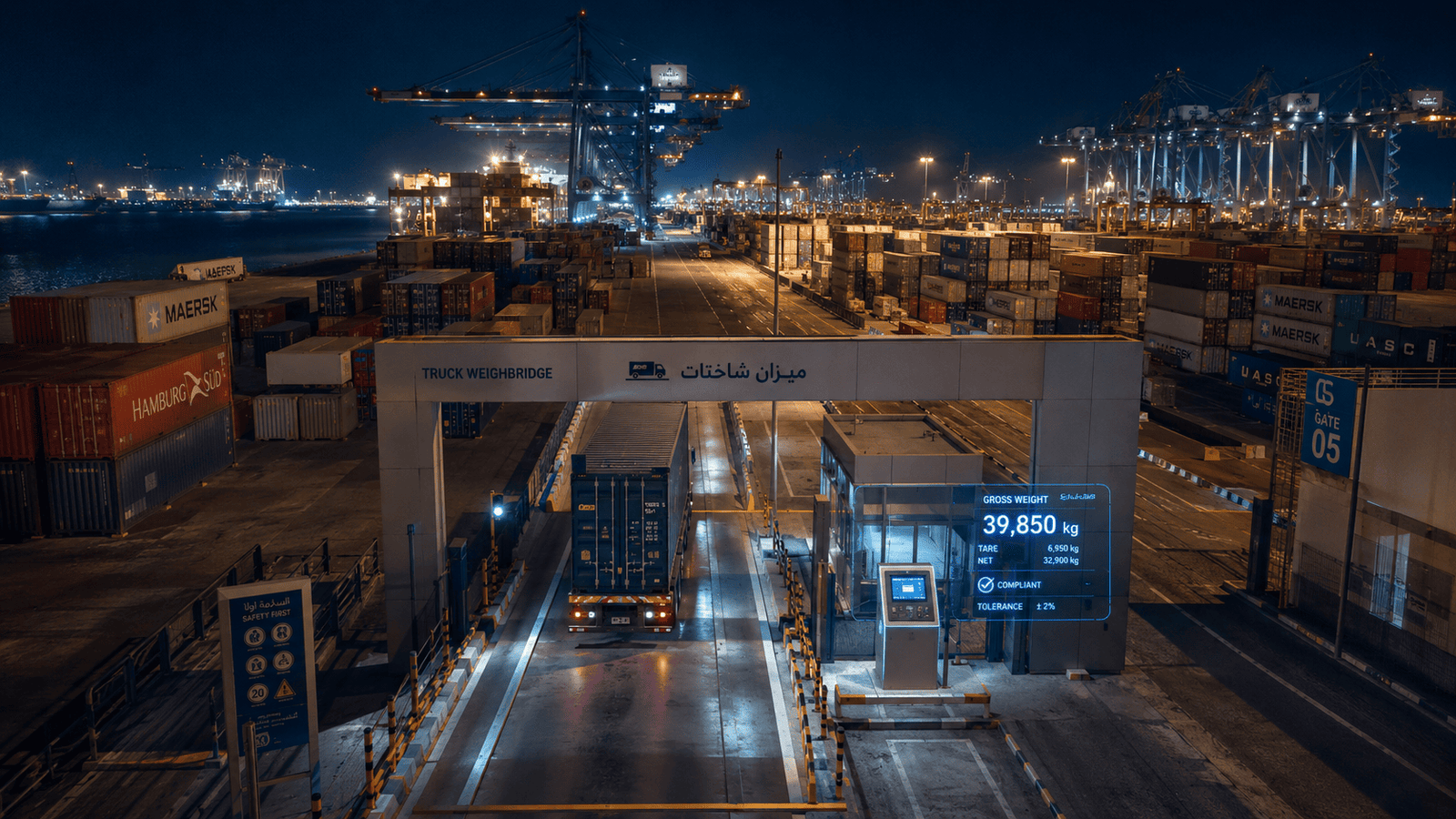
Inaccurate weight data at ports and maritime facilities extends far beyond financial loss. Incorrectly declared container weights jeopardize vessel stability, compromise hull integrity, and directly threaten the safety of crew members and port operators.
The International Maritime Organization's SOLAS regulations on Verified Gross Mass (VGM) exist for exactly this reason. Every container loaded onto a vessel must have a verified, accurate gross mass declared before loading. The rules exist because misdeclared container weights cause ships to be incorrectly loaded, creating instability that can, and does, result in containers going overboard or vessels capsizing.
A peer-reviewed analysis published in Ocean Engineering identified misdeclaration of container weight as the second most significant root cause of containers lost at sea, accounting for 12.6% of container fall events. In February 2025, the US National Transportation Safety Board published its investigation into the President Eisenhower incident, in which a containership lost 23 containers overboard off California. The finding: incorrect container weight data in the cargo loading plan caused stack weights to exceed maximum limits,, triggering structural failure of the securing equipment. Not a storm. Not equipment failure. Wrong numbers.
Meanwhile, per the World Shipping Council's 2024 cargo inspection data, 11.39% of inspected cargo shipments contained deficiencies in 2024, a level the IMO describes as a high concern. Port facilities that cannot produce verified, certified weight data for their cargo face detention, off-hire costs, and insurance complications that far exceed the cost of an accurate weighing system at the gate.
Saudi Arabia's ports and Jeddah Islamic Port, King Abdulaziz Port in Dammam, King Fahad Industrial Port in Jubail, are processing volumes that make this a board-level issue, not a dockworker issue. The weighing systems at these facilities aren't just operational tools. They're compliance instruments and liability shields.
05 Manufacturing: The Invisible Rework Loop
In manufacturing, weighing inaccuracy creates a problem that's harder to see than a fine or a lost shipment, but often more expensive: rework. When input materials are weighed incorrectly at goods-in, or when in-process batch weights deviate from specification, the production lot doesn't fail visibly. It continues through the line. It gets packaged. And then it gets caught, or it doesn't.
In industries with tight tolerance requirements and specialty chemicals, automotive components, electronics manufacturing, and a raw material batch received 2% underweight affects every downstream process that was calibrated around that input. The output may be within spec. It may not. The only way to know is testing, which consumes time and cost, or customer returns, which consume much more.
There's also the direct material giveaway side. In our experience working with manufacturers across the KSA industrial zones, outbound weighing is often less tightly managed than inbound. Product going out over-weight by small margins per unit is a persistent drain. It doesn't trigger an alarm. It doesn't show up on the quality report. It just quietly reduces gross margin, unit by unit, shift by shift.
The maintenance angle matters here too. A floor scale or bench scale that hasn't been serviced is not in a stable state of accuracy and it's in an unknown state of inaccuracy. Linearity errors, temperature drift, and mechanical wear can all introduce systematic bias without any visible indication on the display. The scale reads. The number is wrong. Nobody knows.
Common mistake
Saudi Arabia's summer ambient temperatures push 45–50°C. Thermal expansion affects platform dimensions and load cell performance can introduce systematic bias without any visible indication on the display. If your floor and platform scales haven't been temperature-characterised for your operating environment, they may be reading incorrectly throughout summer, the highest-throughput season for most industrial operations. This is one of the most consistently underestimated sources of weighing error we encounter during site assessments.
“ A floor scale that hasn't been serviced isn't in a stable state of accuracy, it's in an unknown state of inaccuracy. The scale reads. The number is wrong. Nobody knows. — Section 05
06 Food and Beverage: The Dual-Edge Giveaway Problem
Food and beverage manufacturers face what I call the dual-edge problem: you lose money from overfilling, you lose reputation, and face legal action from underfilling. Neither is safe. And both are caused by the same root: inaccurate weighing and filling systems.
Analysis from CimLogic puts the potential savings from a simple 1% reduction in product overfill in the millions of pounds for large food manufacturers annually. That's not a theoretical number, it's a commercial reality that FMCG companies deal with every year. And it's not just the product giveaway itself: when you overfill, you also over-use packaging material, over-fill storage and transport, and distort production cost accounting. The 2% extra product per unit doesn't disappear. It inflates your cost of goods and quietly contracts your margin.
The underfill side is worse for a different reason. In Saudi Arabia, SASO enforces pre-packaged goods regulations that mirror OIML recommendations on average quantity systems and maximum permissible errors for packed products. An F&B manufacturer whose checkweigher is drifting can produce compliant-looking product that is systematically underweight. When SASO inspectors pull shelf samples, the consequences are real: product withdrawal, recalls, fines, and lasting damage to distribution relationships in a market where brand trust in the GCC is hard-won and easily lost.
Saudi Arabia's food processing sector is also subject to SFDA scrutiny, particularly in dairy, processed meats, and packaged grains. SFDA's labelling and quantity-in-package regulations treat systematic underfilling as a consumer protection violation, not just a quality issue. The regulatory risk runs from two directions at once.
07 Pharmaceutical and Healthcare: Where Weighing Errors Become Patient Safety Events
Pharma is the industry where the phrase "hidden costs of inaccurate weighing" starts to feel inadequate. In pharmaceutical manufacturing, the cost of a weighing error isn't just financial, it's clinical.
Active pharmaceutical ingredients (APIs) are dosed by weight. A batch in which a critical ingredient was weighed incorrectly, even by a fraction of a gram, can produce a product that is sub-therapeutic, over-potent, or contaminated with out-of-ratio excipients. Under Saudi Arabia's NCBE and SFDA pharmaceutical manufacturing regulations, as under EU GMP and US FDA 21 CFR Part 211, weighing instruments used in pharmaceutical production must be calibrated, qualified, and documented. Not because regulators are bureaucratic, but because lives depend on it.
The cost of getting this wrong is extreme. Product recalls in pharma are rarely "soft" events. Pharma recalls triggered by manufacturing process deviations, including weighing failures classified under CGMP deficiencies, and are among the most expensive events a company can face: product destruction, regulatory remediation, SFDA warning letters, and potential facility suspension.
In a healthcare context, even the medical devices side carries weighing implications. Patient dosing systems, IV bags, and surgical consumables are all weight-verified during production. The tolerance for error is essentially zero. If you're a pharma or medical device manufacturer operating in KSA and your analytical balances or batch weighing systems haven't been IQ/OQ/PQ qualified recently, you're carrying undisclosed regulatory risk right now.
“ In pharma, the hidden costs of inaccurate weighing are financial and clinical. A batch weighed incorrectly by a fraction of a gram can produce a product that is sub-therapeutic, over-potent, or contaminated. — Section 07
08 Oil and Gas: Custody Transfer and the Multi-Million-Riyal Measurement Gap
Oil and gas is the industry where measurement inaccuracy at industrial scale becomes a geopolitical-scale financial issue. Saudi Arabia's oil and gas sector is, by most measures, the most consequential in the world. Custody transfer, the process of handing ownership of crude oil, refined product, or gas from one party to another, requires absolute measurement accuracy, because the financial exposure from errors is immediate and enormous.
Peer-reviewed research published in Chemical Engineering Science in 2025 quantifies this precisely: in high-capacity custody transfer systems, a measurement error of just 0.25% can represent losses of up to $15,000 per day, equating to approximately $5.5 million per year. That's for a 0.25% error. Many field tank gauging operations run at significantly higher measurement variability than that.
The hidden costs in oil and gas weighing and measurement go beyond custody transfer arithmetic. There's the tax and royalty dimension: ZATCA and Saudi Aramco's fiscal accounting are both dependent on accurate volume and mass measurement data. A systematic measurement bias doesn't just misallocate revenue between buyer and seller, it can create a taxation discrepancy that becomes a regulatory problem. There's also the HSSE dimension. Load cells and weighing systems on tanker truck loading gantries must accurately control fill weights to prevent overfilling events, which in a hydrocarbon environment carry explosive and environmental risk that no operations manager wants to contemplate.
Petrochemical and downstream processing facilities in Jubail and Yanbu, in particular, operate weighing systems across a range of critical points: raw material receipt, catalyst batching, product dispatch, and waste quantification. Each point carries its own risk profile for inaccuracy. And in a sector where margins per tonne can be thin and contractual penalties for delivery shortfalls or overages are embedded in every off-take agreement, the phrase "close enough" has no home.

09 What This Costs You Across All Seven Sectors: A Framework
The costs of inaccurate weighing fall into five categories, and every industry above gets hit by at least three of them.
| Cost Category | Mechanism | Most Exposed Sectors |
|---|---|---|
| Direct product giveaway | Over-dispensing or filling beyond spec | Cement, Food & Beverage, Pharma |
| Revenue leakage | Under-billing due to inaccurate dispatch weights | Logistics, Oil & Gas, Cement |
| Regulatory fines and shutdowns | SASO/SFDA/NCBE/IMO non-compliance | All sectors |
| Recall and rework costs | Batches failing spec due to weighing error | Pharma, Food & Beverage, Manufacturing |
| Liability and litigation | Custody disputes, port incidents, structural issues | Oil & Gas, Maritime, Cement |
The honest answer to "how much does inaccurate weighing cost" is: it depends on your throughput, your product value, and what triggers the error first. But across all seven sectors, the pattern is consistent. The cost of a calibrated, properly maintained, certified weighing system is a small fraction of the cost of operating without one.
“ A 0.25% measurement error in a high-capacity custody transfer system can represent $5.5 million in annual losses. Many field operations run at significantly higher variability than that. — Section 08
10 How to Audit Your Weighing Risk Right Now
Here's a practical checklist and the same one we walk through with clients during an initial weighing assessment.
1. Calibration currency. When was your last third-party calibration carried out and do you have the certificate? SASO requires periodic recalibration for all legal-for-trade instruments. "We calibrated it when we installed it" is not a current certificate.
2. Drift testing. Have you tested your scales for linearity across their full working range recently? A scale that reads correctly at 100 kg may read 1.5% high at 10,000 kg. Drift is not uniform.
3. Environmental compensation. Saudi Arabia's summer ambient temperatures push 50°C. Is your weighing equipment specified for this range and have you checked whether thermal expansion is affecting your platform or load cell readings?
4. Documentation chain. For pharmaceutical, food, and oil and gas operations and is your weighing data electronically logged, time-stamped, and audit-trail compliant? Paper log books are no longer acceptable under most regulatory frameworks.
5. Maintenance records. What is the service history on each scale? When was the last mechanical inspection? Load cells have operating lifetimes and fatigue thresholds. If you don't know, assume the worst.
Pro tip
For pharmaceutical, food, and oil and gas operations, ensure your weighing data is electronically logged, time-stamped, and audit-trail compliant. Paper logbooks are no longer acceptable under most regulatory frameworks. If a regulator arrives tomorrow, can you produce a complete, verifiable record of every weighing event for the past 12 months? If the answer is uncertain, that's the gap to close first.
11 Frequently Asked Questions
These are the questions we hear most often from operations managers and compliance teams across Saudi Arabia when they start taking weighing accuracy seriously.
Is SASO calibration certification mandatory for industrial scales in Saudi Arabia?
Yes. Any weighing instrument used for commercial transactions, legal-for-trade purposes, or regulatory compliance in KSA is required to carry valid SASO certification aligned with OIML recommendations. This includes truck weighbridges, platform scales in logistics, checkweighers in food production, and any scale used to determine the basis of payment in a commercial transaction. Operating without a valid certificate is a compliance violation that can trigger fines, facility audits, or suspension of operations.
How much does weighing error typically cost a mid-size logistics operation per year?
It depends heavily on throughput and product value, but the pattern we see consistently is material. A fleet depot processing 50 truck movements per day, with a weighbridge drifting by 0.5%, can accumulate billing discrepancies of tens of thousands of riyals per month. Add one failed SASO inspection per year and the cost profile changes significantly. There's no universal number but a weighing audit typically surfaces far more than it costs, and the return on a calibration programme is rarely difficult to justify.
What are the SOLAS VGM requirements for Saudi port operators?
Under SOLAS Chapter VI, all containers must have a Verified Gross Mass (VGM) declared before they can be loaded onto a vessel. The VGM must be determined either by weighing the packed container using certified weighing equipment, or by calculating and summing the weight of the contents plus the tare weight of the container. Port facilities and shipping entities in Saudi Arabia must maintain certified weighing systems capable of providing VGM data that meets the accuracy requirements stipulated under the SOLAS amendments. Failure to comply can result in containers being refused loading, delays, and regulatory penalties.
How often should weighbridges be recalibrated in the GCC climate?
For most industrial applications in KSA, annual recalibration is the regulatory minimum but high-throughput or high-value applications such as crude oil dispatch, cement plant weighbridges, and port container scales should be recalibrated more frequently. The GCC climate adds a variable that many operators underestimate: extreme heat causes thermal expansion of structural elements and humidity cycles affect load cell seals and electronic components. We typically recommend a six-month verification check for outdoor weighbridges in exposed desert environments, with full third-party recalibration annually.
What's the difference between calibration and verification for industrial scales?
Calibration is the process of adjusting a weighing instrument so that its readings match a known reference standard and it involves potential physical adjustment to the instrument. Verification is the process of checking that a calibrated instrument continues to meet its specified accuracy class without necessarily adjusting it. For SASO compliance purposes, both processes are relevant: initial calibration establishes accuracy, while periodic verification, often done more frequently, including internally, confirms the instrument hasn't drifted between formal calibrations.
Can pharma manufacturers in KSA use the same weighing equipment for multiple product batches?
Yes, but with important provisos. Pharmaceutical weighing equipment used in GMP environments must be dedicated to, or fully cleaned and validated between, different product batches, particularly for potent compounds. More critically, the weighing instrument itself must be IQ/OQ/PQ qualified and its calibration status must be traceable and recorded in the batch manufacturing record. The SFDA's pharmaceutical GMP guidelines are aligned with WHO and EU GMP standards on this requirement.
12 The Bottom Line
Accurate weighing is compliance infrastructure. It's financial infrastructure. In oil and gas, it's the cash register. In pharma, it's patient safety. In ports, it's load stability and crew lives.
The hidden costs of inaccurate weighing don't show up as a single line item, they distribute themselves across your P&L as giveaway, as rework, as fines, as disputes, as write-offs, occasionally as catastrophic events you didn't see coming.
At Global Scales & Systems, we work with operations across the GCC from logistics hubs in Riyadh to petrochemical loading facilities in Jubail, to assess, specify, install, and maintain industrial weighing scales that meet SASO, NMI, and OIML certification requirements. We're not in the business of selling you a scale and leaving. We're the weighing partner you call when the audit arrives, when a load cell needs replacing at 3am, and your compliance documentation needs to hold up in front of a regulator.
If you're reading this and wondering when your last calibration was; that's the answer. Contact our team or explore our calibration services to schedule a weighing system audit. We'll tell you exactly where you stand.
* Prices and cost estimates in this article are indicative market references only and do not constitute a formal quotation. Regulatory requirements should be verified directly with SASO, SFDA, and the relevant port or industry authority for your specific application.

 Click to start chat