
Reliable Weighbridge Solutions for Industrial Weighing in Saudi Arabia: A Complete Guide
What operators need to know about configuration, SASO/NMI compliance, realistic pricing, and installation before choosing a weighbridge vendor in Saudi Arabia.

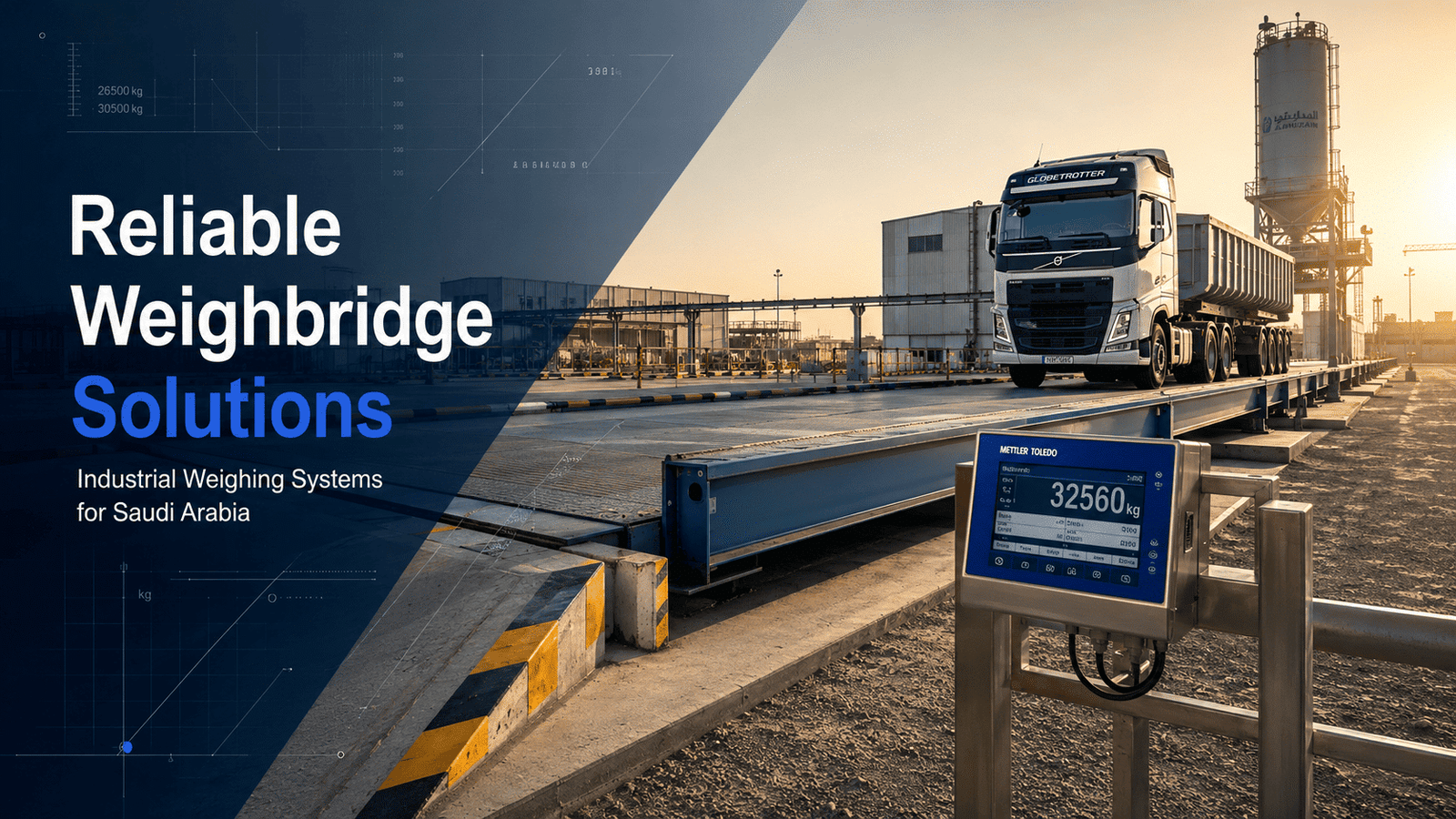
A forty ton aggregate truck rolls onto the weighbridge at a construction site outside Jubail at two in the afternoon, ambient temperature pushing past 47°C, and the reading on the terminal doesn't match the delivery ticket. Nobody wants such a moment in their operation. The driver loses time, the site engineer loses confidence in the numbers, and somewhere down the supply chain a contractor and a supplier are at logggerheads over tonnage that should never have been in question.
This is what's at stake behind every serious weighbridge decision in Saudi Arabia. The equipment itself is only half the story; installation quality, calibration discipline, and SASO compliance decide whether that reading holds up when someone finally questions it. In our experience working with operators across the Kingdom, most weighbridge problems trace back to one of three things: the wrong configuration for the site, a compliance gap nobody caught until an audit, or a vendor who went quiet after the concrete cured.
01 Why Weighbridges Are Essential in Saudi Arabia?
Ask anyone who's run a logistics yard or a quarry in the Kingdom and they'll tell you the same thing: a weighbridge isn't really about weight. It's about trust. Every load that crosses that deck becomes a number on an invoice, a line in a delivery record, and potentially evidence in a dispute six months from now. Get it wrong and you're not just off by a few kilograms, you're exposed on billing accuracy, on load-limit compliance, and on the structural integrity of every road and bridge that truck drives over afterward.
“ A weighbridge isn't really about weight. It's about trust. — Section 01
Saudi Arabia's industrial base gives this extra weight, if you'll forgive the pun. The Kingdom's mining sector alone is targeted to reach SAR 240 billion, about $63 billion, in GDP contribution by 2030, alongside 200,000 direct and indirect jobs and $27 billion in new investment, under a strategy that officially positions mining as the third pillar of national industrial growth alongside oil and petrochemicals. Every tonne of aggregate, ore, or cement that moves through that growth has to be weighed, verified, and billed accurately somewhere along the chain, usually at a weighbridge.
It's not just mining, either. Construction, cement, logistics, and oil and gas all lean on the same infrastructure, and the wider market has noticed. Globally, the weighbridge segment alone was valued at roughly USD 654 million and is projected to keep growing at a compound annual rate above 4 percent, and analysts covering the Middle East and Africa truck scale market point to emerging growth of 3 to 6 percent annually, driven by infrastructure development projects, expanding mining operations, and growing trade volumes across Gulf Cooperation Council countries. That's not explosive growth by tech sector standards, but for heavy industrial equipment with a service life measured in decades, it's a steady, real signal. Operators aren't buying weighbridges on a whim. They're buying them because the alternative, guessing at tonnage or relying on a scale that hasn't been verified in years, has become too expensive to justify.
02 Types of Weighbridge Systems: Choosing the Right Configuration
Not every site needs the same weighbridge, and this is where I see the most expensive mistakes happen. A logistics depot moving vans and light trucks has almost nothing in common with a quarry running fifty ton dump trucks all day in desert heat, yet vendors will sometimes push the same standard configuration on both because it's easier to sell.
Pit-Mounted vs. Surface-Mounted
Pit-mounted weighbridges sit flush with the ground, which is what you want if trucks are moving in multiple directions or space is tight. They cost more to install because of the civil works involved, excavation, drainage, concrete pit walls, but they hold up well long term and look tidy on a site that clients or auditors will actually walk through. Surface-mounted weighbridges sit on top of the ground with ramps leading up to the deck instead. Installation is faster and cheaper, and if you ever need to relocate the unit, it's far less disruptive. The tradeoff is the ramp footprint and, on some sites, a slightly less polished appearance.
Steel Deck vs. Concrete Deck
This one's really a durability versus cost conversation. Steel decks are lighter, quicker to install, and easier to repair if a section takes damage. Concrete decks cost more upfront but shrug off the kind of abuse that comes standard with mining and quarry operations: heavy impact loading, abrasive material spillage, constant traffic.
Capacity and Deck Length
A weighbridge sized for standard six axle trucks won't necessarily handle the longer combination vehicles common in bulk logistics and mining haulage. Get the deck length wrong and you'll be asking drivers to do multi-draft weighing, which slows every single truck down and quietly erodes the throughput the whole investment was supposed to protect.
03 Compliance: What Operators Needs to Know About Weighbridge Solutions For Industrial Weighing
This is the part of the weighbridge conversation you don't want to rush through, and it's exactly the part that matters most once regulators or clients start asking questions.
The Saudi Standards, Metrology and Quality Organization, established in 1972, is the Kingdom's technical authority for standards, metrology, and quality across every sector, industrial weighing included. Sitting inside SASO is the National Measurement and Calibration Center, established in 1406H (1986 AD) as the national entity responsible for developing, maintaining, and applying national measurement standards in the Kingdom. Think of the NMCC as the reference point everything else in Saudi legal metrology traces back to. When a calibration laboratory verifies your weighbridge, its own standards are traceable, ultimately, to the NMCC.
The legal backbone here is the Law of Measurement and Calibration, issued under Royal Decree No. M/51 in 2013. It sets out SASO's and the NMCC's duties, including approving prototypes, granting certificates of conformity, and conducting the initial verification of new measuring instruments before they go into service. Article 11 of the law is worth remembering on its own: Saudi standard specifications for calibration are required to be based on the recommendations of the International Organization of Legal Metrology, better known as OIML.
In practice, that means weighbridges in Saudi Arabia get assessed against OIML R 76, the international recommendation for non-automatic weighing instruments. Instruments are sorted into accuracy classes, and for most industrial and commercial weighbridge applications, including logistics yards, quarries, and factory gates, a Class III instrument is the standard you're working toward. Before a new weighbridge goes into commercial use, it needs primary verification. After that, it needs periodic re-verification to stay legal for trade, and a weighbridge that's drifted out of tolerance without anyone noticing is a liability wearing the disguise of a working scale.
“ A weighbridge that's drifted out of tolerance without anyone noticing is a liability wearing the disguise of a working scale. — Section 03
Common mistake
Here's the thing nobody in this industry likes to admit: plenty of weighbridges in the Kingdom are technically installed but not properly verified, or were verified once at commissioning and never again. That gap doesn't show up on a normal working day. It shows up during a client audit, a customs dispute, or an insurance claim, exactly the moment you can't afford it to.
We keep seeing this same pattern with new clients who come to us after a compliance scare rather than before one.
04 What Drives Weighbridge Pricing in Saudi Arabia
So what does this actually cost? Every operator asks that early on, and the honest answer is that weighbridge pricing in Saudi Arabia depends on capacity, deck material, civil works complexity, and how much automation you want at the terminal. What follows are indicative market ranges to help you budget a conversation with a vendor, not a quote. Ground conditions, site access, and the scope of civil works can move these numbers meaningfully in either direction, so treat this as a starting point for planning, not a number to hold anyone to.
| Configuration | Use Case | Est. Price Range (SAR) | Est. Price Range (USD) |
|---|---|---|---|
| Entry-level (steel deck, manual ticketing) | Small logistics depot, light vehicles | SAR 45,000 to 75,000 | $12,000 to $20,000 |
| Mid-range (RFID / unattended terminal) | Logistics and FMCG distribution | SAR 110,000 to 220,000 | $29,000 to $59,000 |
| Industrial (concrete deck, full spec) | Mining, quarrying, oil and gas | SAR 260,000 to 480,000 | $69,000 to $128,000 |
| Enterprise (multi-lane, ANPR, ERP integration) | Ports and mega-projects | SAR 550,000+ | $147,000+ |
These are indicative market estimates for planning purposes only, not formal quotes. Final pricing depends on site conditions, civil works scope, and configuration, and should be confirmed through a proper site assessment.
Price alone won't tell you whether a weighbridge is going to hold up under five years of daily Saudi heat and round the clock truck traffic. These are the specifics that actually matter operationally.
| Feature | What It Actually Means for You |
|---|---|
| Type-approved load cells verified to OIML R 76 | Your weighbridge passes SASO verification the first time, no re-inspection delays |
| RFID or ANPR unattended weighing | Trucks weigh in and out without a gatekeeper on every single shift |
| IP-rated, corrosion-resistant junction boxes | Desert dust and summer heat don't turn into a six month cabling failure |
| Remote diagnostics and load cell monitoring | You catch a drifting cell before it fails an audit, not after |
| Documented calibration and verification trail | You can hand an auditor or a client every certificate on demand, not a promise that it's around here somewhere |
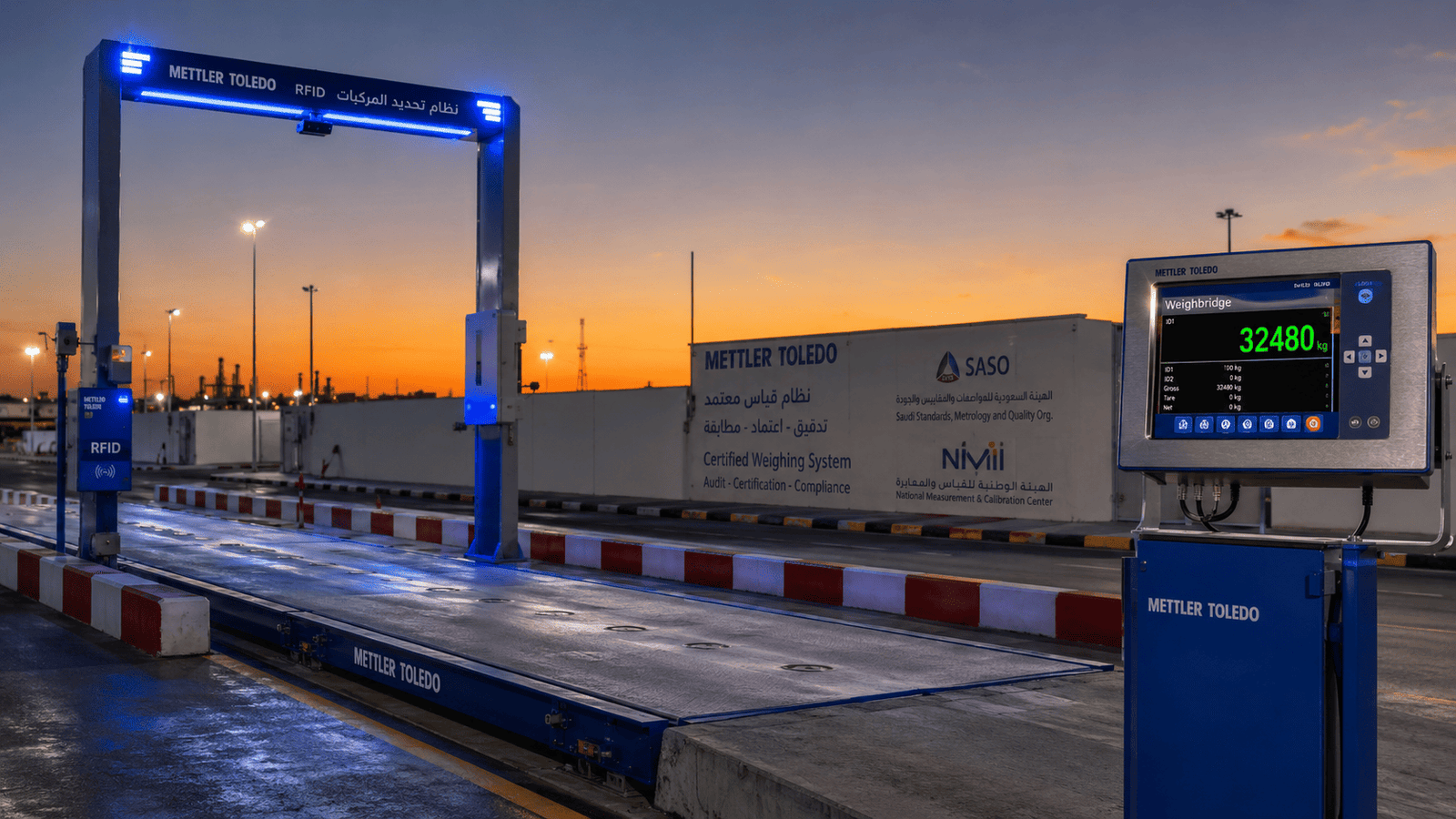
05 Installation Realities in the Kingdom
Here's what nobody tells you at the sales stage: installing a weighbridge in Saudi Arabia isn't the same exercise as installing one in a temperate climate, and treating it that way is how projects run over budget and over schedule.
Heat and Climate
Ambient temperatures regularly climbing past 45°C in summer put real stress on load cells, cabling, and electronic components that weren't specified for the environment. This is exactly why we push clients toward load cells with genuine environmental and lightning protection ratings rather than the cheapest compliant option, because a weighbridge that fails in August was never really fit for the site in the first place.
“ A weighbridge that fails in August was never really fit for the site in the first place. — Section 05
Civil Works and Ground Conditions
Ground conditions across the Kingdom vary enormously, from softer coastal soil near the Red Sea and Arabian Gulf to compacted desert terrain further inland, and foundation design has to account for that before a single load cell goes into the ground. Rushing this stage to hit a deadline is how you end up with a weighbridge that reads inconsistently within its first year, which is a far more expensive problem to fix after the concrete has cured than before it.
Billing and Data Integration
With ZATCA's e-invoicing requirements now part of standard commercial practice in the Kingdom, a weighbridge that can't feed clean, accurate weight data into your invoicing and ERP systems creates manual reconciliation work you shouldn't have to deal with in 2026. Plan the data integration at the same time you plan the civil works, not as an afterthought once the deck is already poured.
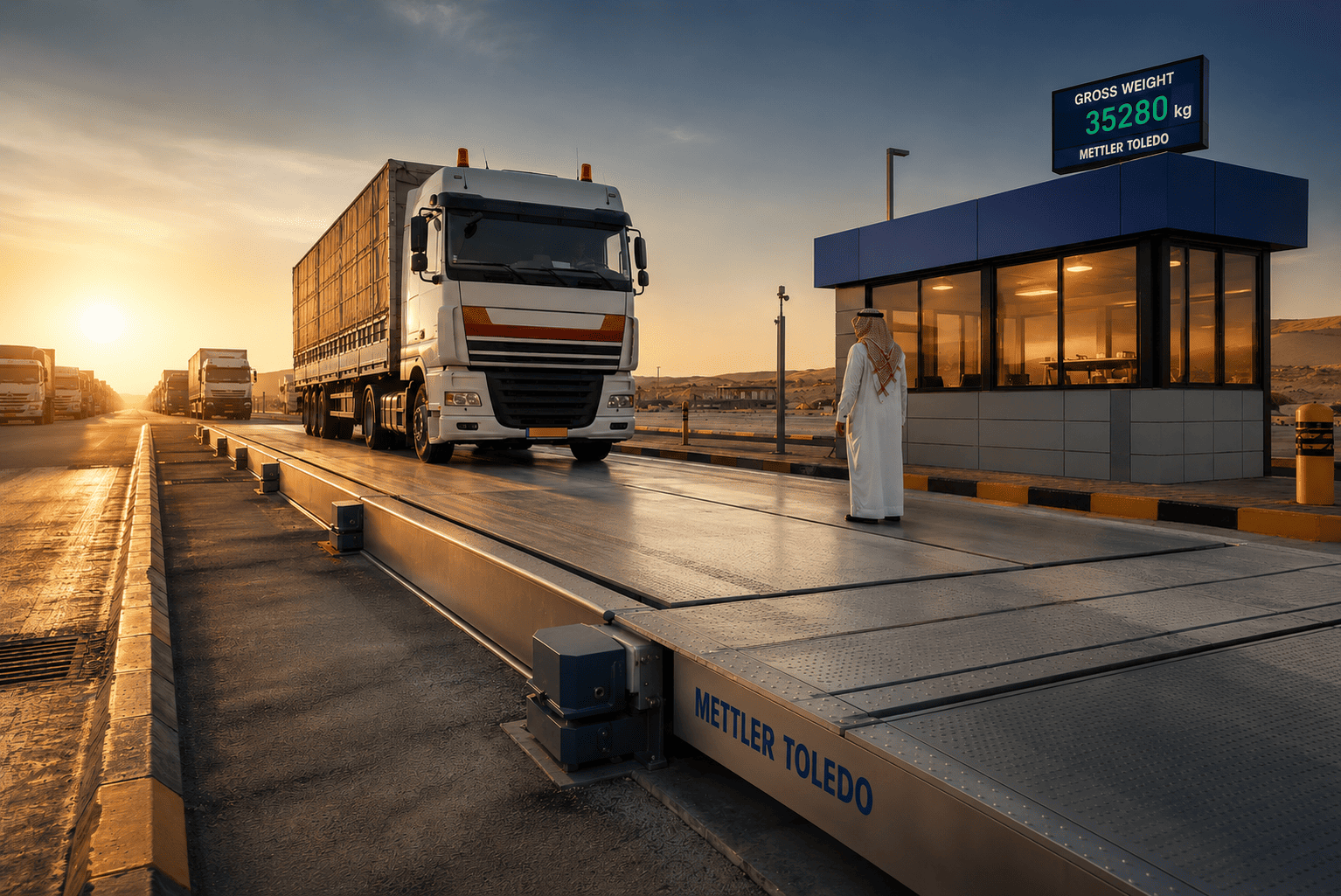
06 Why Choose GSS Weighbridges in Saudi Arabia?
By this point you know what a good weighbridge deployment actually requires: the right configuration, verified compliance, installation that accounts for the Kingdom's climate and ground conditions, and a data trail you can produce whenever someone asks for it. That's the entire business we're in.
Global Scales & Systems works across Riyadh, Jeddah, Dammam, and Dubai, which matters more than it sounds when a weighbridge goes down at a quarry three hours from the nearest city and you need someone on-site, not on a video call. We serve the industries where weighing accuracy isn't optional: oil and gas, logistics, construction and cement, food and beverage, precious metals, and heavy industry, and every one of those verticals has its own compliance pressure points that a generic vendor simply won't know to look for.
What we actually lead with isn't a product catalogue. It's the compliance and calibration side of the relationship, the part that determines whether your weighbridge is still defensible in an audit three years after installation, not just accurate on day one. We manage the SASO verification process, keep your calibration documentation organized and current, and flag re-verification windows before they become a problem you discover the hard way. GSS also holds official Mettler Toledo partner status in the Kingdom, which is worth knowing if hardware pedigree matters to your procurement process, but honestly, the day to day value sits elsewhere: in the site assessment we do before anything gets quoted, the paperwork we handle so you're not chasing a certificate at year end, and the calibration record we can hand you the moment an auditor walks in.
Pro tip
If you're getting three quotes right now, here's what to watch for: ask each vendor to walk you through their post-installation verification process before you ask about price. The ones who can't answer clearly are telling you something important.
07 How to Evaluate a Weighbridge Quote the Right Way
A cheap weighbridge quote isn't automatically a bad one, and an expensive quote isn't automatically thorough. So how do you actually tell a diligent quote from a padded one? The difference is in what's included, and most comparison mistakes happen because operators compare headline numbers instead of scope.
Start by asking what civil works are included versus quoted separately. A quote that looks 30 percent cheaper than the others is often just excluding the excavation, concrete, and drainage work, which doesn't disappear, it just shows up later as a change order. Ask for the load cell specification by name and accuracy class, not a vague "industrial-grade" description that could mean almost anything. Ask whether primary verification and SASO documentation are included in the price or billed separately after commissioning, because a weighbridge that's installed but not verified isn't actually usable for anything involving trade or billing.
And ask about response time on breakdowns. A weighbridge that goes down for a week at a working quarry isn't a minor inconvenience, it's a site that can't bill accurately or, in some cases, can't operate at all. Get a real answer on this before you sign, not after.
08 Frequently Asked Questions
How much does a weighbridge cost in Saudi Arabia?
It depends heavily on capacity, deck material, and civil works, but indicative market ranges run from roughly SAR 45,000 for a basic entry-level system up to SAR 550,000 or more for a full enterprise-grade, multi-lane installation. Treat any number you see online, including the ranges in this guide, as a planning estimate rather than a quote, and confirm actual costs through a site assessment.
Is SASO certification required for weighbridges in Saudi Arabia?
Yes. Weighbridges used for trade, billing, or any transaction where weight determines a payable amount fall under SASO's legal metrology framework, which requires calibration standards to be based on OIML recommendations under the Kingdom's Law of Measurement and Calibration. A weighbridge without valid primary verification and up to date re-verification isn't legally compliant for commercial use.
How long does weighbridge installation take in Saudi Arabia?
It varies by configuration and site conditions, but a surface-mounted system with straightforward ground conditions typically moves faster than a pit-mounted system requiring extensive excavation and drainage work. Ground conditions, weather, and civil works complexity are the biggest variables, which is why a proper site assessment before committing to a timeline matters more than a generic estimate.
What's the difference between a pit-mounted and surface-mounted weighbridge?
A pit-mounted weighbridge sits flush with the ground and allows multi-directional traffic, but costs more to install because of the excavation and civil works involved. A surface-mounted weighbridge sits above ground with access ramps, installs faster and more affordably, and is easier to relocate if your site layout ever changes.
How often does a weighbridge need calibration in Saudi Arabia?
Weighbridges used in legal metrology contexts need primary verification before entering service and periodic re-verification afterward to remain compliant. The exact interval depends on usage and application, so confirm the specific schedule for your instrument with your calibration provider rather than assuming a single interval applies everywhere.
What accuracy class does a weighbridge need under OIML R 76?
Most industrial and commercial weighbridges in Saudi Arabia, including those used at logistics yards, quarries, and factory gates, operate as Class III instruments under OIML R 76. Your specific application, especially anything involving precious metals or high-value goods, may call for a different class, so confirm this with your supplier before finalizing a spec.
Contact us at Global Scales and System Co. Ltd for precise industrial weighing scales (weighbridges) that's reliable and gets the job job even in the harshest of environments.

 Click to start chat