
6 Costly Tanker Truck Weighing Scale Challenges and the Proven Fixes Saudi Operators Use
Liquid cargo behaves in ways solid freight simply does not. Here are the six distinct ways tanker weighing goes wrong in KSA and the technical fixes that protect your operation from fines, disputes, and failed inspections.


The tanker arrives at the gate. The operator waves it onto the scale. The readout climbs... climbs... and stops SAR 180,000 short of legal. The driver knows he's loaded; he's been hauling fuel across the Eastern Province for six years. But the tanker truck weighing scale tells a different story, and the Roads General Authority doesn't negotiate. At SAR 200 per 100 kilograms over the legal limit, with fines capped at SAR 100,000 per the RGA's September 2024 guidelines — one overloaded crossing can erase the margin on an entire route.
And it's not always driver error or deliberate overloading. Liquid cargo behaves in ways that solid freight simply does not and if your weighing setup isn't built to handle those behaviours, you're flying blind on every trip. This guide walks through the six biggest challenges operators face when weighing liquid cargo tankers, and the technical and procedural fixes that actually work.
01 Why Liquid Cargo Makes Truck Weighing Fundamentally Different
Before we get into specific challenges, it's worth understanding why liquid cargo demands a different approach to weighing entirely. When you load a flatbed with steel coils or palletised goods, the weight is fixed once the truck leaves the yard. It doesn't shift, it doesn't change density with ambient temperature, and it doesn't slosh against the walls when the driver brakes hard at an intersection. Liquid cargo does all of that.
According to a study published in the European Journal of Mechanics, partially filled tank trucks have significantly lower directional stability limits than conventional rigid cargo vehicles, precisely because of the dynamic load shifts caused by sloshing liquid. That same dynamic behaviour is what makes accurate weighing, at any point in the journey, such a challenge.
And the scale of the market makes getting this right non-negotiable. The global tanker truck market crossed USD 131.6 billion in 2023 and is tracking a 4.7% CAGR through 2032, with the Middle East, led by Saudi Arabia and the UAE, among the primary demand drivers. Closer to home, Mordor Intelligence projects fluid goods in KSA road freight will advance at a 5.55% CAGR between 2026 and 2031, backed by the downstream expansion of petrochemical plants and rising tanker demand for edible oils and dairy. More tankers on the road means more weighing events and more exposure to regulatory risk.
02 Sloshing and the Dynamic Load Measurement Problem

This is the one that catches operators off guard the most. Liquid inside a partially filled tank doesn't sit still. When a tanker pulls onto a weighbridge, the cargo is still in motion from the approach. The liquid shifts forward under braking, sloshes back as the truck decelerates to scale speed, and then oscillates for several seconds before settling.
If your weighing system reads during that oscillation window, you'll get a different number every time. I've seen operators weigh the same tanker three times in a row and get readings that span 200 kilograms. On a 45-tonne five-axle rig, the maximum gross weight allowed under Saudi Arabia's axle load regulations, that kind of variance is both an inconvenience and a compliance liability.
“ I've seen operators weigh the same tanker three times in a row and get readings spanning 200 kilograms; on a rig where that variance is a compliance liability. — Section 02
The fix: Modern weighbridge controllers and weighing terminals use built-in motion detection and settling algorithms. The system monitors the load cell signal in real time and only locks the weight reading once the output stabilises within a defined tolerance band. For tanker applications, you want a terminal with adjustable settling time and the ability to set minimum stability duration; typically 2 to 5 seconds of consistent reading before the weight is captured.
For operations where tankers can't always stop long enough, dynamic weighing systems (also called weigh-in-motion or WIM) can capture axle loads while the vehicle is moving at low speed. These require more rigorous calibration and OIML-compliant certification to be used for legal-for-trade purposes in KSA, but they're worth the investment at high-throughput sites like port terminals and refinery gates.
03 Temperature-Driven Density Changes in Liquid Cargo
Here's something that doesn't get enough attention in weighing conversations: the same volume of liquid can weigh meaningfully different amounts depending on its temperature. Petrochemicals and edible oils are particularly prone to this. Diesel fuel at 15°C has a density of around 0.82–0.85 kg/L. At 45°C which is a realistic cargo temperature after loading in a KSA summer, that density drops by 1–2%. On a 30,000-litre tanker, that's a difference of 250 to 500 kilograms. If your tanker is being sold by weight, that's either money you're leaving on the table or a compliance discrepancy waiting to happen.
This problem gets worse if the cargo was loaded at one temperature and the weighing happens hours later after the tanker has been sitting in direct sun. Saudi summers regularly push ambient temperatures above 50°C in the Eastern Province, and black tanker bodies can absorb enough heat to raise cargo temperature significantly over a 2–3 hour parked dwell.
The fix: The weighing itself can't correct for density but your operational protocol can. For weight-critical applications, establish a consistent temperature-at-loading reference point and document it with each weigh ticket. Some operators in the petrochemical sector use temperature-compensated mass flow meters for loading verification, then cross-reference at the weighbridge. For custody transfer applications specifically, work with a qualified metrology consultant to align your measurement chain with OIML R 117 (measuring systems for liquids other than water) requirements.
04 Multi-Compartment Load Distribution and Axle Compliance
Most tankers running in KSA today aren't single-compartment units. Food-grade tankers, petrochemical haulers, and multi-product fuel trucks all carry divided tanks with two, three, or four separate compartments. The loading operator fills these compartments in a sequence and if that sequence isn't carefully planned, you can end up with a truck that's technically within gross weight but overloaded on specific axles.
Saudi Arabia's axle load framework is explicit on this point. A five-axle truck is allowed 45 tonnes gross weight total, but the load has to be distributed correctly across the axle groups. Getting the gross right while getting an axle group wrong still earns you a fine, SAR 200 for every 100 kilograms over on a regular violation, per the Roads General Authority. This is one of the most common compliance failure modes we see in multi-compartment tanker operations, and it's almost always a loading sequence problem rather than a weighing problem.
The fix: Multi-axle weighing. A proper tanker weighbridge doesn't just give you a single gross weight readout, you will also get individual axle group weights so you can identify imbalance before the truck leaves the site. Pair this with a portable axle pad system for pre-loading verification at facilities without a permanent weighbridge. For high-volume sites, axle-by-axle weigh-in-motion systems capture per-axle data without slowing throughput.
The investment in axle-specific data pays for itself quickly when you consider that a single axle-overload fine on each of your 20 daily tanker departures adds up faster than the cost of a proper multi-axle scale installation.
05 Corrosion, Spillage, and Harsh Environment Load Cell Degradation
Let's talk about the physical environment for a moment, because this is where tanker weighing gets expensive in ways operators don't always anticipate. Tanker trucks spill. Not catastrophically, usually but fuel vapours, chemical residues, and minor valve drips accumulate on weighbridge platforms over time. In a petrochemical facility or fuel depot, you're also dealing with continuous exposure to hydrocarbons that degrade standard seals and corrode unprotected load cell surfaces. Add in the 50°C ambient summer temperature and the occasional flash flood in the Hejaz highlands, and you've got a load cell environment that will destroy an underpowered installation within a few years.
I've walked facilities where operators have simply stopped trusting the scale because it was giving inconsistent results and when we inspected the load cells, three of the four were corroded through the cable jacket. The scale was still powering on. It was just not accurate anymore.
“ Three of the four load cells were corroded through the cable jacket. The scale was still powering on. It was just not accurate anymore. — Section 05
The fix: For tanker weighing in petrochemical, fuel, or chemical applications, specify load cells with a minimum IP68 or IP69K rating — the latter means the unit is certified to withstand high-pressure, high-temperature water jets, which matters at wash-down facilities. Hermetically sealed, stainless steel load cell housings are non-negotiable for chemical exposure environments. Surge protection is equally important: StrikeShield-equipped load cell systems (as used in Mettler Toledo's POWERCELL PDX platform) provide built-in lightning and transient surge protection, which is critical in KSA's desert environments where ground resistance is high and indirect lightning strikes are a real risk.
Pro tip
Pair a robust IP-rated hardware spec with a preventive maintenance schedule. Quarterly inspection of load cell cables, junction boxes, and platform drain channels extends installation life significantly and catches corrosion issues before they become accuracy issues. A full certified calibration at least once per year keeps your scale legally defensible.
06 Tanker Truck Weighing Scale Configurations: What's Available and What It Costs
There's no single right answer for tanker weighing configurations. What works for a two-truck-per-day edible oil distributor in Jeddah is not what a 24/7 fuel depot in Jubail needs. Here's a practical breakdown of the main configurations with indicative market pricing.
These are indicative market estimates only and do not constitute a formal quotation. Actual pricing varies based on civil works, site conditions, terminal specification, and installation scope. Contact Global Scales & Systems for a site-specific assessment.
| Configuration | Typical Use Case | Est. Price Range (SAR) | Est. Price Range (USD) |
|---|---|---|---|
| Single-deck surface-mounted weighbridge (40–60t capacity) | Small fuel depots, edible oil distributors | SAR 85,000 – 160,000 | USD 22,600 – 42,600 |
| Single-deck with multi-axle indicator + RFID terminal | Mid-size logistics, chemical tankers | SAR 160,000 – 280,000 | USD 42,600 – 74,600 |
| Pit-mounted full-length weighbridge (18m+) | Refinery gates, port terminals, large depots | SAR 280,000 – 500,000 | USD 74,600 – 133,300 |
| Dual-deck drive-through with automated data capture | High-throughput petrochemical, LNG facilities | SAR 500,000 – 900,000+ | USD 133,300 – 240,000+ |
| Weigh-in-motion (WIM) axle array — legal for trade | Port entry control, highway checkpoints | SAR 350,000 – 700,000 | USD 93,300 – 186,600 |
A note on hidden costs: civil works for a pit-mounted weighbridge in rocky KSA terrain can add SAR 40,000 to SAR 120,000 to the total project cost depending on excavation requirements. Always get the civil scope quoted separately from the weighing equipment cost.
07 SASO, NMI, and the Legal Metrology Compliance Gap
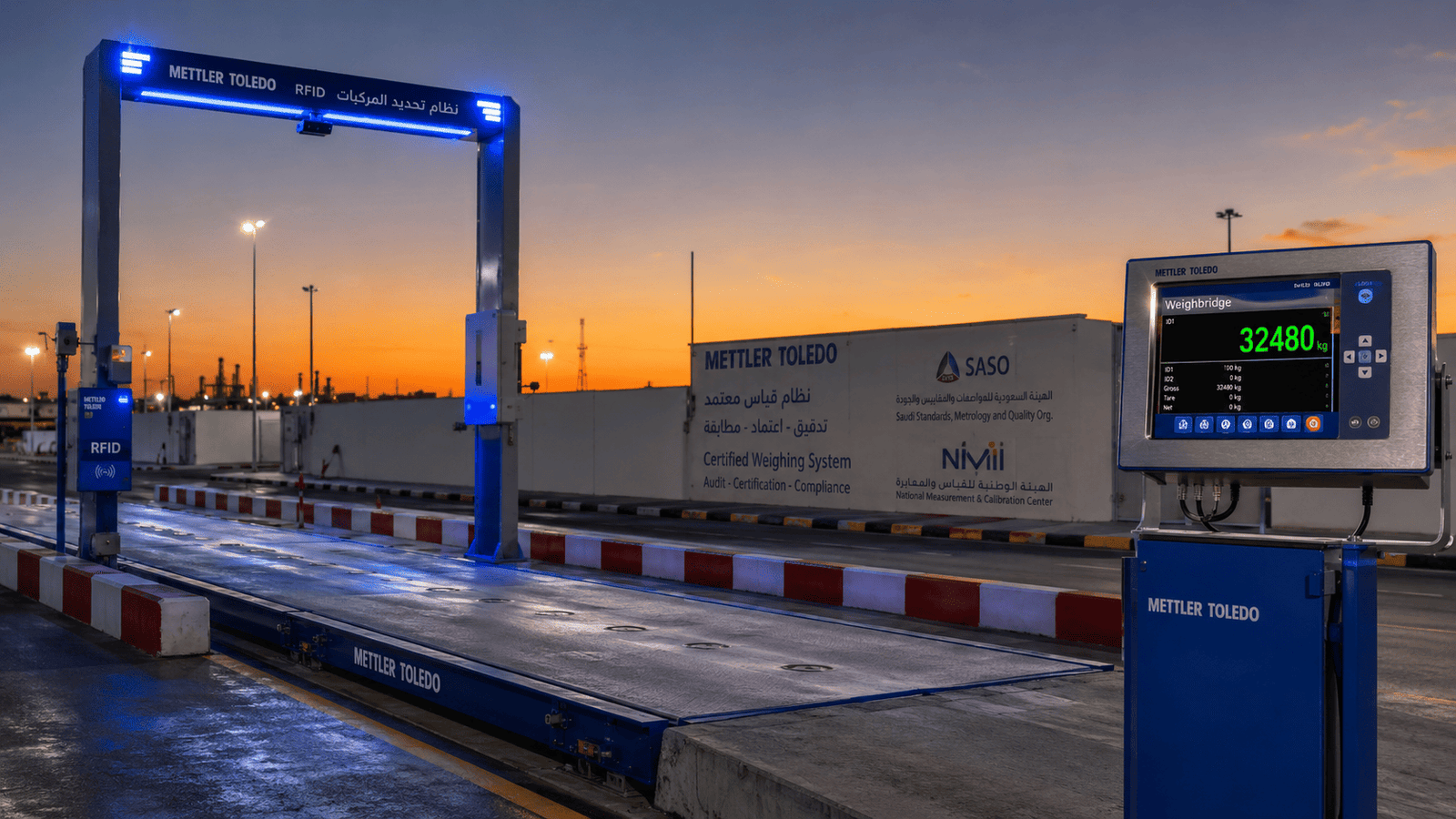
This is where many operators discover they have a problem only after a regulatory inspection. Saudi Arabia's metrology framework, administered through SASO (the Saudi Standards, Metrology and Quality Organization), requires that weighing instruments used for commercial transactions and legal-for-trade applications be type-approved and periodically verified. The relevant standards follow OIML recommendations; OIML R 76 for non-automatic weighing instruments (your standard platform scales and weighbridge indicators) and OIML R 134 for automatic instruments for weighing road vehicles in motion.
The compliance gap we see most frequently in tanker operations: operators install a weighbridge that is technically capable of legal-for-trade accuracy, but then never complete the formal SASO/NMI verification process. The equipment is calibrated internally and the operator assumes that's sufficient. It isn't.
For a tanker scale to be used in custody transfer, meaning the weight determines what you invoice a customer or report to a regulatory body, it needs to carry a valid NMI verification certificate, issued after an accredited inspection against the applicable OIML accuracy class (typically Class III or IIII for truck scales). Verification is not a one-time event; it requires periodic re-verification at intervals defined by the relevant metrology authority, and any modification to the installation (new load cells, new terminal, platform extension) resets the verification clock.
“ Operators install a weighbridge technically capable of legal-for-trade accuracy, then never complete the formal SASO/NMI verification. The equipment is calibrated internally and the operator assumes that's sufficient. It isn't. — Section 07
What this means in practice: If you're running an unverified weighbridge for custody transfer purposes in KSA, you're exposed on two fronts; regulatory penalty risk if inspected, and commercial dispute risk if a customer challenges a weight-based invoice. The fix is straightforward but requires engaging a qualified calibration and metrology service provider who understands the SASO verification process and can support the formal submission.
At Global Scales & Systems, SASO/NMI compliance support is part of every weighbridge and truck scale installation we manage, not an afterthought. We've handled the submission process across oil & gas, food & beverage, and logistics clients in the Eastern Province, and we know exactly where the paperwork bottlenecks are.
Common mistake
Internal calibration records are not a substitute for formal NMI verification in legal-for-trade applications. Any modification to your installation — new load cells, a new terminal, platform extension — resets the verification clock. Confirm your current verification status before your next regulatory inspection, not after it.
08 Feature to Benefit: What Good Tanker Weighing Hardware Actually Delivers
It's easy to get lost in specs. Here's what the key hardware features mean for your day-to-day oil & gas and liquid cargo operation:
| Feature | What It Actually Means for You |
|---|---|
| IP69K-rated hermetically sealed load cells | Scale keeps performing accurately even in high-pressure washdown environments and chemical spill zones; no corrosion-driven drift after 18 months |
| Built-in motion detection and settling algorithm | No more arguing with the driver over three conflicting weigh attempts; the system locks when the reading is stable |
| Per-axle weight display on the terminal | Identifies axle imbalance on multi-compartment tankers before the truck departs; prevents the SAR 200/100kg fine at the roadside |
| RFID vehicle identification integration | Every tanker gets a timestamped weight record tied to its plate or transponder; no manual data entry, no paperwork disputes |
| StrikeShield / transient surge protection on load cells | Your scale survives a nearby lightning strike that would destroy a standard installation; critical in arid, high-resistivity KSA desert sites |
| OIML R 76 Class III accuracy certification | Legally defensible weight data for custody transfer, ZATCA e-invoicing compliance, and commercial invoicing |
09 FAQ: Tanker Truck Weighing in Saudi Arabia
The questions we hear most often from KSA fleet managers and logistics operators, answered directly.
What is the maximum legal weight for a tanker truck in Saudi Arabia?
Saudi Arabia's Roads General Authority sets gross weight limits by axle count. A five-axle tanker, the most common heavy liquid cargo configuration, is permitted 45 tonnes gross vehicle weight. Fines for exceeding this are SAR 200 per 100 kilograms over the limit, with a maximum penalty of SAR 100,000 per violation. Axle group distribution also has to comply with the RGA's load distribution requirements, so a correct gross weight doesn't guarantee you're compliant on every axle.
Does a tanker weighbridge need SASO certification in KSA?
For any weighing used in commercial transactions, custody transfer, or regulatory reporting, yes, the weighbridge must be type-approved under the relevant OIML standard and carry a valid NMI verification certificate issued by SASO or an accredited metrology body. Internal calibration records are not a substitute for formal NMI verification in legal-for-trade applications.
How often does a tanker weighbridge need calibration in Saudi Arabia?
Calibration frequency depends on the instrument class and the volume of use, but a general best practice for heavy industrial truck scales is a full certified calibration at least once per year, with daily or weekly zero-point checks as part of the operator's standard procedure. Any event that could affect scale accuracy, a heavy impact, a load cell replacement, or a flood, should trigger a full recalibration before the scale is returned to service for legal-for-trade use.
Why does my tanker scale give different readings each time for the same truck?
The most common cause is liquid sloshing. If the tanker is still in motion, however slightly, when the reading is captured, the shifting cargo mass will produce different load cell outputs. Ensure the truck is fully stationary, engine off if possible, before the reading is locked. A terminal with a motion detection and stability lock feature will handle this automatically. If readings are inconsistent even with a stationary truck, inspect the load cells for corrosion or damage and check junction box connections.
Can a tanker be weighed while moving in Saudi Arabia?
Weigh-in-motion (WIM) systems can capture axle loads at low travel speeds and are used at some high-throughput facilities. However, for the reading to be used for legal-for-trade purposes in KSA, the WIM system must be type-approved and verified under OIML R 134 requirements. Most sites use WIM for pre-screening and then route flagged vehicles to a static weighbridge for the formal legal-for-trade measurement.
What's the difference between a surface-mounted and pit-mounted weighbridge for tankers?
A surface-mounted weighbridge sits above grade on a concrete ramp approach, faster to install, lower civil cost. A pit-mounted weighbridge is flush with the surrounding surface, which makes the approach angle zero-gradient and eliminates the ramp structure. Pit-mounted installations are generally preferred for high-frequency liquid tanker operations because the level approach reduces dynamic braking effects and the sloshing problem on entry. They cost more upfront in civil works but improve long-term accuracy and reduce driver error.
10 The Bottom Line
Liquid cargo is hard to weigh accurately. Not because the physics is mysterious, but because there are six distinct ways it can go wrong — sloshing, density shifts, axle imbalance, environmental degradation, configuration mismatch, and compliance gaps — and most tanker operators only find out they have a problem after a fine, a customer dispute, or a failed inspection.
The global liquid bulk transportation market is on its way from USD 58.99 billion in 2024 to an expected USD 104.65 billion by 2033. In KSA, the tanker fleet is growing alongside petrochemical expansion and Vision 2030 logistics investments — which means the regulatory environment around tanker weighing is going to get stricter, not looser.
Getting your tanker truck weighing scale setup right now (the right configuration, properly certified, properly maintained) is how you protect your operation from penalties, billing disputes, and the kind of compliance exposure that costs far more than the scale ever did.
At Global Scales & Systems, we've helped oil & gas operators, chemical logistics firms, and food-grade tanker fleets across the Eastern Province, Riyadh, and Jeddah design and commission weighing systems that are accurate, compliant, and built for KSA conditions. If you're unsure whether your current setup is fully SASO/NMI compliant, or if you're specifying a new installation, we're worth a conversation.

 Click to start chat