
Floor Scale vs. Platform Scale vs. Bench Scale: 5 Proven Factors for Smart Industrial Buyers in Saudi Arabia
The floor scale vs. platform scale vs. bench scale question gets answered wrong every week across KSA operations. This guide gives you the five factors that actually matter, so you don't end up with the wrong unit on site.

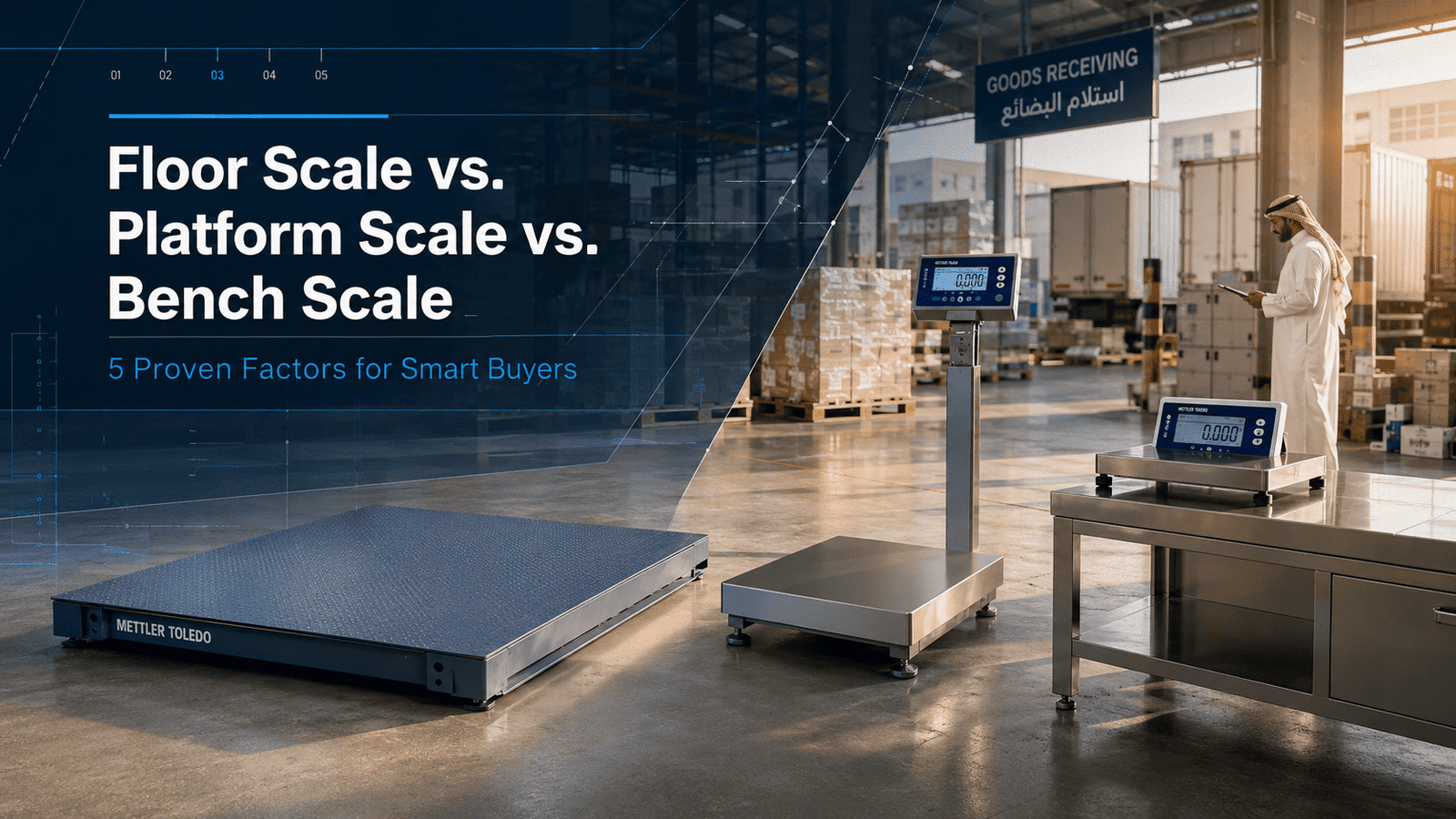
A procurement manager at a logistics depot in Dammam once told me he spent three months waiting on a replacement bench scale because someone in procurement had ordered the wrong type. The operation was doing goods receiving on 500 kg pallets. A bench scale. For 500 kg pallets. When the floor scale vs. platform scale vs. bench scale question gets answered wrong, it doesn't just cost money, it slows down every shift until the right equipment arrives. In a Kingdom where 1,346 new industrial licences were issued in 2024 and total capital investment in in newly licensed factories hit SAR 50 billion, according to Knight Frank's Saudi Arabia Industrial and Logistics Market Review, the pace of operations doesn't leave room for that kind of mistake.
This guide gives you the five factors that actually matter when you're choosing between these three scale types. No fluff. No vendor pitch. Just a clean framework you can apply to your operation today.
01 Why the Terminology Trips Everyone Up
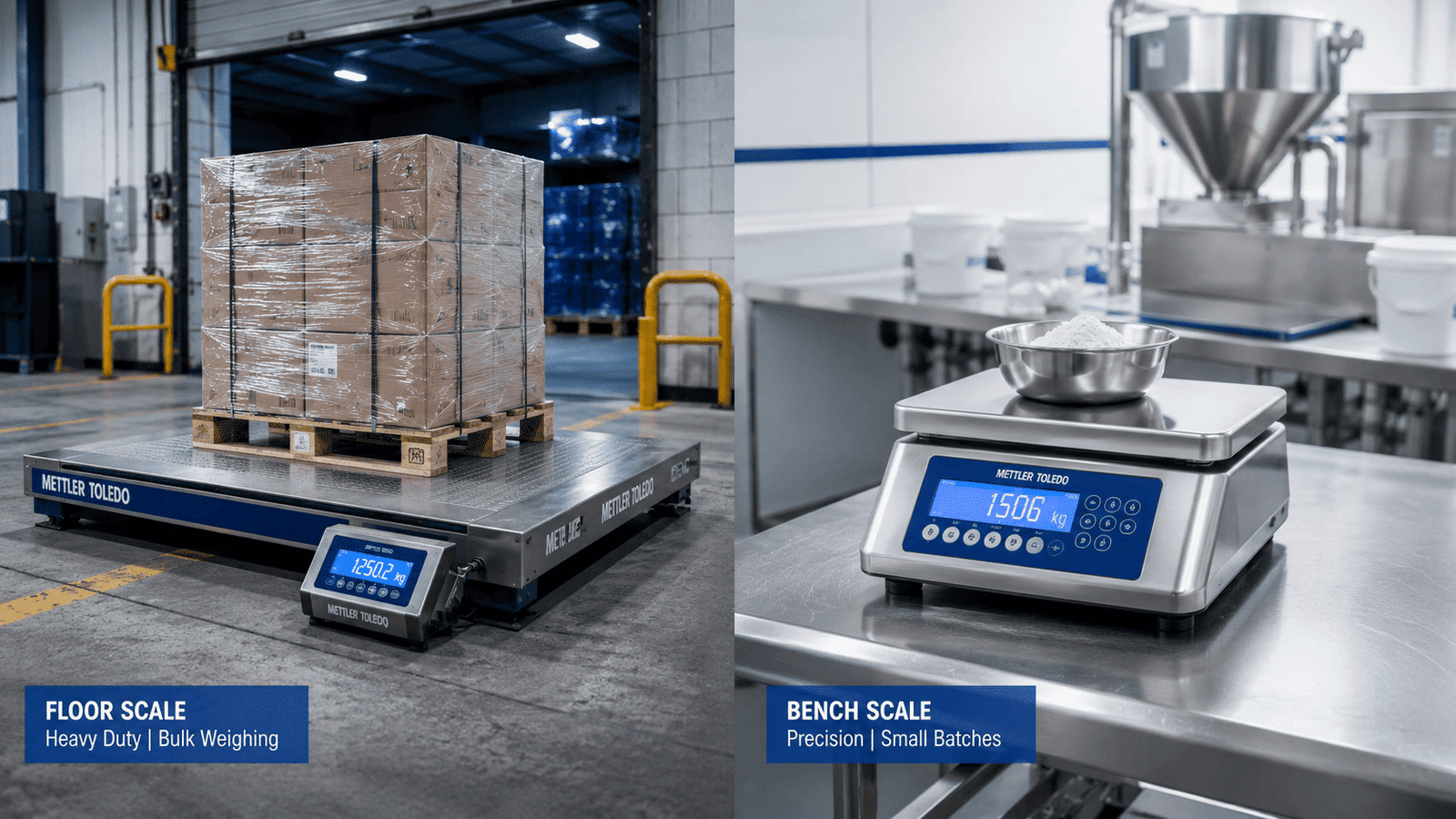
Let's clear something up first, because this confusion causes real purchasing errors. The terms "floor scale," "platform scale," and "bench scale" are used loosely across the industry, and in some catalogues, they overlap. Here's how most experienced industrial buyers define them in practice.
Floor scales sit directly on the floor. They're built for high-capacity loads, drums, crates, IBCs, pallet loads, and their low-profile deck makes loading easier. They're not moved much once installed. Think: a warehouse receiving bay, a chemical drum fill station, a food processing dispatch point.
Platform scales are in some ways the middle category. The term gets applied both to elevated platforms for benchtop use and to heavy-duty floor-level platforms for pallet weighing. When a supplier says "platform scale" they could mean either. In the MT product range, platform scales include configurations from 0.6 kg all the way up to 600 kg, and for heavier applications, you step into the floor scale category. Always confirm capacity and deck dimensions before assuming.
Bench scales are compact, countertop units. They go on a workstation. Capacities typically run from 5 kg up to around 150 kg on standard models, with some industrial bench scales reaching 300–500 kg. They're fast, portable, and ideal for production counting, checkweighing, and quality control tasks that repeat hundreds of times per shift.
The practical risk: a buyer searches for "platform scale," gets results for both a 30 kg lab platform and a 3,000 kg pallet scale, picks one based on price, and the wrong unit shows up on site. This happens. We see it across our service calls in the Eastern Province and Riyadh.
“ A buyer searches for "platform scale," gets results for both a 30 kg lab platform and a 3,000 kg pallet scale, picks one based on price, and the wrong unit shows up on site. — Section 01
02 Factor 1: What Are You Actually Weighing?
Start with the load, not the scale. The three variables that matter here are maximum load weight, the physical size of the items, and how the items get onto the scale.
A 200 kg carton that's loaded by forklift needs a floor-level deck with approach ramps. A bench scale physically cannot serve that application. But a 50 kg bag of pharmaceutical ingredients being checked by a quality technician doesn't need a 2,000 kg floor scale either, that's overspending on capacity and losing accuracy at the low end of the range.
Here's a rough starting framework:
| Load Type | Typical Capacity Requirement | Scale Type to Consider |
|---|---|---|
| Small parts, ingredients, lab samples | Under 30 kg | Bench scale |
| Packaged goods, boxes, small drums | 30–300 kg | Bench scale (heavy-duty) or platform scale |
| Pallets, IBCs, large drums | 300–2,000 kg | Floor scale |
| Heavy industrial loads, machinery parts | 2,000–10,000 kg+ | Heavy-duty floor scale |
One thing buyers overlook: overload protection. Every scale has a safe overload rating, typically 20–50% above its stated maximum. If your loads vary significantly and operators sometimes exceed the nominal maximum, choose a scale with a capacity buffer. Repeatedly exceeding a scale's load cell rating causes accuracy drift that no calibration visit will fully correct. That's an expensive lesson.
Pro tip
Always specify your maximum load weight, not your typical load weight, when selecting a scale. Then check the overload protection rating, most quality scales tolerate 20–50% above maximum. If your operation sees occasional outlier loads, a capacity buffer prevents accuracy drift that routine calibration cannot correct.
03 Factor 2: Capacity, Resolution, and Accuracy Class
These three terms sound interchangeable. They're not.
Capacity is the maximum weight the scale can read. Resolution (or division) is the smallest increment the scale can display, e.g., 100 g on a scale with 1,000 kg capacity. Accuracy class (OIML classes I, II, III, IIII) defines how many divisions the scale can reliably deliver.
A floor scale with 3,000 kg capacity and 500 g resolution is perfectly fine for weighing incoming steel. It's completely wrong for a pharmaceutical blending operation where you're checking 5 g increments. The numbers might look impressive ("3-tonne capacity!") but the resolution makes it useless for fine weighing.
Bench scales genuinely excel at precision. A good industrial bench scale in the 30–60 kg range can offer 1 g or 2 g resolution, which is why they're the workhorse of food production QC, jewellery operations, and pharmaceutical batch verification across the GCC.
Platform scales occupy the middle ground. They offer more resolution than heavy floor scales at moderate capacities, which makes them a solid choice for receiving stations where goods need to be weighed accurately before entering inventory, not just "close enough" for logistics.
04 Factor 3: Environmental Conditions, and Why KSA Makes This Critical
This is where Saudi Arabia changes the calculus compared to most European or North American buying guides. The ambient conditions in KSA industrial environments are genuinely punishing. Summers in the Eastern Province regularly exceed 50°C. Cement plants generate thick airborne particulates. Food and dairy operations require daily wash-down with high-pressure water and caustic cleaning agents. Oil and gas facilities are classified hazardous zones, ATEX ratings aren't optional, they're a legal requirement.
Bench Scales for Dry, Indoor Environments
Standard IP54 or IP65 is usually sufficient for general manufacturing and production floors. If you're near wash-down zones, look for IP67 or IP69K. The MT PBD659 bench platform, for example, meets stringent hygienic design guidelines and supports high-pressure cleaning, the kind of spec a SFDA-audited food facility actually needs.
Floor Scales for Harsh Environments
For chemical plants and wet processing areas, stainless steel construction with IP67–IP69K protection is standard. For dusty industrial environments like cement, aggregates, or grain handling, sealed load cells and dust-resistant enclosures are non-negotiable. In our experience working with cement and petrochemical clients across KSA, scales that aren't spec'd for the actual environment end up failing in 18–24 months, regardless of brand. The repair costs and lost throughput far exceed the upfront cost of getting the right IP rating.
ATEX Environments
If your operation falls under a hazardous area classification, oil terminals, gas processing plants, chemical storage, any scale installed in Zone 1, Zone 2, or equivalent areas must carry ATEX or IECEx certification. This applies to floor scales, platform scales, and bench scales alike. A non-certified scale in a classified zone is a compliance violation, full stop.
Common mistake
Buying a scale that's IP-rated on paper but not designed for your specific chemical environment. IP ratings cover water and dust ingress, they do not guarantee resistance to solvents, caustic cleaning agents, or corrosive atmospheres. In KSA chemical and petrochemical facilities, always confirm housing material compatibility alongside the IP rating before specifying any scale.
05 Factor 4: SASO, NMI, and Legal-for-Trade Requirements
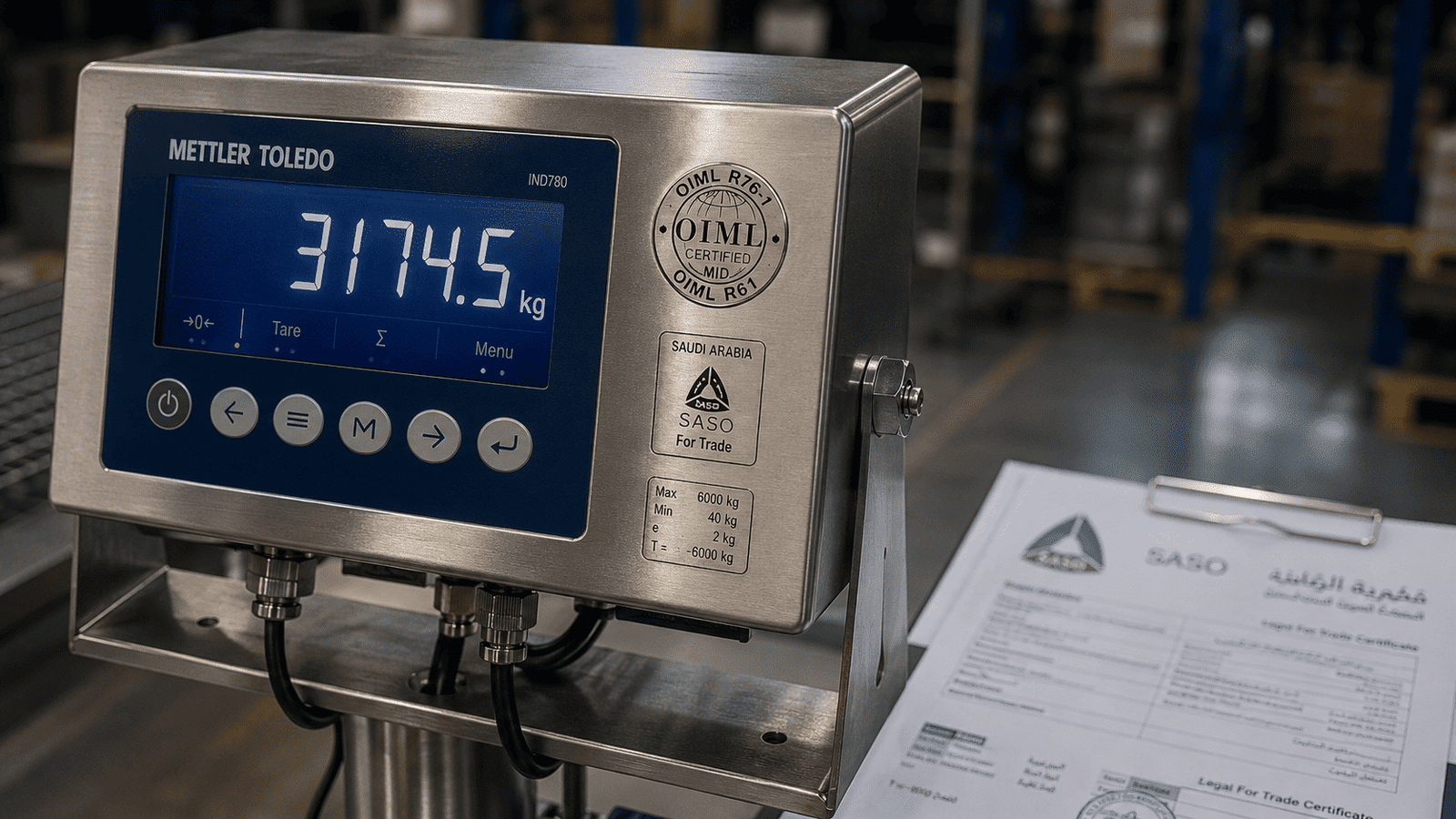
This is the factor that quietly catches buyers out. Not every industrial scale needs to be legal-for-trade certified. If you're weighing raw material input for internal production tracking, a non-certified scale is fine. But if the weight reading forms the basis of a commercial transaction, an invoice, a customs declaration, a sales contract by weight, you need a scale that's been verified and stamped under Saudi Arabia's legal metrology framework.
In KSA, the National Metrology Institute (NMI) under SASO oversees legal metrology, and SASO is a member of the International Organization of Legal Metrology (OIML), which sets the international standards framework. A scale used in a legal-for-trade context needs to be type-approved, verified, and subject to periodic re-verification.
What this means practically:
- Ask your supplier whether the scale has an OIML certificate of conformity or local NMI type approval for the KSA market.
- Legal-for-trade scales must not be adjusted by operators, the indicator needs to be sealed post-verification.
- Calibration records must be maintained and available for inspection. For ZATCA e-invoicing purposes, weight-based transactions should be traceable to a certified measurement.
Bench scales used at retail checkout points and receiving docks involved in commercial weighing fall into this category. So do floor scales at port terminals and logistics hubs processing shipments by weight. If your operation sits on that commercial boundary, get clarity before you buy, retrofitting compliance onto a non-compliant scale is either impossible or prohibitively expensive.
Global Scales & Systems, as a SASO and NMI-recognised compliance partner across Saudi Arabia and the GCC, handles type approval navigation, site verification coordination, and ongoing re-calibration across all three scale types. It's the part of the purchase that vendors often skip over.
“ Retrofitting compliance onto a non-compliant scale is either impossible or prohibitively expensive. Get clarity on legal-for-trade requirements before you buy. — Section 05
06 Factor 5: Total Cost of Ownership, Not Purchase Price
The purchase price of a bench scale, platform scale, or floor scale is the smallest part of what it actually costs you. Here's a comparison a logistics client in Jeddah ran for us a couple of years back.
They were choosing between a mid-range floor scale from a budget supplier (SAR 5,200) and an equivalent MT PowerDeck unit (SAR 11,750). Over a 5-year period, the budget unit required two major load cell replacements (SAR 3,800 total), two unplanned service calls (SAR 4,200 total), and multiple calibration visits to correct drift issues. The MT unit needed one scheduled calibration per year and one minor indicator repair. Total 5-year cost: SAR 16,900 vs. SAR 14,950. And that excludes the 11 working days of downtime on the budget unit.
Calibration frequency, spare parts availability, indicator serviceability, and software connectivity all factor into the real number. When you're evaluating a purchase, ask the supplier:
- What is the annual calibration cost for this model?
- Are load cells field-replaceable, or does the whole unit need to return?
- Does the indicator support integration with your ERP or inventory system?
- What's the lead time on spare parts in KSA?
The last one matters more than people expect. Lead times from European or Asian OEMs into Saudi Arabia for non-stocked parts can run 6–10 weeks. If your floor scale is the gate to your entire receiving operation, that's a long downtime.
“ Over five years, the budget floor scale cost SAR 16,900. The MT PowerDeck cost SAR 14,950 and didn't take 11 working days of downtime with it. — Section 06
07 Price Comparison: Indicative Market Ranges (KSA, 2025)
These are indicative market estimates only, not quotes. Actual pricing varies based on configuration, IP rating, connectivity, compliance certification, and supplier. Contact Global Scales & Systems for accurate project pricing.
| Scale Type | Configuration | Est. Price Range (SAR) | Est. Price Range (USD) | Typical Application |
|---|---|---|---|---|
| Bench Scale | Basic industrial, IP54, 30–150 kg | SAR 750–4,500 | $200–$1,200 | QC lab, production counting, packaging |
| Bench Scale | Hygienic/ATEX, IP69K, 30–300 kg | SAR 4,500–15,000 | $1,200–$4,000 | Food/pharma processing, hazardous zones |
| Platform Scale | Standard, 150–600 kg | SAR 5,250–18,750 | $1,400–$5,000 | Goods receiving, warehouse pallet check |
| Floor Scale | Standard, 500–3,000 kg | SAR 7,500–26,250 | $2,000–$7,000 | Warehouse inbound, bulk goods, logistics |
| Floor Scale | Heavy-duty, ATEX/IP69K, 1,000–10,000 kg | SAR 26,250–75,000 | $7,000–$20,000 | Chemical, cement, oil & gas terminals |
Note: Legal-for-trade verification fees, installation, approach ramps, and indicator upgrades are separate to the above. Budget an additional 15–25% for full commissioning on floor scale installations.
08 The Decision Framework: Which Scale for Which Operation?
Use this as a quick-reference guide. Map your operation to the row that fits.
| Operation Type | Recommended Scale | Key Spec to Confirm |
|---|---|---|
| Production counting, ingredient batching | Bench scale | Resolution (1 g or finer), parts counting function |
| Receiving department (boxes, small goods) | Bench or platform scale | Capacity, OIML accuracy class |
| Receiving department (pallets, drums, IBCs) | Floor scale | Deck dimensions, approach ramp, legal-for-trade |
| Quality control checkweighing | Bench scale | Pass/fail indicators, checkweighing software |
| Chemical drum filling | Floor scale | IP rating, ATEX if required, material compatibility |
| Food processing dispatch | Floor or platform scale | IP69K, hygienic design, SFDA audit readiness |
| Oil & gas site (classified zone) | ATEX floor or bench scale | Zone classification (Zone 1 vs. 2), IECEx/ATEX cert |
| Port or logistics terminal (commercial) | Floor scale | Legal-for-trade NMI approval, data connectivity |
One last thing worth saying directly: the weighing scale market in KSA is growing fast. According to IMARC Group, the Saudi Arabia digital weighing scale market is valued at USD 89.3 million in 2025 and is projected to reach USD 144.8 million by 2034, growing at a CAGR of 5.52%. That growth reflects real investment in industrial infrastructure, and with it comes increasing regulatory scrutiny. The operations that get their weighing infrastructure right now and keep it calibrated and compliant, are the ones that won't face SASO audit issues or transaction disputes down the line.
09 Mettler Toledo Scale Range: Available Through Global Scales & Systems
As the official Mettler Toledo partner in Saudi Arabia, Global Scales & Systems gives KSA and GCC clients access to the full MT industrial scale portfolio, with local stock, local calibration, and local compliance support.
For bench scales, the MT range includes options from basic checkweighing (IND Basics line, pre-calibrated, out-of-the-box ready) through to the PBD659 and PBA639 hygienic platforms with IP69K ratings for food and pharmaceutical environments. Capacities run from 0.6 kg to 600 kg across the range.
For floor scales, the PowerDeck digital floor scale family uses digital load cell signals that increase resolution from the standard 3,000 points to 60,000, which matters when you're tracking yield by weight and small variances compound across thousands of transactions. The PHD779 is the choice for hygienic operations requiring POWERCELL® technology with wash-down capability. For standard logistics and industrial use, the BFA231/BFA236 packages (up to 3,000 kg) and BUA231/BUA236 (up to 1,500 kg) are field-proven and widely deployed across the GCC.
For platform scales in the mid-range, the MT portfolio covers ATEX-certified options for hazardous zones, and the IND570 and IND400 indicator families give connectivity into ERP and SCADA systems, which matters when you're operating a Vision 2030-era facility with integrated supply chain visibility.
| Scale Type | MT Model Family | Capacity Range | Key Feature |
|---|---|---|---|
| Bench scale, basic | IND Basics (BCA/BAK) | 0.6–30 kg | Pre-calibrated, out-of-box ready |
| Bench scale, hygienic | PBD659 / PBA639 | 6–150 kg | IP69K, hygienic design, SFDA-ready |
| Platform scale, standard | BBA/PBK series | 30–600 kg | OIML legal-for-trade, versatile |
| Floor scale, standard | BFA231/BUA231 | 500–3,000 kg | Ramp-compatible, IND terminal included |
| Floor scale, digital | PowerDeck family | 500–10,000 kg | 60,000 resolution, no junction box |
| Floor scale, hygienic | PHD779 | 300–3,000 kg | POWERCELL®, IP69K, wash-down |
Contact Global Scales & Systems for KSA availability, pricing, and compliance certification on any model.
10 Frequently Asked Questions
The questions we hear most often from KSA industrial buyers, answered directly.
What is the main difference between a floor scale and a platform scale?
In practice, the terms overlap, but most industrial buyers use them to describe different capacity tiers and form factors. A floor scale typically sits directly at floor level, handles high-capacity loads (500 kg and above), and is designed for fork loading or rolling loads via approach ramps. A platform scale is more commonly referenced for mid-range applications where the scale sits raised on legs or feet, handles pallets and mid-sized goods, and pairs with a separate indicator. Some suppliers use both terms for the same product category. Always confirm deck dimensions, capacity, and IP rating rather than relying on the label alone.
Do I need a SASO-certified scale for my warehouse in Saudi Arabia?
It depends on whether your weighing is used in commercial transactions. If the weight measurement forms the basis of an invoice, customs declaration, or sale by weight, yes, the scale must be type-approved and verified under the Saudi NMI/SASO legal metrology framework. Internal production weighing, batch tracking, and QC checks that don't directly determine a commercial transaction value can use non-certified scales. When in doubt, consult a compliance-experienced supplier. Getting this wrong exposes your operation to SASO audit risk and transaction disputes.
What IP rating do I need for a floor scale in a Saudi industrial environment?
It depends on the specific environment. For dry warehouses and general logistics, IP54 or IP65 is adequate. For food processing, dairy, and pharmaceutical operations requiring regular wash-down, you want IP67 or IP69K. For outdoor or partially outdoor applications, common in KSA construction and port environments, IP67 minimum, with corrosion-resistant housing. For chemical environments with solvent exposure, confirm the housing material is chemically compatible, not just IP-rated.
How often do industrial scales need calibration in Saudi Arabia?
For legal-for-trade scales, re-verification intervals are set by NMI/SASO and typically run annually. For internal process scales, calibration frequency should be driven by your own quality system requirements, ISO 9001, SFDA, or internal SOPs. In KSA, extreme ambient temperatures can cause thermal drift in load cells, so high-precision operations (pharmaceutical, jewellery, food portioning) often calibrate quarterly or after any major temperature event. A Good Weighing Practice (GWP) assessment, which MT offers, can give you a documented, auditable calibration schedule tailored to your actual process requirements.
Can a bench scale be used for receiving palletised goods?
Not reliably. Standard bench scales max out at 150–300 kg. A loaded euro pallet can easily reach 800–1,200 kg. Even if the pallet were broken down into individual cartons and weighed, the throughput time would make the process unworkable at any reasonable volume. For pallet-level receiving, the right tool is a floor scale or heavy-duty platform scale with appropriate deck dimensions. Bench scales belong in QC, production, and small-parts operations.
What should I ask a supplier before buying a floor scale for KSA?
Ask these five things: (1) Is it legal-for-trade certified for KSA/NMI, and if so, what's the re-verification process? (2) What is the IP rating and is it tested or just rated? (3) What are lead times for load cells and indicators in Saudi Arabia? (4) Does the indicator integrate with your ERP or WMS? (5) What does annual calibration cost, and who performs it locally? Any supplier that can't answer all five clearly is probably not the right partner for a long-term installation.
Global Scales & Systems Co. Ltd is the official Mettler Toledo partner in Saudi Arabia and the GCC, providing industrial weighing scales, calibration services, and SASO/NMI compliance support across all sectors. For a site assessment or product recommendation, contact our team.

 Click to start chat