
Coding and Marking Uptime Benchmarks: What a World-Class Industrial Printer System Actually Looks Like
We set the evidence-based standard for coding and marking uptime, then show exactly where Leibinger's sealed head sits against it.

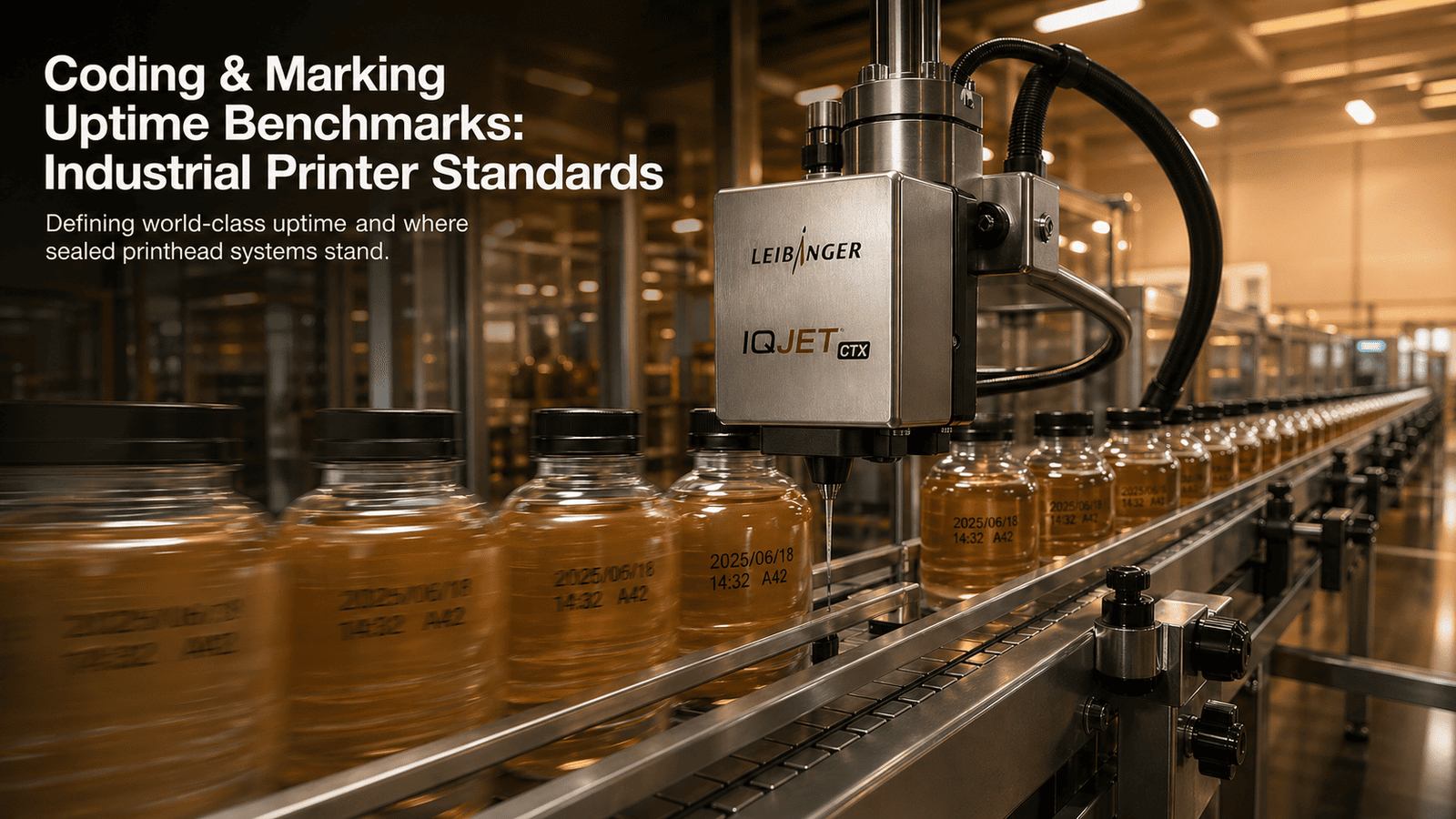
The production line was running at 18,000 bottles per hour. Then it wasn't. A continuous inkjet printer had blocked mid-shift, the print head dried out after an unplanned stop, and by the time the maintenance technician had cleaned, primed, and restarted the system, forty-seven minutes of capacity were gone.
That batch had to be re-dated manually. The customer penalty clause kicked in. The operations manager stood there doing the math and it was not a happy calculation.
This kind of thing happens every day across GCC manufacturing facilities, and most companies have no idea what it's actually costing them. Because nobody measures it. They track OEE at the line level, but the industrial printer sitting on that conveyor is almost never treated as a critical production asset in its own right. It's treated as a consumable. A peripheral. Something the maintenance team handles when it breaks.
That mindset is expensive. And there's a better way to think about it.
01 What World-Class Uptime Actually Means in Industrial Settings
Before we can talk about benchmarks, we need a shared definition. "Uptime" in the coding and marking world means the percentage of scheduled production time during which the industrial printer is actually printing correctly, without operator intervention. Not "sort of printing." Not "printing but skipping every eighth character." Printing. Correctly. Consistently.
World-class OEE in manufacturing is widely cited at 85% or above, meaning 85% of scheduled time is producing saleable product. Within that number, availability losses (which include unplanned equipment stops) are typically targeted at 5% or less. But here's where it gets interesting: most facilities don't separate their industrial printer downtime from their overall availability loss. It gets lumped in with conveyor jams, filler issues, packing problems. Nobody isolates it.
When companies do isolate it, the numbers are often surprising. In my experience working with clients across the Eastern Province and Riyadh's industrial corridors, printer-related stoppages can account for 15 to 30% of total unplanned downtime on a high-speed FMCG line. That's not a peripheral problem. That's a core production issue hiding in plain sight.
So what does genuinely world-class look like? Here's a realistic benchmark framework based on industry data and what top-performing facilities actually achieve:
| Uptime Category | Availability Rate | What It Looks Like in Practice |
|---|---|---|
| Industry Average | 88 to 92% | Regular cleaning stops, occasional blockages, 1 to 2 unplanned interventions per shift |
| Good | 93 to 96% | Scheduled maintenance only, rare unplanned stops, strong ink management |
| World-Class | 97 to 99%+ | Near-zero unplanned interventions, sealed or self-maintaining print head, predictive alerts |
| Theoretical Maximum | 100% | Achieved only in short bursts; not sustainable without the right hardware |
The gap between "good" and "world-class" sounds small on paper. But run those percentages through a 20-hour production day and you'll see it means the difference between 36 minutes of lost time and under 12. At 18,000 units per hour, that's 7,200 units. Per day.
“ Printer-related stoppages can account for 15 to 30% of total unplanned downtime on a high-speed FMCG line. That's not a peripheral problem. — Section 01
02 The Real Culprits Behind Coding and Marking Downtime
You can't fix what you haven't diagnosed. In coding and marking systems, the uptime killers follow a predictable pattern, and the number one offender almost every time is the print head.
Continuous inkjet (CIJ) technology works by pressurising ink into a stream of droplets, charging selected droplets electrostatically, and deflecting them onto the substrate. It's fast, flexible, and works on almost any surface. But it requires the ink to stay fluid and the nozzle to stay clean. When a line stops unexpectedly (even for 10 minutes), solvent evaporates from the nozzle area. Ink residue dries. The next start-up requires a purge. Sometimes two. Sometimes the nozzle is partially blocked and the operator doesn't notice until the QC check flags garbled codes 20 minutes later.
That cycle, stop, dry, purge, restart, check, is where uptime goes to die.
Common mistake
Most facilities don't separate industrial printer downtime from their overall line availability loss. It gets absorbed into the OEE number alongside conveyor jams and filler issues — masking a problem that's entirely solvable with the right hardware choice. If you've never isolated your printer stops specifically, start there. The number is almost always worse than expected.
Viscosity drift is the second major culprit. Ink viscosity changes with temperature. In a facility running at 28 to 35 degrees Celsius (which is most of the year in KSA without perfect HVAC), unclosed ink systems drift outside their target viscosity window faster than in temperate climates. The print quality degrades gradually, which is actually worse than a hard stop because it often isn't caught immediately.
Solvent top-ups and refills add another layer. Open ink systems require regular solvent additions to compensate for evaporation. Each top-up is a manual intervention. Each manual intervention is a potential contamination point and a delay.
Gutter blockages complete the usual trio. The gutter collects uncharged ink droplets for recirculation. If it blocks, you get ink on the substrate and a hard stop. Rare on well-maintained systems, but almost inevitable on poorly maintained ones over time.
Add it all up and you have a system that is fundamentally dependent on operator attentiveness, ambient temperature control, and maintenance discipline. Three variables that are not always in your favour on a Saudi Arabian production floor in July.
03 Where Leibinger's Sealed Head Changes the Equation
This is where the architecture of the printer itself matters, not just the maintenance schedule. Leibinger's IQJET series uses a sealed ink system with an automatically sealed print head. When the printer stops (planned or unplanned), the nozzle is automatically sealed within seconds. Solvent evaporation is eliminated. There's no open nozzle sitting exposed to the ambient air of a Saudi Arabian production floor.
The practical result: the industrial printer starts instantly after any stop, regardless of how long it was off. No purge cycle. No warm-up sequence. No operator intervention. You press start and it prints.
That single design decision removes the most common cause of unplanned downtime in CIJ printing entirely.
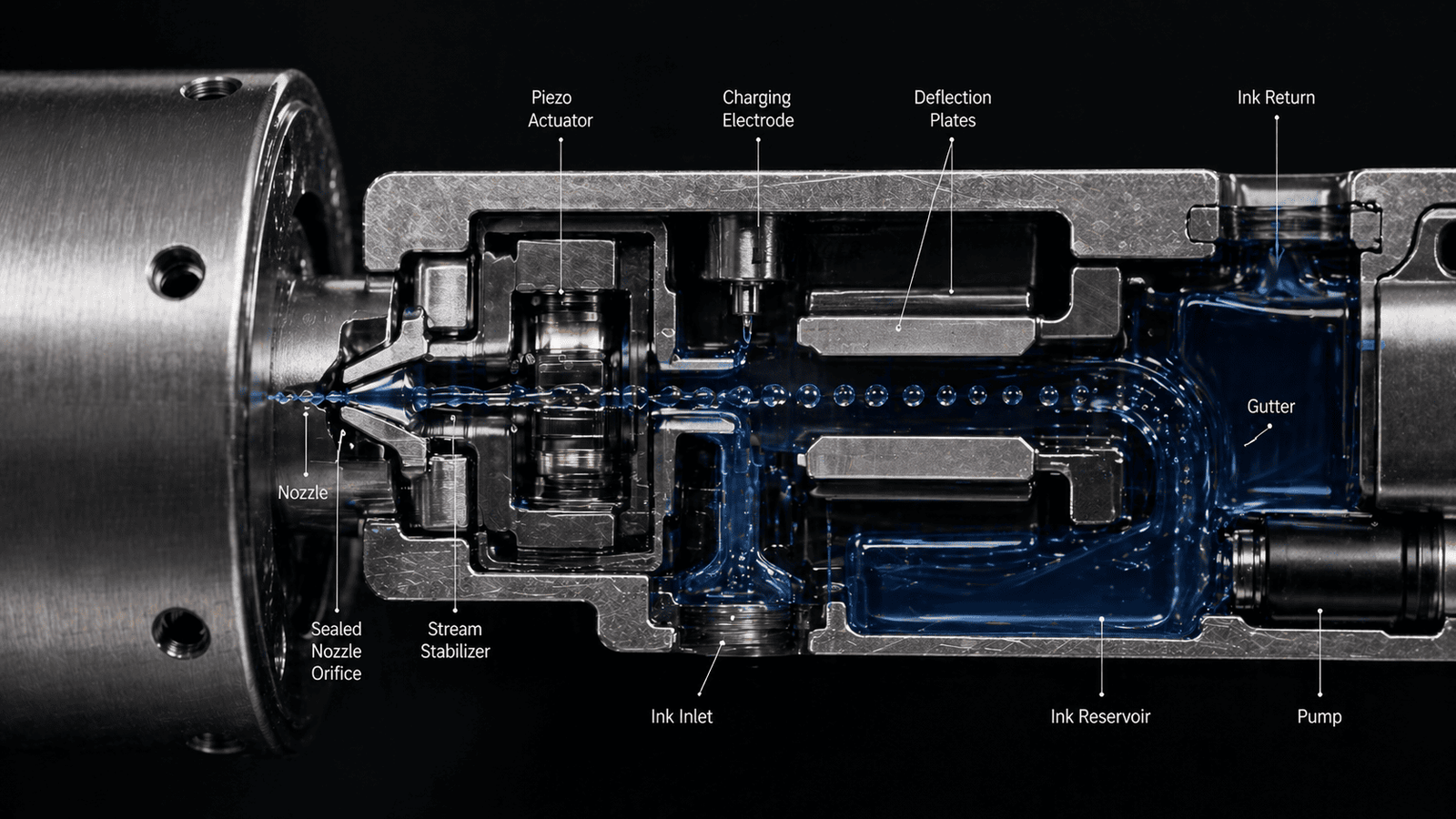
Honestly, when I first reviewed the IQJET specification sheet, the "no scheduled maintenance on the print head" claim felt like marketing language. It didn't. In the field, clients running Leibinger across food production lines in the GCC have reported going months without a single unplanned print stop. That's not typical CIJ performance. That's a different category of equipment.
As Mettler Toledo's official partner in Saudi Arabia, Global Scales & Systems Co. Ltd supplies and supports the full Leibinger IQJET range across KSA and the broader GCC. We've installed these systems in food production, pharmaceutical packaging, building materials manufacturing, and FMCG lines, and the feedback on uptime is consistent.
Here's what the full system delivers for a GCC production environment:
| Feature | What It Actually Means for Your Operation |
|---|---|
| Automatically sealed print head | Zero nozzle drying, instant restart after any stop including overnight shutdowns |
| Closed ink system | No solvent evaporation, no viscosity drift in high-temperature KSA environments |
| No scheduled print head maintenance | Maintenance windows are eliminated from your weekly production calendar |
| Automatic viscosity management | Consistent print quality through 40°C+ ambient temperature swings |
| Quick-change ink cartridges | Ink changes in under 60 seconds, no tools, no contamination risk |
| Remote diagnostics capability | Your team sees what's happening before it becomes a production stop |
| Long service intervals | Annual service cycles vs. the monthly or quarterly schedules traditional CIJ requires |
“ Clients running Leibinger across GCC food production lines have reported going months without a single unplanned print stop. That's a different category of equipment. — Section 03
04 Pricing Guide: What an Industrial Printer Investment Looks Like
Before you request quotes, it helps to have a realistic sense of the investment range. The figures below are budget guides based on current market conditions in KSA, not formal quotations. Actual pricing depends on configuration, substrate, line speed, and installation requirements.
| Configuration | Typical Use Case | Est. Price Range (SAR) | Est. Price Range (USD) |
|---|---|---|---|
| Entry-level CIJ (single head, standard) | Batch coding, light-duty food or pharma packaging | SAR 18,000 to 28,000 | $4,800 to $7,500 |
| Mid-range CIJ (IQJET, sealed head) | High-speed FMCG, beverage, or building materials line | SAR 30,000 to 52,000 | $8,000 to $13,800 |
| Industrial CIJ (high-speed, multi-substrate) | Heavy-duty manufacturing, oil & gas product coding, cement bags | SAR 55,000 to 85,000 | $14,700 to $22,700 |
| Multi-head / integrated system | Port logistics, large-format coding, line integration with SCADA | SAR 90,000+ | $24,000+ |
These are indicative ranges only. Contact Global Scales & Systems for a formal quotation specific to your line configuration and substrate requirements.
One thing worth noting: the total cost of ownership calculation changes significantly when you factor in maintenance consumables, unplanned downtime costs, and technician call-out fees over a three-year horizon. A sealed-head system at a higher initial price often lands cheaper when you run the numbers over 36 months.
Pro tip
When comparing quotes, ask each supplier for a three-year total cost of ownership breakdown, not just the unit price. Include maintenance consumables (ink, solvent, spare parts), scheduled service visits, and an estimate of planned downtime hours per year. A sealed-head CIJ with annual service intervals will almost always outperform on this metric, even when the sticker price is higher.
05 How to Evaluate a Coding and Marking Vendor Without Getting Burned
Look, if you're getting quotes right now, here's what to watch for.
Ask for the mean time between failures (MTBF) figure. Any serious industrial printer manufacturer will have this data. If they can't give you a number, that tells you something.
Ask specifically about startup behaviour after an unplanned stop. This is the real-world test. What happens if power goes out mid-shift and comes back three hours later? Does the printer need a 15-minute purge cycle? Does it need operator intervention? The answer to this question will tell you more about uptime than any brochure.
Request a reference from a client in a similar environment. KSA production conditions are not the same as European ones. High ambient temperature, dusty environments, hard water (which affects some ink formulations), and longer shift patterns all affect how a system performs. Ask for a reference from a GCC operation if you can get one.
Factor in local support. A printer with excellent uptime but no in-country support structure is a risk. When something does fail (and eventually, something always does), you need a team that can reach you without a two-week wait for parts from Germany or Japan. Global Scales & Systems maintains field service capability across Saudi Arabia. Parts, support, and calibration without the delays.
06 Frequently Asked Questions
We keep getting the same questions from operations and procurement teams across KSA, so here are the straight answers.
What uptime should I realistically expect from an industrial CIJ printer?
A world-class CIJ industrial printer on a well-run production line should deliver 97% or higher availability. Standard mid-tier equipment typically runs at 88 to 92%. The difference between those two numbers depends almost entirely on print head design and the printer's ability to restart cleanly after planned and unplanned stops. If your current system requires purging after every stop, you're likely sitting in the 88 to 92% range regardless of how well-maintained it is.
What makes Leibinger different from other CIJ brands?
The sealed print head is the primary architectural difference. Most CIJ printers have open nozzle systems that are exposed to ambient air when the machine is idle. Leibinger's automatic sealing mechanism closes the nozzle within seconds of a stop, eliminating solvent evaporation and nozzle drying. This removes the single most common cause of unplanned stops in CIJ printing. The closed ink system also addresses viscosity drift, which is a real problem in high-temperature KSA production environments.
How often does a Leibinger IQJET printer need servicing?
Annual service intervals are standard for the IQJET series, compared to monthly or quarterly schedules on traditional open-system CIJ printers. There is no scheduled print head maintenance. Ink and solvent changes use a quick-change cartridge system that takes under 60 seconds and requires no tools.
Can Leibinger printers handle the heat in a Saudi Arabian production facility?
Yes, and this is one of the reasons we recommend them specifically for KSA environments. The closed ink system manages viscosity automatically, compensating for temperature variation rather than relying on a stable ambient environment. Facilities running without perfect HVAC see noticeably worse print quality and higher downtime rates with open-system printers. The Leibinger sealed design reduces that dependency significantly.
What substrates can an industrial CIJ printer mark?
CIJ technology works on almost any surface: glass, PET and HDPE plastic, metal cans, coated and uncoated cardboard, cable sheathing, rubber extrusions, and more. Substrate suitability depends on ink selection rather than the printer itself. Global Scales & Systems can advise on the right ink formulation for your specific substrate and any food-contact or pharmaceutical compliance requirements that apply.
Does Global Scales provide on-site installation and calibration?
Yes. Every Leibinger system supplied through Global Scales & Systems Co. Ltd includes installation, commissioning, and operator training as standard. Calibration services are also available on an ongoing basis to maintain print quality and comply with any regulatory audit requirements. We cover KSA nationally and can support broader GCC deployments through our regional network.
07 The Bottom Line on Uptime
Production managers in this region have told me, more than once, that their industrial printer is "just a printer." Until it stops. Until a full shift of products has to be manually inspected because the date code is unreadable. Until the QA audit flags a batch.
A world-class coding and marking system isn't a luxury. It's infrastructure. And like any infrastructure, the smart question isn't "what's the cheapest option?" but "what does failure actually cost me?"
When you run that calculation honestly, and factor in unplanned stops, purge cycles, maintenance windows, consumables, and operator time, the sealed-head approach stops looking like a premium and starts looking like basic operational logic.
Global Scales & Systems Co. Ltd, your uptime, reliability, and compliance partner in Saudi Arabia, supplies and supports Leibinger coding and marking systems across the KSA and GCC. If you want to talk through your current setup and where the uptime gaps are, reach out directly and we'll give you a straight assessment.
Pricing figures are indicative estimates for 2025/2026 and are subject to change based on configuration, lead times, and project-specific requirements. Contact us at Global Scales & Systems Co. Ltd for formal quotations.

 Click to start chat