
Zero Ink Waste: 5 Hidden Costs Leibinger's Low Maintenance Inkjet Printer Eliminates with Jetcap Technology
Leibinger's Jetcap seals the nozzle at every shutdown, cutting purge waste to zero. Here's what the real ROI and uptime numbers look like for KSA production lines.

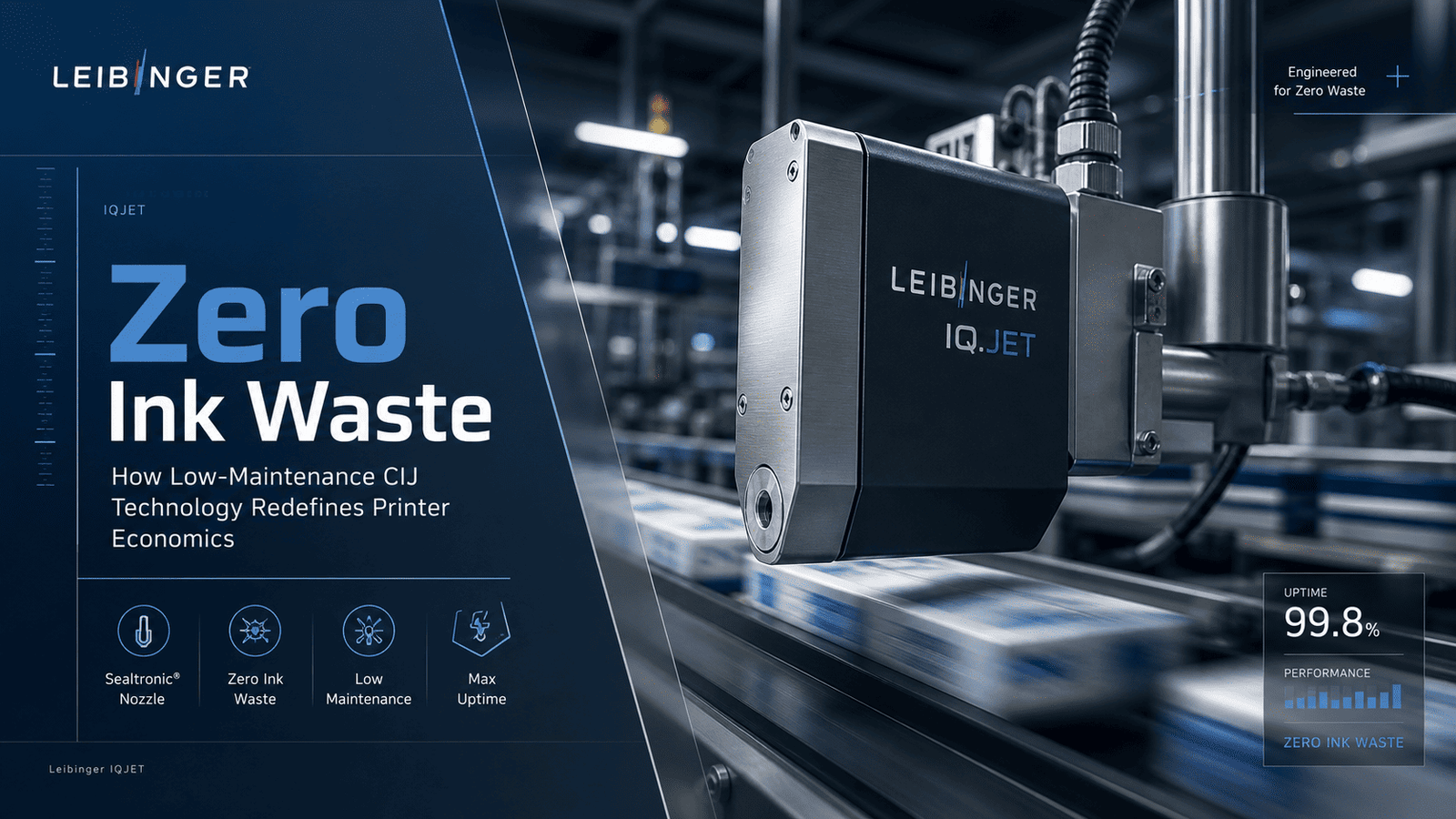
Picture this. It's 2 a.m. on a production shift. A line supervisor calls because the CIJ printer has gone down again; dried ink in the nozzle, a purge cycle that's now burned through 40 minutes of uptime, and a production batch sitting idle. Nobody budgeted for this when they bought the machine. The purchase order said "inkjet printer." Nobody said anything about the hidden tax that comes with every startup, every shutdown, every Monday morning when the line comes back up cold.
This is the reality most plants in Saudi Arabia live with. And it's exactly the problem that low maintenance inkjet printers built around Leibinger's Jetcap technology were designed to kill.
01 What Jetcap Actually Is (And Why It's Not Marketing Language)
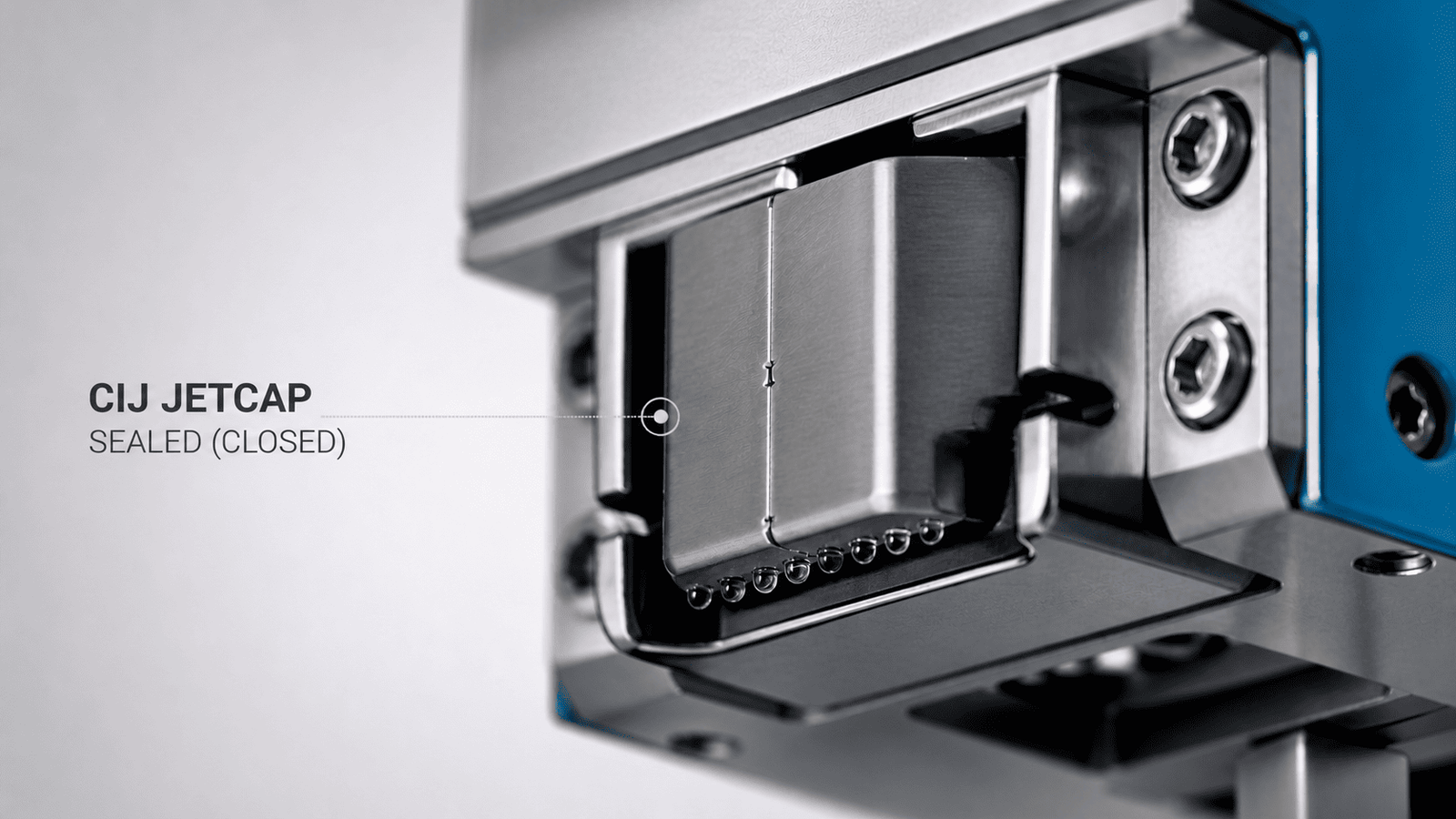
Most CIJ printer manufacturers talk about "easy maintenance" and then bury the real numbers. Leibinger Continuous inkjet (CIJ) printers went a different route and built a physical solution: a sealed nozzle cap that automatically closes when the printer shuts down, keeping the nozzle in a solvent-saturated microenvironment until the next startup.
The mechanism is straightforward. When you switch off a conventional CIJ printer, the nozzle is exposed to air. Solvent evaporates. Ink dries. The next time you power up, the printer has to purge that dried ink out of the system before it can produce a clean print. That purge burns ink, burns solvent, and burns time.
Jetcap eliminates this entirely. The nozzle closes in a sealed cavity. No air exposure, no evaporation, no drying. When you power the printer back up, it's ready to print in roughly 30 seconds, sometimes faster.
Honestly, the first time I walked through this with a client at a food packaging plant in Jeddah, their reaction was: "That's it? That's the whole thing?" Yes. That's it. And yet that one mechanical detail changes the entire maintenance economics of the machine.
02 The Real Cost of Conventional CIJ Maintenance
Let's be direct about what "low cost" actually means in the CIJ world. The purchase price of a continuous inkjet printer is almost never the biggest number in your total cost of ownership. The real costs come from three places most buyers don't calculate upfront.
Ink Waste from Purge Cycles
Every startup purge on a conventional CIJ machine uses ink and solvent. Industry figures typically put this at 50 to 200ml per startup, depending on the machine and how long it's been idle. Multiply that by two or three shifts a day, five or six days a week, and you're looking at litres of fluid wasted every month. On premium inks for high-temperature or chemical-resistant marking, that's not a trivial cost.
Unplanned Downtime from Nozzle Blockages
A partially blocked nozzle doesn't always fail cleanly. Sometimes it produces inconsistent prints, meaning a quality check failure catches it after the batch has already moved. Now you're dealing with reprinting, rework, or in regulated industries like food and pharma, potential recalls. The downtime cost is real; the compliance cost can be catastrophic.
Common mistake
Most plant managers only count equipment purchase price when comparing CIJ printers. The ink waste, downtime hours, and maintenance labour are absorbed into general operating costs and never tracked back to the printer. Run the numbers before you buy, not after. A conventional CIJ machine can quietly cost SAR 45,000 to 90,000 more per year than a sealed-nozzle alternative on a single production line.
Maintenance Labour
Someone has to clean the nozzle, run the purge, replace the filter, check the viscosity, and log the service record. In a Saudi plant running 24/7, that's skilled technician time pulled from other priorities. It adds up faster than most maintenance managers want to admit.
A zero ink waste printer design like Jetcap doesn't just reduce these costs; it removes the root cause. That's a meaningfully different claim.
“ A conventional CIJ printer can quietly waste litres of ink every month; Jetcap removes the root cause entirely. — Section 02
03 The Sealed Nozzle Mechanism: A Technical Deep Dive
Leibinger holds multiple patents around the Jetcap design, and the engineering behind it is worth understanding if you're evaluating CIJ printers for a long-running production environment.
The nozzle cap itself is spring-loaded and solvent-wetted. When the print head receives a shutdown command, the cap closes over the nozzle orifice in under a second. The cavity inside the cap is saturated with solvent vapour, which keeps the ink in the nozzle from drying or skinning over.
What this means in practice is two things that matter enormously on a production floor.
First, startup time. Leibinger machines using Jetcap are typically ready to print in 30 to 45 seconds from a cold start. A conventional CIJ printer without nozzle protection can take 5 to 10 minutes of purging and settling before it produces consistent print quality. On a fast-moving production line, that 10-minute window has a direct cost.
Second, long-idle reliability. This is the one that surprises most plant managers. Jetcap machines can sit idle for days and restart cleanly. We've seen clients in the GCC run weekend shutdowns without a single purge issue on Monday morning. A conventional machine left idle for 48 to 72 hours is almost guaranteed to need a manual cleaning cycle before it's production-ready.
The physics are simple: seal the nozzle, eliminate evaporation, eliminate the problem. But getting that seal to work reliably across temperature swings of 20 to 45 degrees Celsius, which is a realistic day-to-night range in a KSA facility without full climate control, requires some serious engineering. Leibinger has been refining this for decades, which is why it works.
04 ROI and Uptime: What the Numbers Actually Look Like
Here's where it gets interesting. We've run these numbers with clients across food production, pharmaceutical packaging, and petrochemical plants in Saudi Arabia, and the pattern is consistent.
Ink and solvent savings: The average plant switching from a conventional CIJ printer to a Leibinger low maintenance inkjet printer sees a 30 to 50% reduction in consumable consumption in the first 12 months. The exact figure depends on shift patterns and how often the old machine was cycling through purge sequences.
Downtime reduction: This is harder to generalise, but clients running three shifts have reported dropping from 4 to 6 hours of inkjet-related downtime per month to under 30 minutes. The difference is that almost all remaining downtime becomes planned maintenance, not reactive callouts.
Maintenance labour: On a plant running two CIJ printers on each line, the switch to Jetcap machines typically frees 3 to 5 technician hours per week that were previously going to printer maintenance. In a market where skilled maintenance technicians are in short supply, that's not nothing.
The table below shows a rough ROI framework based on client data across Saudi production facilities. These are representative figures; your actual numbers will depend on ink type, shift patterns, and line configuration.
| Cost Category | Conventional CIJ (Annual Est.) | Leibinger Jetcap (Annual Est.) | Saving |
|---|---|---|---|
| Ink & solvent waste (purge) | SAR 18,000 – 35,000 | SAR 3,000 – 7,000 | ~75% |
| Unplanned downtime cost | SAR 25,000 – 60,000 | SAR 4,000 – 10,000 | ~80% |
| Maintenance labour (inkjet tasks) | SAR 12,000 – 22,000 | SAR 3,000 – 6,000 | ~70% |
| Total estimated saving per printer | SAR 55,000 – 117,000 | SAR 10,000 – 23,000 | SAR 45,000 – 94,000/yr |
These are indicative estimates based on field data from GCC production environments. Contact Global Scales & Systems for a site-specific cost analysis.
Pro tip
For most mid-to-large production lines, the payback period on upgrading to a Leibinger low maintenance inkjet printer is 18 to 30 months. After that, you're running on pure saving. Before you request a quote, tally your current monthly purge cycles, your inkjet-related downtime hours, and your maintenance technician hours; those three numbers make the ROI case for you.
05 Leibinger Jetcap Models Available in Saudi Arabia
Global Scales & Systems supplies the full Leibinger CIJ range into the KSA market. Here are the models most relevant to production environments across the industries we serve.
IQJET
The flagship model. Jetcap as standard, print resolution up to 128 x 128 dpi, print speeds up to 6.7 metres per second, and a sealed fluid system that runs with essentially zero environmental solvent emissions. It's the one we recommend for pharmaceutical and food-grade lines where air quality around the machine is a compliance issue.
JET2neo
The workhorse for general industrial coding. Jetcap included, dual-line printing, compatible with a wide range of inks including high-adhesion variants for porous substrates and heat-stable inks for products that go through pasteurisation or sterilisation cycles.
JET3up
Designed for high-speed lines. This is the model we see going into beverage and FMCG plants where the conveyor is moving fast and you can't afford a smeared code. The Jetcap mechanism is especially valuable here because any startup inconsistency becomes immediately visible in quality control.
All models are compatible with Leibinger's CleanJet solvent management system, which handles automatic viscosity control and ink makeup without operator input. Pair that with Jetcap and you have a printer that genuinely runs itself between scheduled services.
“ Pair Jetcap with CleanJet and you have a printer that genuinely runs itself between scheduled services. — Section 05
06 Feature-to-Benefit Breakdown for KSA Production Managers
Specifications only matter if you know what they mean on the floor. Here's what each core Leibinger feature actually translates to in a Saudi production environment.
| Feature | What It Actually Means on Your Line |
|---|---|
| Jetcap sealed nozzle | No purge waste at startup; machine is print-ready in under 60 seconds |
| CleanJet solvent management | Automatic viscosity control; no manual mixing, no operator error |
| Sealed fluid system | Near-zero solvent emissions; passes air quality requirements in enclosed facilities |
| 150+ compatible ink types | One platform serves food, pharma, petrochemical, and logistics marking needs |
| Remote diagnostics via network | Maintenance team gets fault alerts before a line stoppage, not after |
| IP55 rated enclosure (IQJET) | Withstands wash-down environments; fits food and beverage production standards |
| 2,000+ hour service intervals | Scheduled maintenance every 6 months in most configurations, not monthly |
07 Industries in KSA Where Jetcap Changes the Equation
Not every production environment has the same pain points, but across the sectors we serve in Saudi Arabia, the Jetcap advantage shows up consistently.
Food and Beverage Production
Coding compliance is non-negotiable here. SFDA regulations require legible best-before dates, lot codes, and traceability marks on every consumer product. A printer that goes down or produces inconsistent print in a food plant isn't just an operational problem; it's a regulatory one. Jetcap's reliability, combined with Leibinger's food-safe ink options, is why we keep placing these machines in Riyadh and Jeddah food production facilities.
Pharmaceutical Packaging
The stakes are higher again. SFDA GMP requirements, serialisation mandates, and the temperature-controlled environments that pharma plants run mean you need a printer that handles cold-to-warm transitions without nozzle issues. Jetcap handles this better than anything else in the CIJ category.
Petrochemical and Industrial
Pipe marking, component coding, date stamping on industrial product runs. These environments are dusty, hot, and corrosive. The sealed fluid system and IP-rated enclosures on Leibinger machines are built for exactly this. We've put JET2neo machines into Eastern Province petrochemical plants running 24/7 with scheduled service intervals of 6 months and near-zero reactive callouts.
Logistics and Distribution
Outer carton coding at warehouse speeds is a different challenge. High line speed, variable substrates, and the need for sharp machine-readable codes for GS1 compliance. The JET3up handles this well, and the Jetcap mechanism means shift changeovers don't become a printer management exercise.
08 FAQ: Leibinger Jetcap and Low Maintenance Inkjet Printers in Saudi Arabia
These are the questions we hear most from operations and procurement teams evaluating CIJ printers for the first time, or switching from a competitor brand.
What makes Leibinger's Jetcap technology different from other CIJ printers?
Jetcap is a patent-protected mechanical nozzle seal that automatically closes when the printer shuts down. Most competing CIJ printers leave the nozzle exposed to air, causing ink to dry and requiring a purge cycle at every restart. Jetcap eliminates that cycle entirely. It's not a software setting or a maintenance routine; it's a physical mechanism built into every Leibinger CIJ printer.
How much ink does a conventional CIJ printer waste compared to a Leibinger Jetcap machine?
On a two-shift, five-day operation, a conventional CIJ printer can waste 1 to 3 litres of ink and solvent per month in purge cycles alone. A Leibinger Jetcap machine reduces this to near zero under the same conditions. Over a year, that difference runs to tens of thousands of riyals in consumable cost on a single line.
Is Leibinger available in Saudi Arabia with local support?
Yes. Global Scales & Systems Co. Ltd is the authorised distributor for Leibinger coding and marking equipment in Saudi Arabia and the wider GCC. We handle supply, installation, operator training, and ongoing service contracts from our Saudi base, with Arabic-speaking technical support and locally stocked consumables.
What ink types are compatible with Leibinger CIJ printers?
Leibinger printers are compatible with more than 150 qualified ink formulations, covering standard MEK-based inks, high-adhesion inks for difficult substrates, white and colour inks for dark packaging, heat-stable inks for pasteurisation environments, and food-contact-safe inks for direct marking on packaging that contacts food. Your ink selection depends on your substrate, line speed, and regulatory requirements; our team can advise.
How long do Leibinger CIJ printers go between services?
In typical production environments, Leibinger machines are configured for 2,000+ hour service intervals, which translates to roughly 6 months between scheduled maintenance visits for a two-shift operation. This is significantly longer than most conventional CIJ printers, which typically require service every 1,000 to 1,500 hours. The sealed fluid system and Jetcap nozzle protection are the main reasons for this extended interval.
Can a Leibinger CIJ printer handle the heat in Saudi Arabia?
Yes. Leibinger machines are rated for operating ambient temperatures up to 45 degrees Celsius, and the sealed fluid system's automatic viscosity management compensates for temperature-driven ink behaviour changes. We've deployed these machines in facilities without full air conditioning in the Eastern Province and Riyadh industrial zones without performance issues.
Here's the thing about maintenance economics: the numbers only look obvious in hindsight. Before you switch, the purge cycles feel like background noise, the downtime gets absorbed into shift reports, and the maintenance labour disappears into general headcount. After the switch, you start seeing it all clearly.
In my experience working with production managers across the GCC, the clients who get the most out of a low maintenance inkjet printer are the ones who did the maths before they bought, not after. If you're currently running conventional CIJ equipment and haven't calculated your annual ink waste, downtime cost, and maintenance hours, that's the starting point.
Global Scales & Systems Co. Ltd, supplies and supports the full Leibinger CIJ range across the Kingdom. We offer a host of solutions including helping you run a proper total cost of ownership comparison against your current equipment, and if the numbers work, handle everything from installation to ink supply to ongoing service. Reach out to book a consultation or request a demonstration at your facility.
 Click to start chat