
Why Industrial Scales Drift: 5 Proven Causes and How Often You Really Need to Recalibrate
Five proven causes of scale drift explained, plus the recalibration schedule that keeps KSA industrial operations accurate, compliant, and out of trouble.

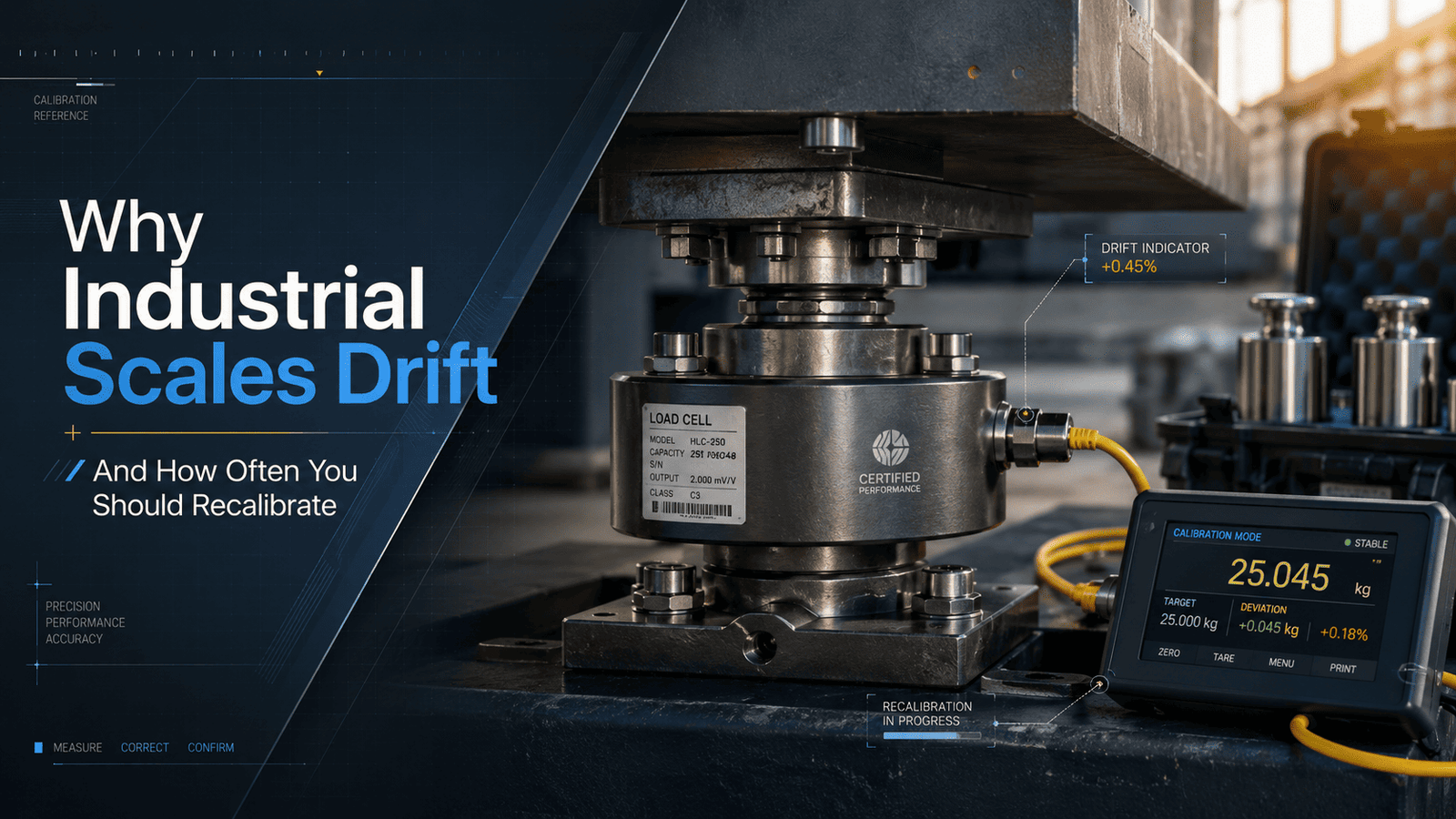
Your scale passed its last calibration check. The certificate is on file. And yet, three months later, a batch of outgoing product is 40 kg heavier than your records show. Or lighter. Either way, someone is losing money and right now, nobody on your team knows it's happening.
This is one of the most consistent problems we see across industrial operations in Saudi Arabia, from logistics hubs in Riyadh to chemical plants in Jubail. The scale looks fine. It powers on. The display shows a number. And that number is quietly, gradually wrong.
Understanding why industrial scales drift, and more practically, how often you should recalibrate them, is one of those maintenance fundamentals that tends to get pushed down the priority list until it causes a real problem. This article is for operations managers and quality teams who want to get ahead of it before it costs them.
01 What "Drift" Actually Means on an Industrial Scale
Scale drift isn't a sudden failure. That's what makes it dangerous. A sudden failure is obvious: your scale goes to zero or throws an error code, and someone calls for service. Drift is different. It's a slow, progressive deviation between what your scale reads and what's actually on the platform.
A few grams today. A few hundred grams next month. A kilogram or two by the end of the quarter. And because the numbers still look plausible, the drift often goes undetected for a long time.
Technically, drift is defined as the change in output over time when input conditions remain constant. In industrial weighing, it shows up in two main forms. Zero drift is when the scale doesn't return accurately to zero when the platform is empty. Span drift is when the scale reads incorrectly across its full capacity range, say, reading 502 kg when the actual load is 500 kg.
Both matter. Zero drift might seem minor, but compounded across thousands of transactions in a logistics operation, or across invoiced tonnage in a quarry, it becomes financially significant fast. I've seen operations run at a consistent 0.3% loss on product weight for six months before someone cross-checked a delivery and caught it. By then, the damage was done.
“ A scale reading 502 kg instead of 500 kg doesn't look wrong. That's exactly why drift is so expensive. — Section 01
02 The 5 Proven Reasons Why Industrial Scales Drift
Not all drift has the same cause, and getting to the right fix means knowing which of these is actually happening in your facility. Here are the five drivers we keep seeing across industrial sites throughout the GCC.
1. Temperature Fluctuations
This is the biggest driver of drift in KSA industrial environments, and it's almost always underestimated. Load cells, which are the sensing elements inside virtually every modern industrial scale, work by measuring tiny deformations in a piece of metal under load. The electrical resistance of the strain gauge that detects that deformation is sensitive to temperature. When ambient temperature shifts significantly, the output of the load cell shifts with it, even when the load hasn't changed at all.
In Saudi Arabia, this matters more than almost anywhere else. A facility that starts the day at 20°C inside and reaches 45°C by afternoon, or a weighbridge in the Eastern Province that heats up through direct sun exposure, can experience measurable temperature-induced drift within a single working day. Not just seasonally. Daily.
2. Mechanical Settling and Structural Changes
Scales are mechanical systems anchored to structures. Those structures move. Foundation settling is one of the most common causes of long-term drift in weighbridge and floor scale installations. Concrete foundations in KSA's desert soil conditions can shift subtly over months, particularly in areas with high sand content or seasonal water table changes near the coast. When the foundation moves, the load distribution across the load cells changes with it. The scale doesn't break. It just drifts.
Platform deformation is another version of the same problem. A steel platform that has absorbed years of forklift loading, heavy drops, or shock impacts will deform slightly, changing how force transfers through the structure to the load cells.
3. Vibration and Shock Loading
Heavy industry environments are not quiet. And sustained vibration is genuinely damaging to calibration. In facilities near compressors, conveyors, presses, or high-traffic vehicle areas, the constant low-frequency vibration gradually affects the mechanical components that hold load cells in their correct position. Mounting hardware loosens. Small shifts accumulate. Calibration moves.
Common mistake
Shock loading is worse than sustained vibration, and it's often the real cause when an operation reports that the scale "suddenly started reading wrong" after passing a recent calibration. A single significant impact, like dropping a heavy load onto the platform rather than placing it, can cause an immediate span shift. Treat the scale as damaged after any major shock event and verify it before the next transaction.
4. Humidity, Corrosion, and Contamination
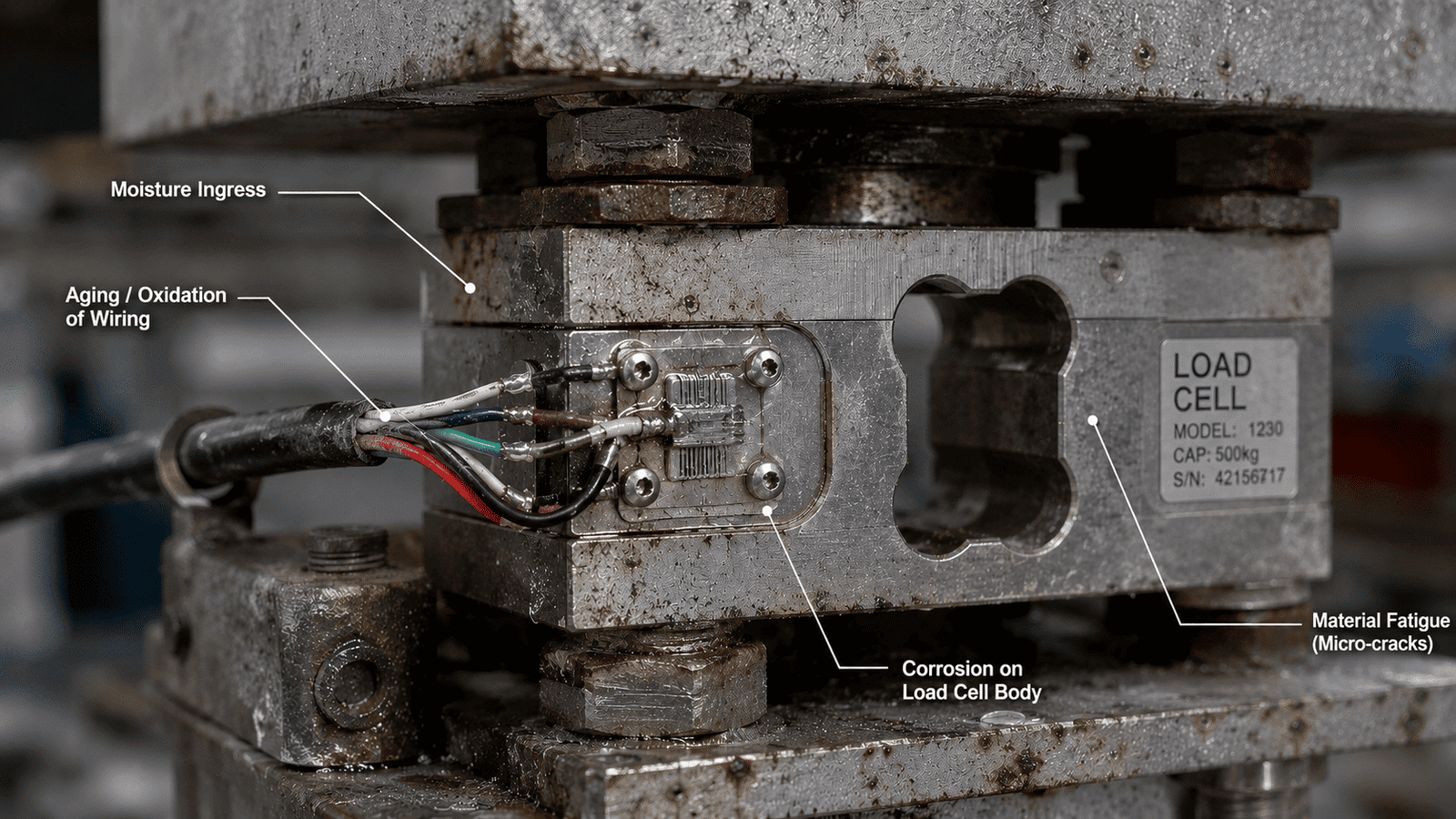
Load cells contain precision electronics sealed inside a metal housing. The quality of that seal determines how long the cell maintains its calibrated performance in anything less than perfect conditions. In coastal industrial areas like Jubail, Yanbu, or Jeddah, salt-laden air is a genuine threat. Moisture infiltration into load cell housings causes corrosion of the internal components and introduces electrical resistance that changes the output signal over time.
This is one of the reasons the ingress protection (IP) rating of your load cells and junction boxes matters so much. It's not just about durability. It's directly about long-term calibration stability.
5. Electrical Interference (EMI)
Less talked about, but real. Industrial facilities run variable frequency drives, welders, large motors, generators. All of these produce electromagnetic interference that can affect the low-voltage signal coming out of a load cell. The effect is often intermittent and can look like instability or erratic readings rather than steady drift, but persistent low-level EMI does contribute to signal noise that shifts the effective zero or span reading over time. Proper cable shielding, grounding, and routing away from power lines are the engineering controls. When those aren't done correctly at installation, drift often follows.
03 Temperature in KSA: Why Drift Happens Faster Here Than Almost Anywhere
Saudi Arabia is genuinely one of the harder environments on the planet for maintaining precision measurement equipment. And that's not an exaggeration worth softening.
The daily temperature swing in many industrial locations, particularly in the Najd plateau around Riyadh or in the Eastern Province, routinely reaches 25 to 30 degrees Celsius between early morning and peak afternoon. If your facility isn't temperature-controlled, your weighing equipment is cycling through that range every single day.
Compound that with high levels of airborne dust and sand that get into junction boxes and around load cell mounting points, UV radiation that degrades cable insulation over time, and the seasonal extremes of summer heat, and you have an environment that accelerates every single drift mechanism described above.
This is worth naming plainly because it changes the answer to "how often should we calibrate?" The answer for a scale in Riyadh or Jubail running outdoors in an industrial setting is different from the answer for a scale in a climate-controlled European warehouse. KSA conditions compress the timeline.
“ Calibration intervals that work fine in moderate climates may not be adequate in Saudi Arabia's industrial environments. The physics doesn't care about your maintenance schedule. — Section 03
04 How Often Should You Recalibrate? The Honest Answer by Application
Here's where most operations get it wrong: they pick one interval and apply it universally to everything in the facility. The right recalibration frequency depends on what the scale is used for, what environment it operates in, and what the consequences of inaccuracy actually are.
A single universal interval, say once a year, makes sense as a minimum floor. But for many industrial applications in KSA, it's not sufficient on its own. The table below gives realistic guidance by application type.
| Application Type | Environment | Recommended Minimum Interval | Notes |
|---|---|---|---|
| Legal-for-trade weighbridge (invoicing, custody transfer) | Outdoor / exposed | Every 6 months | SASO requires verified annual calibration; harsh environments warrant semi-annual |
| Platform scales (warehouse / logistics) | Indoor, temperature-stable | Annually | More frequent if high-throughput or shock loading is common |
| Checkweighers (production line) | Indoor, industrial | Quarterly to semi-annual | High cycle count accelerates mechanical wear; SOP usually specifies interval |
| Floor scales (manufacturing) | Industrial, vibration-prone | Semi-annual | Vibration environment justifies shorter intervals |
| Bench / precision scales (pharma, lab) | Climate-controlled | Quarterly or per SOP | ISO 9001 and GxP environments often mandate more frequent verification |
| Weighbridges (mining / quarry) | Outdoor, remote | Semi-annual minimum | Extreme loading cycles and remote foundation conditions increase drift risk |
These are recommended minimums. Your quality team should set the actual interval based on your measurement uncertainty requirements and the risk tolerance of your operation.
Pro tip
Calibration and verification are not the same thing. A full calibration adjusts the scale to correct any deviation, while a verification check places a known reference weight and records the reading without adjusting. Many operations do a quick verification check monthly or even weekly as a sanity check between full calibrations. This is smart practice and it will catch sudden shifts early. Just don't confuse it with a proper calibration visit.
One more rule that doesn't get mentioned enough: after any significant maintenance event, including replacing a load cell, repairing the platform, or moving the scale to a new location, recalibration is mandatory. Don't wait for the next scheduled interval. The scale is effectively a new installation after a structural change.
05 How Mettler Toledo Technology Reduces Drift Between Calibrations
There's a meaningful difference between scales that just hold their calibration and those that actively help you monitor it. As Mettler Toledo's official partner in Saudi Arabia, Global Scales & Systems regularly specifies reliable systems specifically because of their built-in drift management capabilities.
The POWERCELL PDX load cell is a digital load cell, which means it converts the weight signal to a digital format at the point of measurement rather than transmitting an analog signal down a cable. This matters because analog signals are susceptible to interference and voltage drop over cable length, both of which contribute to drift. A digital signal doesn't degrade the same way. The POWERCELL PDX also includes individual temperature compensation per cell and built-in diagnostics that detect abnormal conditions before they affect readings.
StrikeShield lightning protection, integrated into POWERCELL installations, protects the load cell electronics from voltage surges. This is particularly relevant in KSA, where static discharge events and occasional lightning strikes during winter storms can damage unprotected electronics and shift calibration in an instant.
iDNet digital communication between load cells and the terminal creates a closed-loop system that monitors the individual performance of each load cell in real time. If one cell is performing differently from the others, the system flags it. That's predictive maintenance capability that most analog systems simply don't have.
| Feature | What It Means for Drift and Recalibration |
|---|---|
| POWERCELL PDX digital load cell | Digital signal is immune to cable-length resistance drift; per-cell temperature compensation reduces temperature-induced span error |
| 10-year load cell warranty | Guaranteed load cell performance over the warranty period, reducing the risk of unexpected drift from component degradation |
| StrikeShield lightning protection | Prevents surge-related calibration shifts in harsh outdoor KSA environments, particularly coastal and desert sites |
| iDNet real-time diagnostics | Flags individual load cell anomalies before they cause measurable drift at the system level; shifts maintenance from reactive to predictive |
| IND9U stainless steel terminal (IP69K rated) | Sealed against dust, moisture, and washdown; eliminates a major pathway for environmental contamination that drives drift over time |
The practical impact is that a well-specified installation in a demanding KSA environment will typically hold its calibration longer and more predictably than a budget system. It doesn't eliminate the need for recalibration, but it shifts the conversation from "why has the scale drifted again?" to "when is our next scheduled check?" That's a different conversation to be having.
06 What a Proper Recalibration Visit Should Actually Include
Not all calibration services are equal. And in Saudi Arabia's industrial sector, this matters more than most buyers realise.
A proper recalibration visit should cover more than putting a certified weight on the platform and issuing a certificate. Here's what a thorough service engagement looks like.
Pre-check inspection. Visual inspection of the load cell mounting, junction boxes, cable runs, and platform condition before any adjustments are made. The purpose is to identify any mechanical issues that would cause the scale to drift again shortly after calibration. There's no point calibrating a scale with a cracked platform or a load cell with compromised sealing.
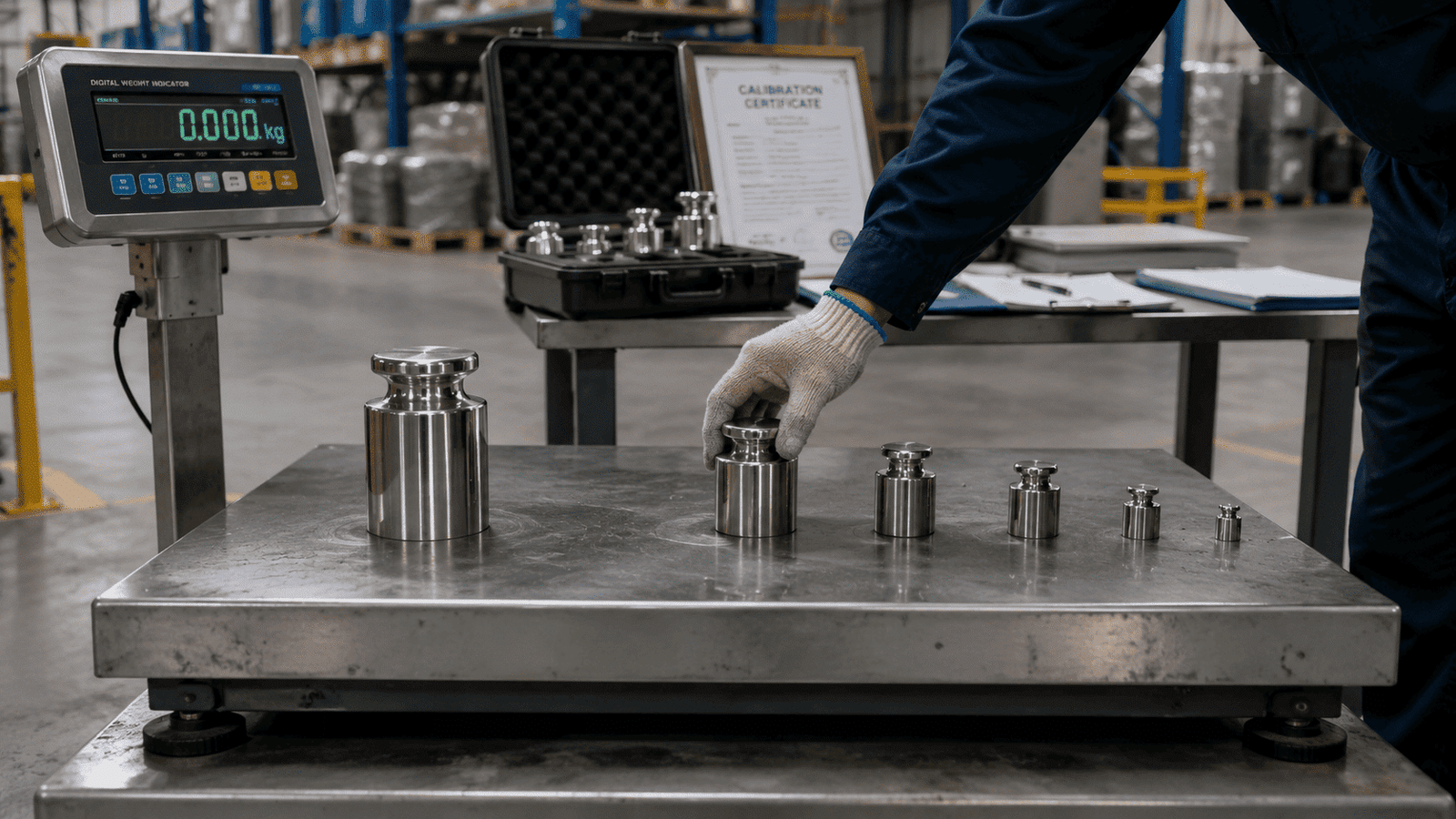
Zero check and span check with certified reference weights. The scale should be tested across its working range, not just at a single mid-point load. This reveals whether the error is consistent, which points to a span issue, or whether it varies with load, which can indicate a damaged load cell or a structural problem.
Adjustment and documentation. If the scale is out of tolerance, it gets adjusted. The tolerance limits should be defined before the visit, based on the accuracy class requirements for your application. Everything gets documented: as-found readings before adjustment, as-left readings after adjustment, and the reference weights used.
Certificate of calibration. The certificate should reference the standards used, the measurement uncertainty of the calibration process, and the equipment used to perform it. In a legal-for-trade context, the calibration equipment must be traceable to national or international measurement standards. If your current provider's certificate doesn't show measurement uncertainty, that's a gap worth addressing.
Service report with recommendations. A quality service provider won't just calibrate and leave. They'll flag what they found, any wear or condition issues likely to cause problems before the next interval, and give you a clear recommendation on the next calibration date based on observed performance rather than a generic schedule.
Global Scales & Systems provides calibration and verification services for high-end equipments across Saudi Arabia. If you're unsure whether your current service provider is delivering a complete service or just a quick check and a certificate, that's worth investigating directly.
07 Quick Answers: Recalibration, Drift, and KSA Compliance
Why do industrial scales lose accuracy over time?
The main causes are temperature change, mechanical settling and vibration, moisture and corrosion, and electrical interference. In Saudi Arabia's industrial environments, temperature cycling is the dominant factor for most outdoor and semi-outdoor installations. The load cells inside the scale are temperature-sensitive by nature, and without high-quality temperature compensation, daily ambient swings cause measurable output changes that accumulate over time.
How often should a weighbridge be calibrated in Saudi Arabia?
For legal-for-trade weighbridge in KSA, annual calibration by an accredited service provider is the baseline regulatory requirement under SASO's metrology framework. For weighbridges in harsh outdoor environments, high-throughput applications like mining or quarrying, or anywhere with significant temperature swings, semi-annual calibration is more appropriate. After any structural maintenance, relocation, or load cell replacement, the scale must be recalibrated regardless of the schedule.
What is the difference between calibration and verification?
Calibration is the full process of comparing the scale's output to a known reference, identifying any deviation, adjusting the scale to bring it within tolerance, and issuing a calibration certificate. Verification is a check performed without adjustment, typically using a reference weight, to confirm the scale is still within acceptable tolerance. Verification is a useful interim check between full calibrations, but it doesn't replace calibration.
Can a scale drift shortly after being calibrated?
Yes, and this is more common than most operations expect. If the root cause of drift hasn't been addressed, calibration is a temporary fix. A scale with a damaged load cell, a settling foundation, poor moisture sealing, or significant vibration will drift again relatively quickly after calibration. The calibration visit is also when those underlying issues should be identified and flagged by the service provider.
What SASO standards apply to industrial scale calibration in KSA?
SASO aligns with OIML (International Organization of Legal Metrology) recommendations for weighing instruments. For non-automatic weighing instruments, the relevant framework is broadly consistent with OIML R 76. Scales used in legal-for-trade transactions must be verified by an approved metrological authority or an accredited calibration body. The specific requirements depend on the accuracy class of the scale and its application.
How do I know if my scale is drifting right now?
The most practical approach is a regular spot check using a certified reference weight. Place a known weight on the empty scale and record what the display shows. Do this at the same time of day, on the same line, with the same reference weight. Track the readings over time. If you start to see a trend, the scale is drifting. This simple practice catches most drift before it becomes a compliance or financial problem. It costs almost nothing and takes two minutes. We are just a phone call away, reach out today for personalized assistance tailored to your company's requirement.

 Click to start chat